
THC Clearance Calculator: How Long Does Weed Stay in Your System?
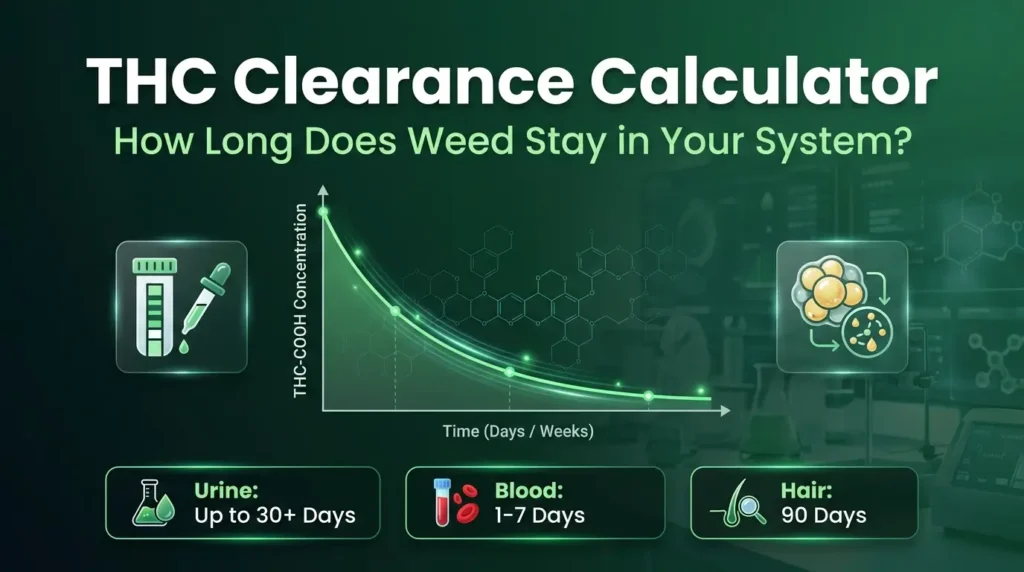
Estimate how long THC-COOH stays detectable in urine, blood, saliva, and hair. Our THC clearance calculator factors in body fat, usage frequency, BMI, and test cutoff levels for the most accurate estimate possible.
| Test Type | Cutoff Level | Detection Window | Your Estimate | Status |
|---|
Detection Windows by Use Pattern
- Single Use 3-4 days
- Occasional (1-3x/wk) 5-7 days
- Moderate (4-5x/wk) 10-15 days
- Daily User 15-21 days
- Heavy (multiple/day) 21-30 days
- Chronic (years daily) 30-90 days
Standard Test Cutoffs
- Urine (SAMHSA/NIDA) 50 ng/mL
- Urine confirm cutoff 15 ng/mL
- Blood (active THC) 1-5 ng/mL
- Oral Fluid (saliva) 4 ng/mL
- Hair Follicle 1 pg/mg
Factors That Slow Clearance
- High body fat % Major factor
- Heavy/chronic use Major factor
- Sedentary lifestyle Moderate
- High potency product Moderate
- Female biology Minor (+5-10%)
- Slow metabolism Minor
THC Metabolism Facts
- THC to THC-COOH conversion Yes (liver)
- Urine marker tested THC-COOH
- THC half-life in plasma 1-4 hrs
- THC-COOH terminal HL 20-57 hrs
- Fat release back to blood Ongoing
- Second-phase clearance Slow
How long does weed stay in your system for a urine test?
For a one-time user, THC-COOH typically clears urine (below 50 ng/mL) in 3-4 days. Moderate users need 1-2 weeks. Daily or heavy users can test positive for 21-30 days. Chronic long-term users may test positive for 30-90 days due to THC stored in fat tissue slowly releasing back into the bloodstream.
Why does the THC clearance calculator ask for body weight and height?
THC is fat-soluble, meaning it binds directly to fat cells (adipose tissue). The more body fat you have, the more THC can be stored and the longer it takes to clear. Our THC clearance calculator uses your BMI to estimate body fat percentage, which is a key factor in how quickly THC-COOH clears your urine.
Does exercise speed up THC clearance?
Exercise burns fat, which releases stored THC back into the bloodstream temporarily, potentially causing a short-term spike in urine levels. However, over time, regular cardio exercise burns fat stores and speeds up overall clearance. Avoid intense exercise directly before a test as it may temporarily raise detectable levels.
What does the THC clearance calculator detect in urine?
Standard urine drug tests do NOT detect active THC (the compound that causes impairment). They detect THC-COOH (11-nor-9-carboxy-THC), the inactive metabolite produced by the liver when it processes THC. THC-COOH is excreted through urine and remains detectable long after any psychoactive effects have worn off.
How Long Does THC Stay in Your System? The Complete Science-Backed Guide
If you’ve landed on our THC clearance calculator, you’re probably asking one of the most-searched drug testing questions on the internet — and for good reason. The answer is more complicated than most websites will tell you.
Unlike alcohol or nicotine, THC doesn’t clear your body on a simple schedule. It’s fat-soluble. That means it embeds itself in your body’s fat cells and slowly leaks back into your bloodstream over days or even weeks — long after you feel any effect. That’s what makes our THC clearance calculator different from simple lookup charts: it accounts for your body, your usage pattern, and your biology.
This guide explains the complete science behind THC detection times, what drug tests actually look for, and what factors matter most for your clearance window.
What Do Drug Tests Actually Detect? (It’s Not What You Think)
This is the single most important thing to understand before using any THC clearance calculator or reading any detection chart.
Standard urine drug tests do not detect THC itself — the compound that causes the psychoactive “high.” Instead, they detect THC-COOH (scientific name: 11-nor-9-carboxy-delta-9-tetrahydrocannabinol), which is an inactive metabolite produced by your liver when it processes THC.
Why does this matter?
Because THC-COOH has a dramatically longer half-life than active THC. Here’s the breakdown:
- Active THC (in blood): Half-life of 1–4 hours. Clears from blood within hours of use.
- THC-COOH (urine marker): Terminal half-life of 20–57 hours. Can remain detectable for weeks.
This is why a urine test can show positive results 3 to 4 weeks after your last use — even though you haven’t been “high” in weeks. The test is detecting old metabolite, not current impairment.
Key takeaway: A positive THC urine test does not prove recent impairment. It only proves that you consumed cannabis within the detection window — which can range from 3 days (single use) to 90+ days (chronic heavy use).
Why Body Fat Percentage Is the #1 Factor in THC Clearance
Most “how long does weed stay in your system” charts are dangerously oversimplified. They list flat detection windows like “3-4 days for occasional users” without accounting for the single biggest variable: how much body fat you have.
THC is lipophilic — it chemically bonds to fat molecules. When you consume cannabis, THC is rapidly distributed into:
- Brain and nerve tissue (causing psychoactive effects)
- Adipose tissue (body fat) — where it is stored in high concentrations
- Liver — where it is converted into THC-COOH
The fat-stored THC then slowly re-releases back into your bloodstream over days and weeks. Your liver continues converting it to THC-COOH, which then exits through urine.
The practical math
A person with 15% body fat and a person with 35% body fat — both moderate daily users — can have detection windows that differ by 7–14 days for the same test cutoff. Our THC clearance calculator uses the Deurenberg BMI-to-body-fat formula (peer-reviewed, 1991) to estimate your body fat and adjust your personal clearance window accordingly.
For more context on how body chemistry affects drug test results, see our Urine Dilution & Creatinine Calculator which explains how urine concentration affects test validity.
THC Clearance Time by Use Pattern: What the Research Shows
The following detection windows represent urine test results at the SAMHSA 50 ng/mL cutoff and are based on clinical research including studies by Huestis et al. (NIDA) and the Journal of Analytical Toxicology.
Single Use (First-Time or One-Off)
- Average detection window: 3–4 days
- Range: 1–7 days (highly variable by potency and body fat)
- Notes: Single use produces low peak THC-COOH in urine. First-time users with low body fat may clear in under 48 hours. High-potency concentrate use can push to 5–7 days even for a single session.
Occasional Use (1–3 Times Per Week)
- Average detection window: 5–7 days
- Range: 3–10 days
- Notes: Some accumulation of THC in fat tissue begins. Potency and consumption method become more important at this level.
Moderate Use (4–5 Times Per Week)
- Average detection window: 10–15 days
- Range: 7–21 days
- Notes: Significant fat accumulation. Body fat percentage starts to be a major differentiator in clearance time.
Daily Use
- Average detection window: 15–21 days
- Range: 10–30 days
- Notes: Fat stores are well-saturated. The “slow release” phase dominates — THC-COOH continues re-entering urine from fat reserves long after abstinence begins.
Heavy Use (Multiple Times Per Day)
- Average detection window: 21–30 days
- Range: 15–45 days
- Notes: Fat tissue is heavily saturated. Clearance time is strongly influenced by body fat, BMI, and physical activity.
Chronic Long-Term Use (Daily for Years)
- Average detection window: 30–77 days (documented cases to 90+ days)
- Range: 30 days minimum, up to 90+ days for high body fat
- Notes: Multiple clinical studies have documented positive urine tests in chronic users more than 77 days after abstinence (Johansson et al., 1988). This is not an anomaly — it reflects the massive fat-tissue THC reservoir built up over years of use.
How Each Drug Test Works: Urine, Blood, Saliva, and Hair
Our THC clearance calculator covers all four major test types. Here’s what you need to know about each.
Urine Drug Test (Most Common)
Cutoff: 50 ng/mL (SAMHSA/DOT standard) or 15 ng/mL (confirmation/low-sensitivity)
The most widely used test for employment, probation, and clinical screening. Detects THC-COOH — not active THC. The 50 ng/mL SAMHSA cutoff was set as a balance between sensitivity and avoiding false positives from passive exposure.
A result between 15–50 ng/mL on an initial screen is typically confirmed by GC-MS (gas chromatography-mass spectrometry) using the lower 15 ng/mL cutoff. Using our THC clearance calculator with the “Urine Low-Cut (15 ng/mL)” setting gives you the more conservative estimate.
For additional context on how urine concentration and hydration affect test results, read our full guide on how accurate an ETG calculator is — many of the same dilution principles apply.
Blood Test
Cutoff: 1–5 ng/mL (active THC)
Blood tests are primarily used by law enforcement (roadside DUI testing) and in clinical settings. Unlike urine tests, blood tests detect active THC — not the metabolite. This means:
- Active THC clears from blood within 4–8 hours of use for most people
- Chronic heavy users may have low-level THC in blood for 24–48 hours even without recent use
- Occasional users typically clear blood THC within 12–24 hours
Blood tests are rarely used for employment screening due to their narrow detection window and the invasive collection process.
Oral Fluid / Saliva Test
Cutoff: 4 ng/mL (SAMHSA proposed; varies by jurisdiction)
Saliva tests also detect active THC (not THC-COOH), making them a tool for detecting recent use. Detection window:
- Single use: 1–12 hours
- Regular use: Up to 72 hours
- Heavy chronic use: Up to 72 hours (rarely longer)
Saliva tests are increasingly used in roadside testing (especially in states with cannabis DUI laws) and some workplace programs. They are poor at detecting use from more than 24–48 hours ago.
Hair Follicle Test
Cutoff: 1 pg/mg (SAMHSA standard)
Hair follicle tests have a unique and fixed 90-day detection window — based on the fact that hair grows approximately 1 cm per month, and testing labs analyze the 3 cm segment of hair closest to the scalp. Any cannabis use in the past 90 days that deposited metabolites in the hair shaft will be detected.
Important facts about hair testing:
- Hair tests do NOT detect single-use or very recent use well (use in the past 7 days is unlikely to show in hair yet)
- Hair tests are controversial because THC deposits in hair are affected by hair color, cosmetic treatments, and external contamination
- Body hair (which grows slower) may reflect a longer window than scalp hair
- Reference: SAMHSA Hair Testing Guidelines
Does Exercise Help You Clear THC Faster?
This is one of the most popular questions our THC clearance calculator users ask. The answer is nuanced.
The fat-burn argument (why exercise helps long-term)
Because THC is stored in fat cells, burning fat through aerobic exercise theoretically accelerates the release of stored THC back into circulation — and ultimately its clearance from the body. Research supports this: regular physical activity is associated with faster THC clearance over a period of weeks.
A study published in Drug and Alcohol Dependence (2013) found that exercise caused a significant short-term increase in blood THC levels in regular users, consistent with fat mobilization releasing stored THC.
The pre-test danger (why exercise can backfire)
Here’s the critical caveat: intense exercise immediately before a drug test can temporarily spike your urine THC-COOH levels — potentially pushing you over the cutoff if you were close to passing.
The mechanism: fat burning releases stored THC back into blood → liver converts it to THC-COOH → it concentrates in urine.
Recommendation: If you are within 48 hours of a drug test, avoid intense exercise. Over longer periods, regular moderate activity (reflected in our THC clearance calculator’s activity level input) genuinely accelerates clearance.
Does Drinking Water Help Pass a THC Test?
Drinking water alone does not speed up THC-COOH elimination. The metabolite is processed by your liver and cleared by your kidneys at a fixed biological rate — water does not change that rate.
What water can do is dilute your urine, which lowers the concentration of THC-COOH. This is why some people drink excessive water before a test. However, labs test for this:
- Creatinine level: If urine creatinine falls below 2 mg/dL, the sample is flagged as substituted (invalid)
- Specific gravity: If specific gravity falls below 1.0010, the sample is flagged as dilute
- A dilute result (creatinine 2–20 mg/dL, SG 1.001–1.003) is often treated as a failed test or requires a retest
To understand exactly how urine dilution affects drug test results and creatinine levels, use our dedicated Urine Dilution & Creatinine Calculator — the most precise free online tool for this purpose.
Key Factors Our THC Clearance Calculator Uses
Our calculator incorporates every major evidence-based variable that affects your personal clearance window:
| Factor | Why It Matters |
|---|---|
| Use frequency | Sets baseline fat saturation level |
| Consumption method | Affects bioavailability (smoked 25% vs. vape 40% vs. concentrate 50%) |
| THC potency | Higher % THC = larger dose = longer clearance |
| Days since last use | Starting point for elimination curve |
| Body weight + height → BMI | Used to estimate body fat % |
| Biological sex | Females typically have slightly higher body fat → ~7% longer clearance |
| Activity level | Higher activity = faster fat burn = faster release and clearance |
| Test cutoff | 50 ng/mL vs 15 ng/mL vs blood vs saliva vs hair — very different windows |
The Research Behind This THC Clearance Calculator
This tool is built on published pharmacokinetic research, not arbitrary timelines:
- Huestis MA et al. (NIDA) — Urine cannabinoid metabolite concentration profiles following smoked marijuana. Primary source for THC-COOH detection window ranges. Read the research
- Johansson E et al. (1988) — “Prolonged apparent half-life of delta 1-tetrahydrocannabinol in plasma of chronic marijuana users.” Documented 77-day detection in chronic users.
- Smith-Kielland A et al. (1999) — Urinary excretion of 11-nor-9-carboxy-delta-9-tetrahydrocannabinol and cannabinoids in frequent and infrequent drug users.
- Deurenberg P et al. (1991) — Body mass index as a measure of body fatness: age- and sex-specific prediction formulas. PubMed
- SAMHSA Mandatory Guidelines — Federal workplace drug testing cutoff levels. SAMHSA.gov
Related Calculators on EtG Calculator Hub
If you found our THC clearance calculator useful, you may also benefit from these research-based tools:
- EtG Calculator — Calculate how long alcohol (EtG) stays in your urine
- Urine Dilution & Creatinine Calculator — Find out if drinking water will make your sample invalid
- Cotinine Clearance Calculator — How long does nicotine stay in your system?
- EtG Pass/Fail Predictor Calculator — Will you pass an alcohol urine test?
Medical Disclaimer
The THC clearance calculator and all content on this page are provided for educational purposes only. Results are estimates based on population-average pharmacokinetic models and individual results will vary significantly. This tool is not a substitute for laboratory testing and should not be used to make legal, medical, or employment-related decisions. If you have a drug test scheduled, consult a medical professional or toxicologist for guidance specific to your situation.