
How Long After One Drink Will EtG Show Up?
Short answer: EtG can become detectable in urine within about an hour after drinking, but whether one drink produces a positive test depends on the amount consumed, time since drinking, urine concentration, laboratory method, and especially the EtG cutoff.
If you had one beer, glass of wine, or shot and are wondering whether an EtG urine test could detect it later, there is no universal “one drink = X hours” rule.
The answer changes depending on how much ethanol was actually consumed, when the specimen was collected, and how sensitive the test is.
For an educational estimate based on drinking amount and elapsed time, you can also use the ETG Calculator.
What Is EtG?
Ethyl glucuronide (EtG) is a metabolite produced when the body processes ethanol.
Unlike ethanol itself, EtG can remain measurable after alcohol has fallen out of the bloodstream. That makes urinary EtG useful for identifying recent alcohol exposure.
EtG testing is used in different settings, including clinical monitoring, alcohol-use monitoring, treatment programs, professional monitoring, and some forensic or justice-system applications. Mayo Clinic Laboratories describes urine EtG/EtS testing as useful for monitoring abstinence in clinical and justice-system settings.
If you’re new to the subject, our guide What Is EtG? can provide the basic background before looking at detection times.
EtG is not the same as BAC
| Test | Measures | Main purpose |
|---|---|---|
| Breath alcohol | Ethanol | Current/recent alcohol |
| Blood alcohol/BAC | Ethanol | Current alcohol concentration |
| Urine EtG | Ethyl glucuronide | Recent alcohol exposure |
| Urine EtS | Ethyl sulfate | Recent alcohol exposure |
| PEth | Phosphatidylethanol | Longer-term alcohol-use assessment |
This distinction explains why someone can have no measurable BAC while still having detectable EtG in urine.
How Soon After One Drink Can EtG Show Up?
EtG can become detectable in urine relatively soon after alcohol consumption. Research literature describes urinary EtG appearing at early post-drinking intervals, with approximately one hour often cited as a possible point of detectability.
But detectable EtG is not automatically the same as a positive EtG test.
There are actually two separate questions:
- Is EtG present in the urine?
- Is the EtG concentration high enough to exceed the laboratory’s cutoff?
That distinction is critical.
A sensitive test may detect a small concentration that would not exceed the reporting threshold of a higher-cutoff test.
A practical evidence-based timeline
| Time after drinking | General interpretation |
|---|---|
| About 1 hour | EtG may begin to become detectable |
| Same evening | Detection depends on dose and test sensitivity |
| Next morning | Previous-night drinking can remain detectable |
| Around 24 hours | Light-drinking detection becomes less reliable |
| Around 48 hours | Sensitivity is substantially reduced after smaller amounts |
| Several days | Longer detection can occur, particularly after heavier/repeated drinking |
These are not guaranteed personal detection times.
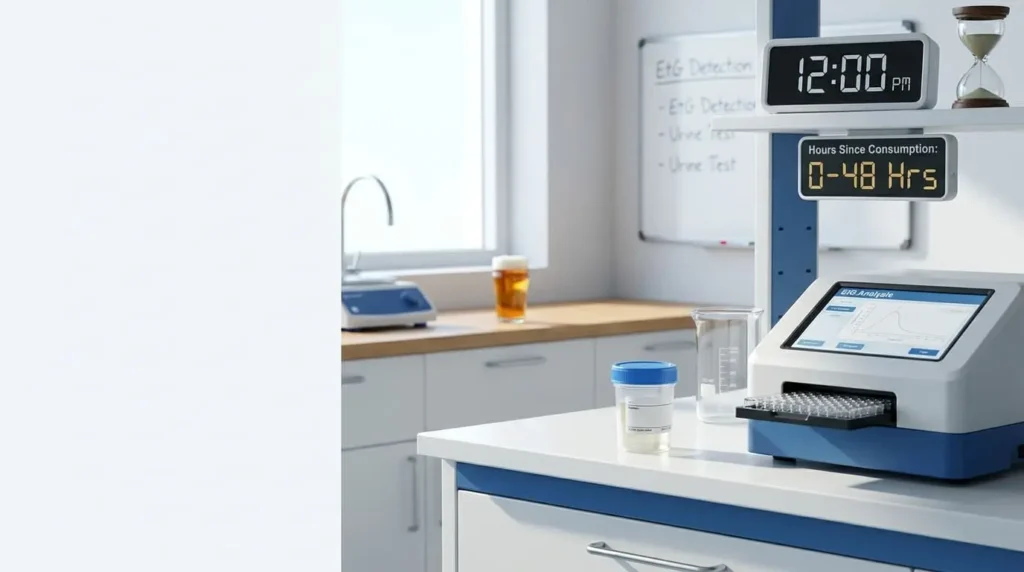
Controlled research found that previous-night drinking should generally be detectable the following morning at 100 or 200 ng/mL, while sensitivity for light drinking was poor at 24 hours and low after 48 hours following six drinks or less.
Can One Drink Show Up on an EtG Test the Next Morning?
Yes, it can.
This is one of the most important distinctions for anyone asking specifically about one drink.
In a controlled alcohol challenge study, researchers evaluated EtG and EtS at different concentrations and found that previous-night drinking was generally detectable the following morning at 100 and 200 ng/mL. Detection was substantially less sensitive at the 500 ng/mL cutoff.
So if someone asks:
“I had one drink last night. Could it show up tomorrow morning?”
The scientifically appropriate answer is yes, it could, but the result cannot be predicted from the phrase “one drink” alone.
The test cutoff matters.
The actual alcohol content matters.
The elapsed time matters.
And urine concentration matters.
What Happens After 12, 24, 36 and 48 Hours?
After 12 hours
Previous-night drinking can still be detectable, particularly when a lower EtG cutoff is used.
Research comparing different cutoffs found substantially greater sensitivity at 100 and 200 ng/mL than at 500 ng/mL.
After 24 hours
The answer becomes less predictable.
Controlled research found that sensitivity for light drinking was poor at 24 hours. That does not mean EtG is guaranteed to be absent after 24 hours.
A larger real-world study also demonstrated that detection varies according to drinking level, cutoff, and elapsed time.
After 36 hours
Detection generally becomes more difficult after a small drinking episode as EtG concentration declines.
However, there is no scientifically reliable universal “negative after 36 hours” rule.
After 48 hours
Detection following smaller amounts becomes increasingly unlikely, but again, this should not be interpreted as a guaranteed negative result.
Controlled research found low sensitivity after 48 hours following six drinks or less.
The distinction between one light drinking episode and heavier or repeated alcohol exposure is extremely important.
How EtG Cutoff Levels Change Detection
The EtG cutoff is one of the biggest reasons people find conflicting information online.
A lower cutoff generally provides greater analytical sensitivity.
| Cutoff | Relative sensitivity |
|---|---|
| 100 ng/mL | Higher |
| 200 ng/mL | Higher than 500 ng/mL |
| 300 ng/mL | Intermediate |
| 500 ng/mL | Lower |
This is why our EtG 100 ng/mL Calculator and EtG 300 ng/mL Calculator are useful when someone wants to examine the same scenario against different cutoff assumptions.
Similarly, if the relevant testing threshold is 200 ng/mL, the EtG 200 ng/mL Calculator focuses specifically on that cutoff.
Why does the cutoff matter?
Imagine two laboratories evaluating the same urine specimen.
If the concentration were 250 ng/mL:
- A 100 ng/mL cutoff could classify it as positive.
- A 200 ng/mL cutoff could also classify it as positive.
- A 300 ng/mL cutoff would not.
- A 500 ng/mL cutoff would not.
This simplified example demonstrates why asking “How long does EtG last?” is incomplete.
The more useful question is:
“How long might EtG remain above the cutoff used by this particular test?”
Does One Beer Equal One Drink?
Not necessarily.
“One beer” does not tell you exactly how much ethanol was consumed.
A beverage’s alcohol content depends on:
- serving size
- alcohol percentage
- recipe
- container size
- pour size
The same issue applies to wine and spirits.
A large beer with a higher alcohol percentage can contain considerably more ethanol than a smaller, lower-strength beer.
A cocktail can contain more than one standard drink depending on how much spirit it contains.
One beer vs wine vs liquor
| Beverage | Main variable |
|---|---|
| Beer | Volume and alcohol percentage |
| Wine | Pour size and alcohol percentage |
| Shot | Volume and alcohol concentration |
| Cocktail | Amount and strength of spirits |
| Large serving | May contain multiple standard drinks |
For this reason, “I had one drink” is not a sufficiently precise input for making an individual laboratory prediction.
USA vs UK vs Europe: What Counts as One Drink?
The biology of EtG does not change based on whether testing occurs in the United States, United Kingdom, or Europe.
The terminology does.
United States
US sources commonly use the concept of a standard drink.
United Kingdom
UK guidance commonly uses alcohol units.
Europe
European countries may use alcohol units, grams of ethanol, or national terminology.
For EtG interpretation, the important issue is the actual ethanol exposure, not what the drink is called.
If you are comparing results internationally, do not assume that a “drink,” “unit,” and “standard drink” represent exactly the same quantity.
What Factors Affect EtG Detection?
Several variables can influence whether a urine specimen exceeds a particular cutoff.
1. Alcohol dose
More ethanol generally means greater EtG production.
2. Time since drinking
EtG concentration changes substantially as time passes.
3. Cutoff
A 100 ng/mL test is more sensitive to low concentrations than a 500 ng/mL cutoff.
4. Urine concentration
Dilution can influence measured urinary concentrations.
Laboratories may also evaluate creatinine and other specimen-validity indicators.
5. Laboratory method
Testing can involve immunoassay screening and/or more specific analytical methods such as LC-MS/MS.
6. Individual variation
People can produce different EtG concentrations after apparently similar alcohol exposures.
For a more detailed explanation of the reliability and limitations of estimates, see How Accurate Is an EtG Calculator?.
Can Water, Food, Exercise or Sleep Change EtG?
There is no reliable home technique that can guarantee rapid removal of EtG from urine.
Drinking water can alter urine concentration, but it does not provide a dependable way to eliminate EtG rapidly.
Similarly, food, exercise, coffee, showers, or sleep should not be viewed as reliable ways to control a laboratory result.
EtG formation and elimination are biological processes.
If you need to understand the underlying testing process, our guide How Does EtG Testing Work? explains the testing pathway in more detail.
Can Mouthwash or Hand Sanitizer Affect an EtG Test?
EtG can also be associated with exposure to ethanol-containing products, although the significance depends on the exposure, timing, concentration, and laboratory cutoff.
Research has investigated EtG after exposure to products and foods containing ethanol or producing alcohol exposure.
This is one reason cutoff selection matters.
However, a positive EtG result should not automatically be attributed to mouthwash, hand sanitizer, or another incidental exposure without considering the actual result and testing circumstances.
EtG vs BAC vs EtS vs PEth
Understanding the different biomarkers prevents many interpretation errors.
| Biomarker | Specimen | What it indicates |
|---|---|---|
| BAC | Blood | Current alcohol concentration |
| Ethanol | Breath/blood | Current/recent alcohol |
| EtG | Urine | Recent alcohol exposure |
| EtS | Urine | Recent alcohol exposure |
| PEth | Blood | Longer-term alcohol exposure |
EtG and EtS are direct ethanol metabolites, while PEth is used for a different type of alcohol-use assessment.
The right test depends on the question being investigated.
How Laboratories Test EtG
A typical testing process can involve:
- Urine specimen collection
- Specimen-validity assessment
- Initial screening
- EtG measurement
- Confirmation when required
- Interpretation against laboratory reporting criteria
One important example comes from Mayo Clinic Laboratories.
Mayo currently describes a urine EtG screen using a 500 ng/mL immunoassay cutoff, with positive screens undergoing LC-MS/MS confirmation. Its confirmation interpretation uses EtG ≥250 ng/mL and/or EtS ≥100 ng/mL.
That example demonstrates why you should never assume that every “EtG test” uses the same cutoff.
Recommended outbound resources
For laboratory methodology and authoritative reference information, useful sources include:
- Mayo Clinic Laboratories — EtG/EtS testing information
- PubMed — Jatlow et al. EtG/EtS dose-ranging research
- PubMed Central — McDonell et al. real-world EtG detection study
- PubMed — research on incidental ethanol exposure and urinary EtG
These are preferable to relying on generic commercial “80-hour” charts when you need to understand the underlying evidence.
How to Interpret an EtG Result
If you already have an EtG result, use this sequence:
Step 1: Identify the specimen
Confirm that the test was performed on urine.
Step 2: Identify the biomarker
Determine whether the report measures:
- EtG
- EtS
- both EtG and EtS
- another alcohol biomarker
Step 3: Find the cutoff
Look for the laboratory’s stated screening or reporting threshold.
Step 4: Check the concentration
A quantitative result provides more information than simply seeing “positive” or “negative.”
Step 5: Establish timing
Determine approximately when alcohol exposure occurred.
Step 6: Consider the amount consumed
One small drink is not equivalent to several drinks.
Step 7: Review specimen validity
Check any reported creatinine, dilution, or validity information.
Step 8: Consider the testing context
Clinical, workplace, treatment, professional-monitoring, probation, and forensic programs may have different procedures.
EtG Testing for Workplace, Court, Probation and Treatment
EtG testing may be used for abstinence monitoring in clinical, treatment, professional, workplace, or justice-related settings.
But the specific testing program determines how the result is handled.
That may include:
- laboratory selection
- cutoff
- screening method
- confirmation method
- chain-of-custody procedures
- specimen validity requirements
- interpretation rules
Therefore, if an EtG test has employment, court, probation, treatment, or professional consequences, an online detection chart should not be treated as a substitute for the program’s actual testing policy.
Why Websites Give Different EtG Detection Times
You may see claims such as:
- 6–10 hours
- 12 hours
- 12–24 hours
- 24–48 hours
- 24–72 hours
- up to 80 hours
The problem is that these statements often describe different circumstances.
One drink is not a fixed dose
A drink may contain very different quantities of ethanol.
100 ng/mL is not 500 ng/mL
Lower cutoffs detect lower concentrations.
Controlled research is not an individual prediction
A study result describes a population under defined conditions. It does not guarantee an individual’s result.
Screening is not the same as confirmation
An immunoassay screen and LC-MS/MS confirmation can have different analytical characteristics.
Light drinking is not heavy drinking
A long detection window associated with heavier alcohol exposure should not automatically be applied to one small drink.
This is the biggest reason a generic “EtG lasts 80 hours” statement can be misleading.
Can an EtG Calculator Predict My Exact Test Result?
No.
An EtG calculator can provide an educational estimate, but it cannot reproduce every variable involved in an actual urine laboratory test.
ETG Calculator Hub states that its calculators use scientific data and averages and that individual results can vary.
For users who want to explore different assumptions, you can use:
- ETG Calculator
- Advanced ETG Calculator
- EtG 100 ng/mL Calculator
- EtG 200 ng/mL Calculator
- EtG 300 ng/mL Calculator
The important principle is:
Use an EtG calculator to understand possibilities, not to guarantee a laboratory outcome.
People Also Ask
How long after one drink will EtG show up?
EtG may become detectable in urine within about an hour after drinking, but whether a test becomes positive depends on alcohol dose, elapsed time, urine concentration, laboratory method, and cutoff.
Can one drink cause a positive EtG test?
Yes. A single drink can produce detectable EtG, particularly when a sensitive cutoff is used. However, a positive result cannot be predicted solely from the number of drinks.
Does one beer show up on an EtG test?
It can. The actual ethanol content of the beer, the time since consumption, urine concentration, testing method, and cutoff all influence the result.
Will one drink show up after 24 hours?
It can, but detection becomes less reliable after light drinking as time passes. Research does not support a universal guaranteed negative time.
Will one drink show up after 48 hours?
Detection from a small drinking episode becomes increasingly unlikely with time, but a universal 48-hour rule is not scientifically justified.
Is 100 ng/mL more sensitive than 500 ng/mL?
Yes. A lower EtG cutoff generally detects lower urinary concentrations than a higher cutoff.
Can EtG prove exactly when someone drank?
No. EtG indicates recent alcohol exposure but does not function as an exact drinking-time clock.
Can water flush EtG out?
No reliable home method can guarantee rapid EtG elimination. Water can affect urine dilution but does not provide a predictable way to control an EtG result.
Is EtG the same as BAC?
No. BAC measures ethanol, whereas EtG measures a metabolite of ethanol. EtG can remain detectable after ethanol itself is no longer measurable.
Is 80 hours the EtG detection time for one drink?
No. An approximately 80-hour window is sometimes cited for EtG under certain circumstances, particularly with heavier alcohol exposure and sensitive testing. It should not be applied as a guaranteed timeline for one drink.
Conclusion
The answer to “How long after one drink will EtG show up?” is more nuanced than a simple number of hours.
EtG may become detectable relatively soon after alcohol consumption, and a previous-night drink can remain detectable the next morning. As time passes, detection after light drinking becomes less reliable, while heavier or repeated drinking can produce longer detection windows.