
LSD Clearance Calculator
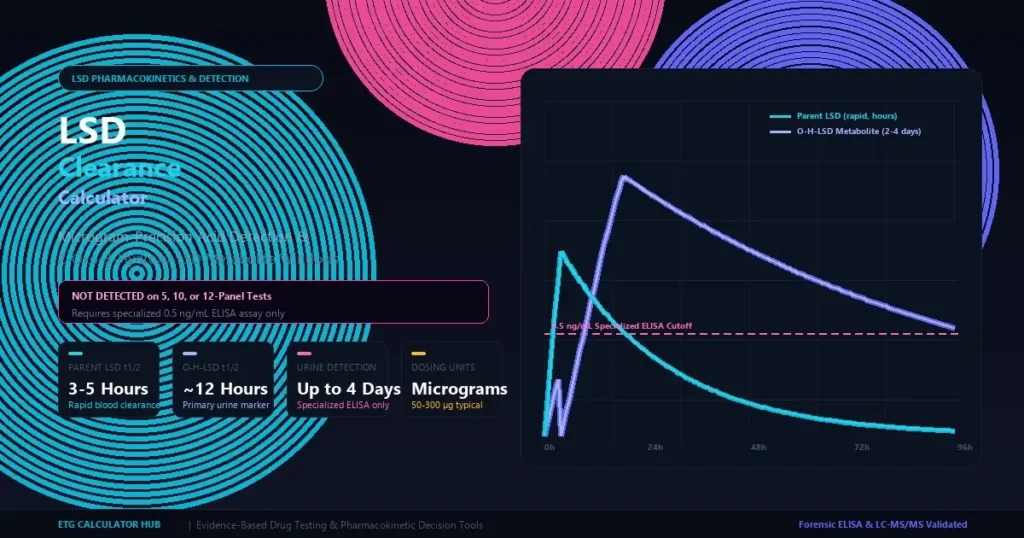
LSD (lysergic acid diethylamide) clears the blood in hours, but its urinary metabolite 2-oxo-3-hydroxy-LSD (O-H-LSD) can persist for 2–4 days. This calculator models both using accurate microgram-level pharmacokinetics — and reveals exactly which drug panels can (and cannot) detect acid.
Which Drug Tests Can Detect LSD?
Why LSD Is Nearly Undetectable
LSD is pharmacologically active at doses measured in micrograms (millionths of a gram). A standard recreational dose of 100 µg is 0.0001 grams — making it the most potent psychoactive substance known to pharmacology.
Because so little drug enters the body, even at peak urinary excretion, LSD concentrations in urine rarely exceed 1 to 5 ng/mL (compared to cocaine metabolites at 50,000–500,000 ng/mL). This requires assays with 100 to 1,000-fold greater sensitivity than standard drug tests can provide.
The O-H-LSD Metabolite: The Real Urinary Marker
When LSD is ingested, liver CYP3A4 enzymes rapidly convert it to several metabolites. The dominant urinary biomarker is 2-oxo-3-hydroxy-LSD (O-H-LSD), first identified as the major metabolite by Pichini et al. and Canezin et al.:
- O-H-LSD is excreted in urine at 8 to 16 times higher concentrations than parent LSD
- It has a longer elimination half-life (approx. 12 hours vs. 3–5 hours for parent LSD)
- Modern specialized assays target O-H-LSD as the primary detection analyte rather than parent LSD
- It is pharmacologically inactive and carries no psychedelic properties
LSD (Acid) Clearance Times & Detection Windows: Complete Forensic Pharmacokinetics Guide
Whether preparing for an employment drug test, court-ordered evaluation, or exploring psychedelic harm-reduction science, one of the most widespread questions is: “How long does LSD (acid) stay in your system — and will it trigger a positive drug screen?”
Because lysergic acid diethylamide (LSD) is dosed in infinitesimal micrograms rather than milligrams, its elimination kinetics and detection characteristics differ drastically from almost every other psychoactive substance. While LSD clears from human blood within hours, its primary inactive hepatic metabolite, 2-oxo-3-hydroxy-LSD (O-H-LSD), remains in urinary filtrate for multiple days.
Use the interactive LSD Clearance Calculator above to model your microgram dosage, hours elapsed, and target assay type.
1. How Long Does LSD Stay in Urine, Blood, and Hair?
The detection window of acid depends entirely on whether a standard workplace panel or an advanced forensic assay is performed:
| Diagnostic Matrix | Standard Employment Screen | Specialized Forensic Assay | Diagnostic Cutoff Threshold |
|---|---|---|---|
| Standard Workplace Urine | 0 Days (NOT DETECTED) | N/A | Not included on standard panels |
| Specialized Urine ELISA | N/A | 2 to 4 Days (48 to 96 Hours) | 0.5 ng/mL (500 pg/mL) |
| Confirmatory Urine LC-MS/MS | N/A | 3 to 5 Days (72 to 120 Hours) | 0.2 ng/mL (200 pg/mL) |
| Blood / Plasma Screen | 0 Days (Not Tested) | 8 to 16 Hours | 0.1 ng/mL |
| Saliva / Oral Fluid Swab | 0 Days (Not Tested) | 12 to 24 Hours | Specialized immunoassay only |
| Hair Follicle Analysis | 0 Days (Not Tested) | Up to 90 Days | 200 pg/mg (Specialty RIA / LC-MS) |
Key Clinical Takeaway: In 99% of workplace, athletic, DOT, and pre-employment situations, LSD is not tested at all. You will pass standard 5-panel, 10-panel, and 12-panel drug screens even if the test is administered while you are actively experiencing psychedelic effects.
2. Does LSD Show Up on Standard Workplace Drug Tests?
A widespread fear among individuals who have consumed acid is that it will trigger a false positive for amphetamines, PCP, or opioids.
Why Standard Panels Miss LSD Completely
Standard workplace screenings (including federal SAMHSA-5 and commercial 10-panel or 12-panel rapid cup tests) utilize antibody-antigen competitive immunoassay strips calibrated to specific target drugs:
- Marijuana (THC-COOH): 50 ng/mL cutoff
- Cocaine (Benzoylecgonine): 150–300 ng/mL cutoff
- Amphetamines / Methamphetamine: 500 ng/mL cutoff
- Opiates (Morphine/Codeine): 2,000 ng/mL cutoff
- Phencyclidine (PCP): 25 ng/mL cutoff
- (Expanded panels add Benzodiazepines, Barbiturates, Methadone, and Oxycodone).
LSD possesses an ergoline/indole core structure that produces zero cross-reactivity with these antibodies. Furthermore, because LSD is active at tiny microgram dosages (0.0001 grams), urinary concentrations peak between 1.0 and 5.0 ng/mL — concentrations 100 to 1,000 times lower than what standard immunoassay strips are manufactured to detect.
When Is LSD Actually Screened?
Testing for LSD is uncommon, expensive, and ordered almost exclusively in:
- Forensic & Autopsy Toxicology: Post-mortem criminal investigations or acute psychiatric emergency admissions.
- Military Special Investigation Commands: Specific armed forces sweeps with suspicion of hallucinogen consumption.
- High-Security Federal Probation: Selective court-ordered testing using contracted private reference laboratories.
- Clinical Research & Clinical Trials: FDA-regulated psychedelic psychotherapy protocols.
3. Pharmacokinetics: Parent LSD vs. 2-Oxo-3-Hydroxy-LSD Metabolite
When swallowed, LSD is rapidly absorbed across the gastrointestinal tract with near-total bioavailability, distributing readily to brain tissue and lipid compartments.
LSD Ingestion (Oral)
   │
   ├── Tmax (Peak Blood): 1.5 to 2.5 Hours Post-Dose
   ├── Subjective Duration: 8 to 12 Hours
   ├── Parent LSD Plasma Half-Life: 3.0 to 4.5 Hours
   └── Hepatic Biotransformation (CYP3A4 / CYP2E1)
         │
         ├── Demethyl-LSD (Minor, <5%)
         ├── 2-Oxo-LSD (Intermediate)
         └── 2-Oxo-3-Hydroxy-LSD (O-H-LSD)  ◄── Dominant Urinary Analyte (8–16x concentration)
The Role of 2-Oxo-3-Hydroxy-LSD (O-H-LSD)
Historical forensic protocols failed to detect LSD in urine beyond 24 hours because they targeted parent un-metabolized LSD. In the late 1990s, landmark toxicological studies by Pichini et al. and Canezin et al. discovered that:
- Less than 1% to 2% of an LSD dose is excreted unchanged as parent drug in urine.
- The liver’s cytochrome P450 enzyme system converts the vast majority into 2-oxo-3-hydroxy-LSD (O-H-LSD).
- O-H-LSD is excreted in human urine at concentrations 8 to 16 times higher than parent LSD.
- O-H-LSD has an elimination half-life of approximately 10 to 14 hours (compared to 3.6 hours for parent LSD), remaining detectable for 48 to 96 hours (2 to 4 days).
Modern forensic testing protocols (such as Abbott and Immunalysis specialized ELISA kits) use antibodies specifically engineered to bind both parent LSD and O-H-LSD.
4. Elimination Half-Life & Microgram Mechanics
A standard active tab of blotter acid contains between 50 µg and 150 µg of lysergic acid diethylamide:
- 100 µg (Standard Dose): Peak plasma level reaches ~2.0 ng/mL. Parent LSD drops below 0.5 ng/mL in urine within ~18 hours; O-H-LSD drops below cutoff within 48 to 72 hours (2 to 3 days).
- 200–300 µg (High / Double Dose): Peak urinary metabolite concentrations increase proportionally. O-H-LSD can persist above the 0.5 ng/mL cutoff for 72 to 96 hours (3 to 4 days).
- Microdosing (10–20 µg): Sub-perceptual microdoses produce peak urine levels that frequently never exceed the 0.5 ng/mL threshold, clearing below detection in 12 to 24 hours.
Chemical Instability & Testing Pitfalls
LSD is notoriously fragile compared to drugs like methamphetamine or cotinine. In forensic urine samples:
- Light Sensitivity: Exposure to ultraviolet light or natural sunlight degrades LSD within hours.
- Thermal Degradation: Samples left un-refrigerated show rapid loss of parent drug.
- Chlorine Inactivation: Municipal tap water containing chlorine oxidizes LSD instantly on contact, rendering it undetectable in adulterated samples.
5. Can You Flush Acid Out of Your System?
Because parent LSD clears within 24 hours through normal metabolic pathways, aggressive detox kits, cleansing teas, or dangerous over-hydration are completely unnecessary and counterproductive:
- Dilution Risks: Chugging excessive water right before an official urine screen risks a “Negative-Dilute” specimen status due to low urinary creatinine (< 20 mg/dL). In forensic or court testing, a dilute sample is routinely rejected or treated as a positive failure. Use our Urine Dilution & Creatinine Calculator to verify hydration safety parameters.
- Natural Elimination: The body’s hepatic CYP enzymes and renal glomerular filtration process microgram quantities of LSD with exceptional efficiency without any artificial intervention.
6. Frequently Asked Questions
Will LSD show on a 10-panel drug test?
No. Standard 10-panel drug tests screen for Amphetamines, Barbiturates, Benzodiazepines, Cannabinoids, Cocaine, Methadone, Methaqualone, Opiates, Phencyclidine, and Propoxyphene. None of these strips detect LSD.
Does acid cross-react with psilocybin (shrooms)?
No. While both LSD and psilocin act as agonists at the 5-HT2A serotonin receptor, they belong to entirely different chemical classes (ergolines vs. substituted tryptamines). Neither drug cross-reacts on drug tests. Learn more with our Psilocybin Clearance Calculator.
Can acid be detected in a spinal tap?
No. The persistent urban legend claiming that “LSD stays in your spinal fluid forever” or causes “flashbacks from spinal leakage” is a complete pharmacological myth. LSD does not pool in cerebrospinal fluid and is fully eliminated from the central nervous system within hours of ingestion.
What is the cutoff level for a specialized LSD test?
Specialized initial immunoassay screening (ELISA) typically utilizes a cutoff of 0.5 ng/mL (500 pg/mL). Confirmatory testing via liquid chromatography-tandem mass spectrometry (LC-MS/MS) uses a sensitive cutoff of 0.2 ng/mL (200 pg/mL) for parent LSD and O-H-LSD.
Scientific Studies & Clinical References
- Passie, T., Halpern, J. H., Stichtenoth, D. O., Emrich, H. M., & Hintzen, A. (2008). The pharmacology of lysergic acid diethylamide: a review. CNS Neuroscience & Therapeutics, 14(4), 295-314. PubMed PMID: 19040644.
- Pichini, S., Poulsen, L., Pacifici, R., & Altieri, I. (1998). Quantification of lysergic acid diethylamide (LSD) and its main metabolite 2-oxo-3-hydroxy-LSD in human urine by liquid chromatography-tandem mass spectrometry. Journal of Chromatography B, 716(1-2), 163-172.
- Canezin, J., Cailleux, A., Turcant, A., Le Bouil, A., Harry, P., & Allain, P. (2001). Determination of LSD and its metabolites in human biological fluids by high-performance liquid chromatography. Journal of Analytical Toxicology, 25(8), 697-703. PubMed PMID: 11765030.
- Dolder, P. C., Liechti, M. E., & Rentsch, K. M. (2015). Pharmacokinetics and concentration-effect relationship of oral LSD in healthy subjects. Clinical Pharmacokinetics, 54(10), 1055-1066.
- Substance Abuse and Mental Health Services Administration (SAMHSA). Mandatory Guidelines for Federal Workplace Drug Testing Programs. Federal Register, HHS. SAMHSA.gov.