
MDMA Clearance Calculator: How Long Does Ecstasy Stay in Urine?
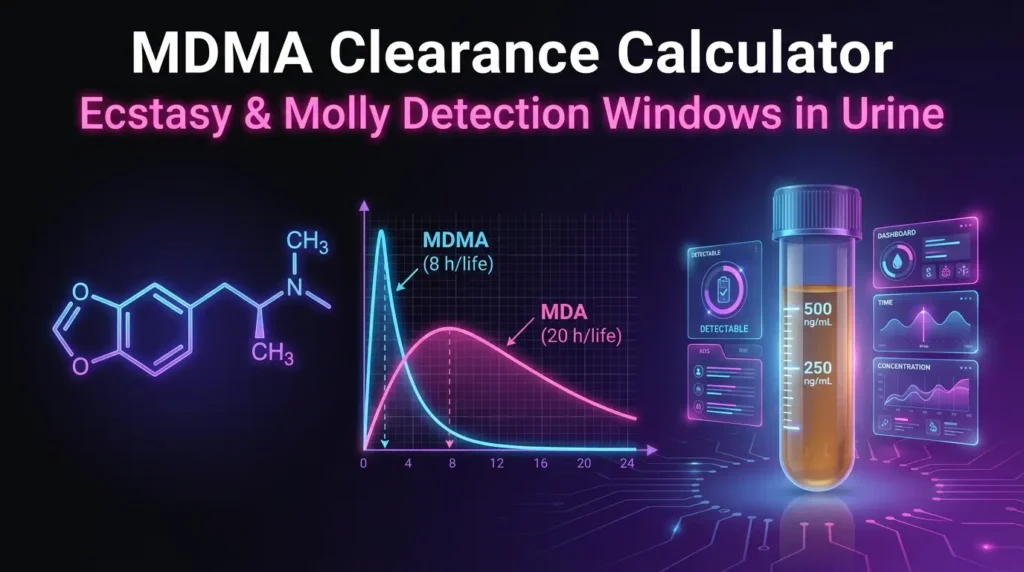
Set your details, then tap Calculate. Standard screen cutoff 500 ng/mL, parent MDMA t½ ~8 h, active metabolite MDA t½ ~20 h.
Advanced: urine pH
Disclaimer: Educational and harm-reduction information only. Real elimination depends on CYP2D6 genetics, temperature, hydration, urine pH and exertion. Not medical or legal advice.
MDMA Clearance Calculator: The Complete Clinical Detection Guide
Whether preparing for an upcoming pre-employment drug panel, federal workplace screening, probation urinalysis, or reviewing harm-reduction pharmacokinetics, understanding how MDMA (ecstasy, molly) eliminates from the human body is essential.
While the primary entactogenic effects of MDMA typically subside within 3 to 6 hours, the compound and its active metabolites linger in the biological system much longer. Our MDMA clearance calculator calculates realistic detection windows across urine, blood, saliva, and hair, taking into account dosage, redosing/booster timing, urinary pH, and hepatic CYP2D6 enzyme autoinhibition.
Below is a detailed clinical overview explaining how MDMA metabolizes, why redosing causes non-linear metabolic delays, and how standard immunoassay cups detect amphetamine-class compounds.
What Is MDMA and How Does the Body Metabolize It?
MDMA (3,4-methylenedioxymethamphetamine) is a synthetic substituted amphetamine and empathogen that stimulates massive presynaptic release of serotonin (5-HT), dopamine, and norepinephrine while inhibiting their reuptake.
Following oral ingestion, MDMA undergoes complex hepatic biotransformation:
- Hepatic Demethylenation (CYP2D6): The primary metabolic pathway involves O-demethylenation into 3,4-dihydroxymethamphetamine (HHMA), mediated predominantly by the Cytochrome P450 CYP2D6 enzyme (with contributions from CYP1A2, CYP2B6, and CYP3A4).
- COMT Methylation to HMMA: HHMA is rapidly methylated by catechol-O-methyltransferase (COMT) into 4-hydroxy-3-methoxymethamphetamine (HMMA), the most abundant metabolite circulating in blood and urine.
- N-Demethylation to Active MDA: A secondary metabolic route (~10% of the ingested dose) cleaves the methyl group to produce 3,4-methylenedioxyamphetamine (MDA). MDA is pharmacologically active, highly neurotoxic, and has a significantly longer half-life than parent MDMA.
- Renal Excretion: Approximately 65% to 75% of the dose is excreted through the kidneys within 72 hours, consisting of unchanged parent MDMA (roughly 20% to 30%), HMMA conjugates, and active MDA.
Elimination Half-Life: Parent MDMA vs. Active MDA
A drug’s elimination half-life ($t_{1/2}$) is the time required for plasma concentrations to decrease by 50%. Under the pharmacokinetic 5.5 half-life clearance rule, a compound is functionally cleared from blood (>98% eliminated) after 5 to 6 half-lives:
| Compound | Metabolic Status | Elimination Half-Life ($t_{1/2}$) | 5.5 Half-Life Clearance (Blood) | Typical Urine Detection Window |
|---|---|---|---|---|
| Parent MDMA | Active Entactogen | 7.0 to 9.0 Hours (Mean: ~8.0h) | 38.5 to 49.5 Hours | 2 to 3 Days (48 to 72 Hours) |
| Active MDA | Active Metabolite (~10%) | 16.0 to 28.0 Hours (Mean: ~20h) | 88.0 to 110.0 Hours | 3 to 5 Days (72 to 120 Hours) |
| HMMA Conjugate | Major Metabolite | 7.0 to 9.0 Hours | 38.5 to 49.5 Hours | 2 to 3 Days |
Notice that while parent MDMA drops below detection levels after 2 to 3 days, active MDA metabolites circulate with a much longer 20-hour half-life, extending confirmatory urine and hair detection windows.
The Non-Linear Phenomenon: CYP2D6 Autoinhibition & Redosing
One of the most critical clinical discoveries regarding MDMA pharmacokinetics is its non-linear clearance behavior (de la Torre et al., 2000; Farré et al., 2004).
MDMA is not simply metabolized by the liver’s CYP2D6 enzyme; it acts as a mechanism-based, quasi-irreversible “suicide inhibitor” of CYP2D6.
Why Redosing Causes Disproportionate Accumulation:
- When an individual takes an initial dose (e.g. 100 mg), circulating MDMA binds to and temporarily deactivates CYP2D6 enzymes.
- If a “booster” or secondary dose is taken 1 to 3 hours later, the body has virtually zero active CYP2D6 enzymes remaining to clear it.
- The liver is forced to rely on slower, lower-affinity secondary pathways (CYP1A2, CYP2B6, CYP3A4).
- Clinical Consequence: Doubling the dose from 100 mg to 200 mg does not produce double the blood concentration—it causes a 3- to 4-fold increase in peak plasma concentration ($C_{\text{max}}$) and extends the urinary detection window by 24 to 36+ additional hours.
How Urinary pH Dictates Amphetamine-Class Excretion
Because MDMA is a basic amine compound with a dissociation constant ($\text{p}K_a$) of approximately 9.9, its renal clearance is heavily influenced by urinary pH (the Henderson-Hasselbalch principle):
- Acidic Urine (pH < 6.0): In acidic urine, MDMA molecules exist primarily in their ionized, water-soluble form. The renal tubules cannot reabsorb ionized molecules, resulting in rapid urinary excretion and shorter detection times.
- Alkaline Urine (pH > 7.5): In alkaline urine (often induced by high doses of sodium bicarbonate or antacids), MDMA remains non-ionized. Non-ionized molecules easily diffuse across renal tubular membranes back into systemic circulation, prolonging clearance and increasing toxicity risks.
Multi-Matrix Detection Windows (Urine, Blood, Saliva, Hair)
Our MDMA clearance calculator estimates clearance across all clinical and workplace testing matrices:
| Diagnostic Matrix | Standard Cutoff Level | Detection Window (Single Dose: 100–125mg) | Detection Window (High Dose / Booster / Chronic) |
|---|---|---|---|
| Urine (Screening Immunoassay) | 500 ng/mL | 24 to 48 Hours (1–2 Days) | 3 to 5 Days (72–120 Hours) |
| Urine (Confirmatory GC-MS/LC-MS) | 250 ng/mL | 48 to 72 Hours (2–3 Days) | 4 to 6 Days |
| Blood Plasma Screen | 10 ng/mL | 24 to 36 Hours | 48 to 72 Hours |
| Oral Fluid (Saliva Swab) | 20 ng/mL | 24 to 48 Hours | 48 to 72 Hours |
| Hair Follicle Analysis | 200 pg/mg | Up to 90 Days | Up to 90 Days |
For historical hair test timelines, review our Hair Follicle Drug Test Calculator.
Does MDMA Show Up on Standard 5-Panel Drug Tests?
A common source of anxiety is whether ecstasy or molly triggers standard employment drug screenings:
1. Standard 5-Panel Federal Workplace Screen: YES
Under federal SAMHSA and Department of Transportation (DOT) guidelines, standard 5-panel drug tests screen for Amphetamines. Because MDMA is chemically 3,4-methylenedioxymethamphetamine, it shares a phenethylamine core with methamphetamine and amphetamine:
- Standard screening cups use an initial immunoassay cutoff of 500 ng/mL.
- MDMA and MDA cross-react strongly with modern amphetamine antibodies, triggering a Presumptive Positive result.
2. Confirmatory GC-MS / LC-MS Analysis
When a specimen screens presumptive positive, the laboratory performs confirmatory mass spectrometry:
- The confirmatory cutoff is set at 250 ng/mL.
- Confirmatory testing specifically identifies and quantifies the exact molecular weights of MDMA, MDA, and MDEA, proving definitively that ecstasy was consumed rather than prescription Adderall or methamphetamine.
Can You Flush MDMA Out of Your System?
No detox drink or quick home remedy can force hepatic enzymes to clear MDMA overnight. However, understanding renal physiology prevents dangerous specimen dilution flags:
- Excessive Water Consumption: Drinking gallons of water does not accelerate liver clearance. Drinking excessive fluid before a drug screen dilutes your specimen, dropping creatinine below 20 mg/dL and specific gravity below 1.003. Testing facilities automatically report this as a “Negative Dilute,” which employers frequently treat as a test failure or require an immediate observed re-test.
(Assess your dilution status using our Urine Dilution & Creatinine Calculator). - Avoid Bicarbonate / Antacids: Ingesting baking soda or antacids alkalinizes urine, which physically impedes renal excretion and causes MDMA to recirculate in blood.
- Maintain Normal Hydration: Standard water consumption supports natural glomerular filtration without compromising specimen validity.
Scientific Studies & Clinical References
The mathematical clearance models in our MDMA clearance calculator are based on published clinical pharmacology and toxicology literature:
- de la Torre R., et al. (2000) — Non-linear pharmacokinetics of MDMA (‘ecstasy’) in humans. British Journal of Clinical Pharmacology, 49(2), 104-109. PubMed PMID: 11092114.
- Kolbrich E.A., et al. (2008) — Major MDMA metabolites and urinary excretion profiles in humans. Journal of Analytical Toxicology, 32(7), 479-487. PubMed PMID: 18024564.
- Farré M., et al. (2004) — Repeated doses of MDMA: clinical pharmacology, autoinhibition, and disposition. Clinical Pharmacokinetics, 43(14), 1017-1033. PubMed PMID: 15319548.
- Substance Abuse and Mental Health Services Administration (SAMHSA) — Mandatory Guidelines for Federal Workplace Drug Testing Programs (Amphetamines/MDMA Cutoffs). SAMHSA.gov.
- Segura M., et al. (2005) — Contribution of cytochrome P450 2D6 to the metabolism of MDMA in humans. Clinical Chemistry, 51(10), 1801-1810.
Explore Our Other Diagnostic Calculators
Examine clearance timelines across other medications and testing media:
- Cocaine Clearance Calculator — Calculate benzoylecgonine and cocaethylene clearance windows in urine.
- Adderall Clearance Calculator — Model prescription amphetamine elimination and urinary pH effects.
- Opioid Clearance Calculator — Calculate clearance for oxycodone, hydrocodone, morphine, and fentanyl.
- Xanax Clearance Calculator — Estimate alprazolam half-life and benzodiazepine urine detection windows.
- Ketamine Clearance Calculator — Dual-curve clearance model for ketamine and active norketamine metabolites.
- THC Clearance Calculator — Estimate cannabinoid detection based on BMI and consumption frequency.
- Urine Dilution & Creatinine Calculator — Check specific gravity and creatinine levels to avoid dilute specimen flags.
- Hair Follicle Drug Test Calculator — 90-day forensic detection calculator based on monthly hair growth rates.
- EtG Clearance Time Calculator — First-order pharmacokinetic elimination calculator for alcohol urine tests.
Medical & Legal Disclaimer
The MDMA clearance calculator and all supporting clinical materials on this website are provided strictly for educational, scientific, and harm-reduction purposes. Actual detection windows vary between individuals based on CYP2D6 genetic polymorphisms (poor vs. extensive metabolizers), hydration, urinary pH, physical exertion, body mass index, and testing laboratory sensitivity. This digital tool does not constitute medical advice or legal counsel.