
Cocaine Clearance Calculator
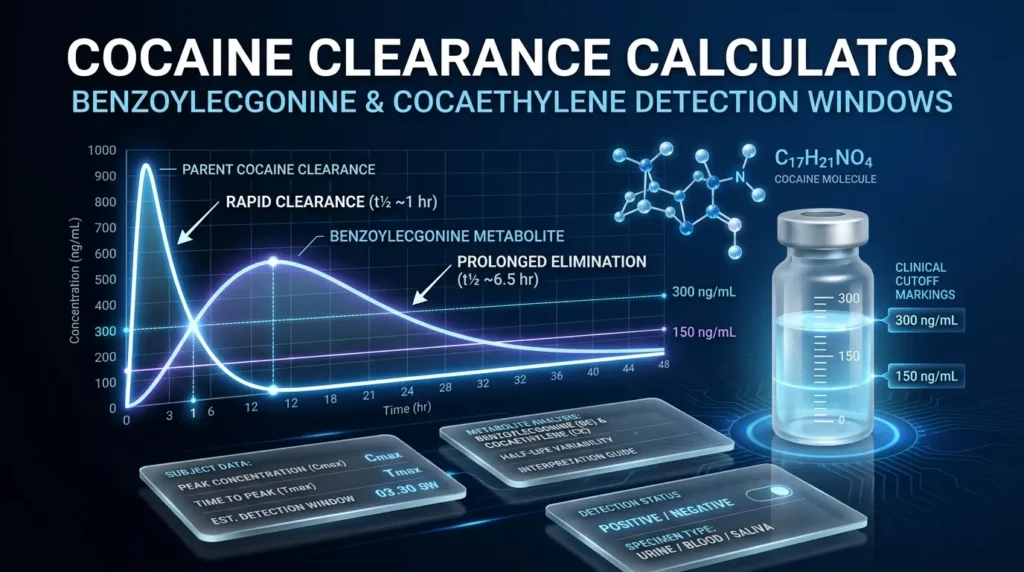
Set your details, then tap Calculate. Target analyte: benzoylecgonine (t½ ~6.5 h), standard screen 300 ng/mL.
Advanced: metabolism and liver / kidney function
Disclaimer: Educational and harm-reduction information only. Real elimination depends on BChE and CES1 enzyme activity, urine pH, kidney function, hydration and body composition. Not medical or legal advice.
Cocaine Clearance Calculator: The Complete Clinical Detection Guide
Whether facing an upcoming pre-employment drug panel, random DOT screening, probation urinalysis, or medical toxicology evaluation, understanding how long cocaine remains detectable in the human body is critical.
A widespread myth claims that cocaine clears out of the system in just 24 hours because the stimulant high lasts under an hour. In reality, while parent cocaine vanishes rapidly from blood, clinical urine drug screens do not test for cocaine. Instead, laboratories screen for its primary active breakdown product, benzoylecgonine (BE), which possesses a dramatically longer half-life and remains trapped in urine for several days.
Our cocaine clearance calculator accurately models the pharmacokinetics of cocaine, benzoylecgonine, and alcohol-induced cocaethylene, accounting for dosage, route of administration, liver carboxylesterase enzymes, and federal SAMHSA cutoff thresholds.
Below is an evidence-based clinical breakdown of how cocaine metabolizes, why combining cocaine with alcohol extends drug test detection windows, and how long metabolites remain detectable across urine, blood, saliva, and hair.
Cocaine vs. Benzoylecgonine: Why Drug Tests Don’t Test for Cocaine
To understand why cocaine drug tests remain positive for days, one must distinguish between the parent drug and its urinary metabolites:
- Parent Cocaine (Benzoylmethylecgonine):
- Highly lipophilic alkaloid extracted from the leaves of the Erythroxylum coca plant.
- Rapidly metabolized in plasma and liver tissues. Less than 1% to 5% of an ingested dose is excreted into urine unchanged.
- Because parent cocaine clears from systemic circulation within 12 to 24 hours, testing for parent cocaine in urine would produce an unacceptably high rate of false negatives.
- Benzoylecgonine (BE):
- The primary polar metabolite generated when liver carboxylesterase enzymes (CES1) and spontaneous chemical hydrolysis cleave the methyl ester group from cocaine.
- Accounts for 35% to 45% of total urinary excretion.
- Because benzoylecgonine is water-soluble, slowly filtered by the renal glomerulus, and has an elimination half-life over 6 times longer than parent cocaine, it serves as the universal target analyte for all workplace, court, and hospital drug screenings.
- Ecgonine Methyl Ester (EME):
- Generated by plasma butyrylcholinesterase (BChE) cleavage of the benzoyl group.
- Represents roughly 30% to 40% of the dose, serving as a secondary confirmatory marker in forensic toxicological investigations.
Elimination Half-Life: Parent Cocaine vs. Metabolites
A substance’s elimination half-life ($t_{1/2}$) represents the duration required for circulating concentrations to decrease by 50%. Under the standard 5.5 half-life pharmacokinetic clearance rule, a compound is functionally cleared (>98% eliminated) after 5 to 6 half-lives:
| Compound | Primary Metabolic Pathway | Elimination Half-Life ($t_{1/2}$) | 5.5 Half-Life Clearance (Blood) | Typical Urine Detection Window |
|---|---|---|---|---|
| Parent Cocaine | Plasma Butyrylcholinesterase / CES1 | 0.8 to 1.5 Hours (Mean: ~1.0h) | 5.5 to 8.0 Hours | 12 to 24 Hours (Trace only) |
| Benzoylecgonine (BE) | Renal Glomerular Filtration | 6.0 to 8.0 Hours (Mean: ~6.5h) | 33.0 to 44.0 Hours | 2 to 4 Days (up to 7+ days chronic) |
| Cocaethylene | Hepatic Transesterification | 2.5 to 3.5 Hours (Mean: ~3.0h) | 14.0 to 19.5 Hours | 2 to 5 Days |
| Ecgonine Methyl Ester | Plasma Enzymatic Hydrolysis | 3.5 to 4.5 Hours | 19.0 to 24.5 Hours | 24 to 48 Hours |
Notice that while parent cocaine clears systemic blood within 8 hours, urinary benzoylecgonine takes roughly 36 to 48 hours to clear systemic circulation, continuing to concentrate in bladder urine for several days.
The Alcohol Impact: How Cocaethylene Delays Drug Clearance
One of the most clinically dangerous and pharmacokinetically unique drug interactions occurs when cocaine is consumed alongside ethanol (alcohol):
When cocaine and ethanol circulate through the liver simultaneously, hepatic carboxylesterase-1 (CES1) enzymes undergo an enzymatic transesterification reaction. Rather than simply hydrolyzing cocaine into benzoylecgonine, the enzyme replaces the methyl ester group with an ethyl group, synthesizing an entirely novel psychoactive metabolite: Cocaethylene (ethylcocaine).
Consequences of Cocaethylene Formation:
- Prolonged Detection Windows: Cocaethylene clearance is significantly slower than cocaine ($t_{1/2} \approx 2.5 – 3.5\text{ hours}$ vs. $1.0\text{ hour}$). Furthermore, the presence of ethanol competitively inhibits the metabolic breakdown of cocaine itself, extending total urinary detection times by 30% to 50%.
- Increased Toxicity: Cocaethylene produces intense cardiac stimulation, carries an estimated 18- to 25-fold higher risk of acute cardiovascular events and arrhythmias, and causes prolonged neuropsychiatric effects.
- Drug Testing Evidence: Confirmatory forensic drug testing (GC-MS/LC-MS) routinely isolates cocaethylene to scientifically prove simultaneous alcohol and cocaine consumption in DUI, probation, and workplace injury cases.
Bioavailability and Absorption by Administration Route
The route of cocaine administration dramatically impacts initial peak blood concentrations ($C_{\text{max}}$), absorption velocity, and total metabolite yield:
| Administration Route | Bioavailability (%) | Onset of Action | Peak Plasma Time ($T_{\text{max}}$) | Detection Window Impact |
|---|---|---|---|---|
| Intranasal (Snorted Powder) | 60% to 75% | 1 to 3 minutes | 30 to 45 minutes | Local vasoconstriction in nasal mucosa delays absorption slightly, producing a steady metabolic excretion profile over 2 to 3 days. |
| Inhaled / Smoked (Crack Cocaine) | 70% to 90% | Immediate (5–10 sec) | 1 to 5 minutes | Pyrolysis produces extremely rapid alveolar absorption; intense blood spikes result in rapid hepatic conversion to high peak urinary BE levels. |
| Intravenous (IV Injection) | 100% | Immediate (10–30 sec) | 2 to 5 minutes | Complete systemic availability; maximal initial plasma peak yielding elevated metabolite concentrations in first voids. |
| Oral Ingestion | 30% to 40% | 15 to 30 minutes | 60 to 90 minutes | Extensive first-pass hepatic metabolism degrades a large fraction into BE before reaching systemic circulation, slightly extending elimination. |
Multi-Matrix Detection Windows (Urine, Blood, Saliva, Hair)
Our cocaine clearance calculator models elimination timelines across all standard diagnostic specimen matrices:
| Diagnostic Matrix | Standard Cutoff Level | Detection Window (Single Low Dose) | Detection Window (Chronic Daily Binge) |
|---|---|---|---|
| Urine (Screening Immunoassay) | 300 ng/mL | 24 to 48 Hours (1–2 Days) | 3 to 5 Days |
| Urine (Sensitive Screen / Pain Mgmt) | 100 ng/mL | 48 to 72 Hours (2–3 Days) | 5 to 7 Days |
| Urine (Confirmatory GC-MS/LC-MS) | 150 ng/mL | 36 to 60 Hours (1.5–2.5 Days) | 4 to 6 Days |
| Blood Plasma Screen | 10 ng/mL | 12 to 24 Hours | 24 to 48 Hours |
| Oral Fluid (Saliva Swab) | 20 ng/mL | 24 to 36 Hours | 36 to 48 Hours |
| Hair Follicle Analysis | 500 pg/mg | Up to 90 Days | Up to 90 Days |
For forensic hair analysis timelines, consult our Hair Follicle Drug Test Calculator.
SAMHSA Federal Screening vs. Confirmatory Cutoff Levels
Workplace drug tests administered under the Substance Abuse and Mental Health Services Administration (SAMHSA) and Department of Transportation (DOT) adhere to a rigorous two-step testing protocol:
Step 1: Initial Urine Immunoassay Screen (300 ng/mL Cutoff)
- Rapid immunoassay strips use targeted antibodies engineered against benzoylecgonine.
- If urinary BE concentration is below 300 ng/mL, the specimen is immediately certified as Negative.
- If concentration exceeds 300 ng/mL, the specimen is flagged as “Presumptive Positive” and sent for confirmatory analysis.
Step 2: Confirmatory GC-MS / LC-MS Analysis (150 ng/mL Cutoff)
- To eliminate any chance of false positives, the laboratory tests the identical sample using Gas Chromatography-Mass Spectrometry (GC-MS) or Liquid Chromatography-Tandem Mass Spectrometry (LC-MS/MS).
- The confirmatory cutoff drops to 150 ng/mL.
- The mass spectrometer identifies the unique molecular fingerprint of benzoylecgonine and parent cocaine, providing legally defensible quantification.
Single Line vs. Weekend Binge vs. Chronic Heavy Use
Clearance duration varies drastically based on cumulative consumption and frequency:
- Single Line / Occasional Use (50–100 mg):
- Peak urinary benzoylecgonine concentrations typically reach 1,500 to 4,000 ng/mL within 4 to 8 hours.
- With normal renal function and hydration, concentrations typically fall below the 300 ng/mL screening cutoff within 24 to 48 hours.
- Weekend Binge (0.5g – 1.0g over 1–2 days):
- Repeated doses saturate plasma butyrylcholinesterase and liver esterase pathways.
- Peak urinary BE levels often exceed 20,000 to 50,000 ng/mL.
- Detection window expands to 3 to 4 days (72 to 96 hours).
- Chronic Daily Heavy Use (1g+ daily for weeks/months):
- While cocaine is water-soluble, prolonged high-dose use leads to tissue accumulation in adipose tissue and deep biological reservoirs.
- As the body slowly redistributes and eliminates stored metabolites, chronic heavy users can test positive for 5 to 7+ days, and in rare clinical case reports, up to 10 to 14 days.
Can You Flush Cocaine Out of Your System with Water?
There is no scientific shortcut to artificially accelerate liver enzyme hydrolysis. However, understanding renal physiology helps prevent catastrophic drug screening mistakes:
- Excessive Water Consumption: Drinking gallons of water before a test does not accelerate liver carboxylesterase enzymes. While it temporarily dilutes urine, it simultaneously dilutes urinary creatinine (< 20 mg/dL) and specific gravity (< 1.003). Testing facilities automatically flag such samples as “Negative Dilute,” requiring an immediate monitored retest or treating the specimen as a presumptive fail.
(Assess your sample integrity with our Urine Dilution & Creatinine Calculator). - Avoid Alcohol: If preparing for a drug screen, completely abstain from alcohol, as even trace ethanol triggers cocaethylene synthesis and competitively delays cocaine clearance.
- Maintain Healthy Hydration: Standard water intake (2 to 3 liters daily) supports natural glomerular filtration without triggering dilute specimen rejections.
Scientific Studies & Clinical References
The mathematical clearance models in our cocaine clearance calculator are based on published clinical pharmacology and toxicology literature:
- Cone E.J., et al. (2003) — Pharmacokinetics and urinary excretion of cocaine and its metabolites in humans after intravenous, intranasal, and smoked administration. Journal of Analytical Toxicology, 27(7), 386-401. PubMed PMID: 12841595.
- Harris D.S., et al. (2003) — Cocaethylene metabolism and interaction with cocaine in human subjects. Drug and Alcohol Dependence, 72(2), 169-182. PubMed PMID: 12695349.
- Substance Abuse and Mental Health Services Administration (SAMHSA) — Mandatory Guidelines for Federal Workplace Drug Testing Programs. SAMHSA.gov.
- Baselt R.C. (2017) — Disposition of Toxic Drugs and Chemicals in Man (11th ed.). Biomedical Publications.
- Preston K.L., et al. (2002) — Urinary excretion of cocaine and metabolites: comparison of continuous vs. intermittent administration. Journal of Analytical Toxicology, 26(7), 393-400.
Explore Our Other Diagnostic Calculators
Check detection timelines across other substances and clinical testing methods:
- Opioid Clearance Calculator — Calculate clearance windows for oxycodone, hydrocodone, morphine, and fentanyl.
- Adderall Clearance Calculator — Model amphetamine urinary excretion and half-life based on urine pH.
- Xanax Clearance Calculator — Estimate alprazolam and benzodiazepine half-life and urine detection.
- Ketamine Clearance Calculator — Dual-curve clearance model for ketamine and active norketamine metabolites.
- THC Clearance Calculator — Estimate cannabinoid detection based on BMI, body fat, and consumption frequency.
- Urine Dilution & Creatinine Calculator — Check specific gravity and creatinine levels to avoid dilute specimen flags.
- Hair Follicle Drug Test Calculator — 90-day forensic detection calculator based on monthly hair growth rates.
- EtG Clearance Time Calculator — First-order pharmacokinetic elimination calculator for alcohol urine tests.
Medical & Legal Disclaimer
The cocaine clearance calculator and all supporting clinical materials on this website are provided strictly for educational, scientific, and harm-reduction purposes. Individual clearance rates vary widely based on individual plasma butyrylcholinesterase (BChE) enzyme activity, hepatic carboxylesterase (CES1) levels, renal filtration efficiency, urinary pH, and laboratory analytical sensitivity. This digital tool does not constitute medical advice or legal counsel.