
EtG Half-Life Calculator
Enter your drinks, body weight, and metabolic rate to estimate your peak EtG level and see how it declines over time toward common lab cutoffs.
Inputs
Decay curve
EtG Half-Life Calculator: How Long Does EtG Actually Take to Clear Your System?
If you've had a drink recently and you're staring down an upcoming urine test, the question isn't really "is alcohol still in my system" — it's "how much EtG is left, and how fast is it dropping." That's exactly what our EtG Half-Life Calculator is built to estimate. Instead of giving you a single generic number pulled from a chart, it models the actual decay curve of ethyl glucuronide (EtG) in your body, based on your own drinking details and a chosen metabolic rate.
This guide walks through what EtG half-life actually means, how the calculator arrives at its estimate, what affects your personal clearance speed, and how to read the results without misinterpreting them.
Prefer to jump straight to a number? Try the ETG Calculator for a quick estimate, or the Advanced ETG Calculator if you want more input control.
What Is the EtG Half-Life Calculator?
The EtG Half-Life Calculator is a free tool that estimates how your body's ethyl glucuronide level declines over time after drinking, based on the concept of biological half-life — the time it takes for a substance's concentration to drop by 50%.
Rather than asking you to guess your current EtG level in ng/mL (a number nobody actually knows without a lab test), the calculator works backward from something you do know: how many drinks you had, your body weight, and your biological sex. It uses that to produce a rough estimated peak EtG level, then plots how that level decays hour by hour toward the common lab cutoffs of 500, 300, and 100 ng/mL.
It's designed to sit alongside our other tools — if you already know a specific reading, the ETG 100 ng/mL Calculator, ETG 200 ng/mL Calculator, and EtG 300 ng/mL Calculator let you check it directly against a specific threshold.
How Does the EtG Half-Life Calculator Work?
The calculator runs in two stages.
Stage one — estimating your peak level. It takes your number of standard drinks (14 grams of ethanol per drink), body weight, and biological sex, and runs them through the Widmark formula, a long-standing method used to estimate blood alcohol concentration from a person's alcohol dose and body water distribution. That estimated peak blood alcohol figure is then converted into an illustrative peak urinary EtG concentration.
Stage two — modeling the decline. Once it has a starting point, the calculator applies exponential decay based on your selected half-life setting: fast (2.5 hours), average (3.75 hours), or slow (5 hours). That range reflects the elimination rates reported in published pharmacokinetic research on EtG, rather than a single fixed assumption.
It's worth being upfront about the limits here: this is a modeling exercise, not a lab measurement. Nobody — not this calculator, not any other free tool online — can tell you your exact EtG level without an actual test. What this tool gives you is a reasonable, transparent estimate of the shape of your decline, which is genuinely useful for understanding your situation even if the exact numbers won't match a lab printout. For more on this limitation, see our guide on how accurate an EtG calculator really is.
What Is EtG Half-Life, Exactly?
EtG half-life is the time it takes for the concentration of ethyl glucuronide in your body to fall by half. It's a different concept from "detection time" — detection time is how long EtG stays above a specific cutoff, while half-life describes the rate of decline itself.
Pharmacokinetic research on ethyl glucuronide has generally reported an elimination half-life in the range of roughly 2.5 to 3 hours in blood, with urinary clearance following a broadly similar pattern once absorption is complete. One frequently cited study tracking EtG through the full course of absorption and elimination found the metabolite behaves in a fairly predictable, dose-dependent way once peak concentration is reached (Høiseth et al., 2007, Forensic Science International). Because individual metabolism varies, our calculator gives you a slow-to-fast range (2.5–5 hours) rather than one fixed figure, so you can see how sensitive the estimate is to your own likely metabolic rate.
How to Use the EtG Half-Life Calculator
- Enter your number of standard drinks. One standard drink is roughly 12 oz of beer, 5 oz of wine, or 1.5 oz of spirits (about 14g of ethanol).
- Enter your body weight. This affects how the alcohol you consumed is distributed and therefore your estimated peak level.
- Select your biological sex. Body water percentage differs between men and women, which changes the estimate.
- Choose a metabolic rate — slow, average, or fast — based on how quickly you generally metabolize alcohol.
- Move the "hours since last drink" slider to see your estimated current level and how much time remains until you're projected to fall below each cutoff.
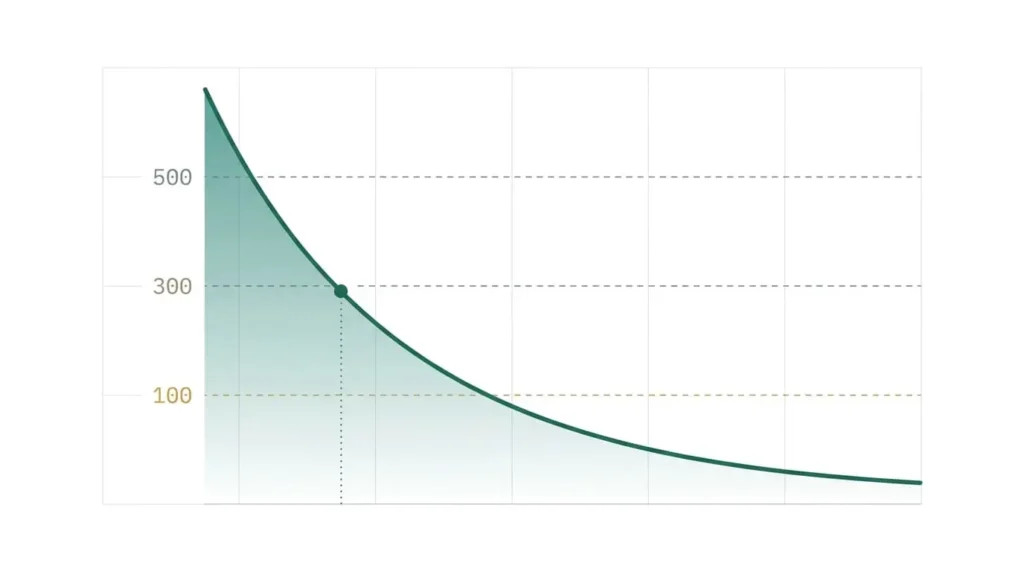
The chart updates live, showing your decay curve against dashed lines for the 500, 300, and 100 ng/mL thresholds — the three cutoffs most commonly used in workplace, clinical, and court-ordered testing programs.
EtG Cutoff Levels: Why the Threshold Matters as Much as the Level
Your estimated EtG level only tells half the story — the cutoff your test uses determines whether that level counts as a "pass" or a "fail."
- 100 ng/mL — the most sensitive cutoff, typically used in probation and zero-tolerance monitoring. Research on immunoassay cutoffs has found that a 100 ng/mL threshold can flag drinking that occurred up to roughly two days prior (McDonell et al., 2015, Drug and Alcohol Dependence).
- 300 ng/mL — a mid-range threshold used across many clinical and workplace programs.
- 500 ng/mL — the least sensitive of the three, generally only picking up more recent or heavier drinking.
If you know which threshold applies to your specific test, running your numbers through the ETG 100 ng/mL Calculator or EtG 300 ng/mL Calculator will give you a more direct read than the general half-life view alone.
Factors That Affect Your EtG Half-Life
The 2.5–5 hour range built into the calculator exists because half-life isn't identical from person to person. Several things push it in one direction or the other:
- Liver function. Since EtG is produced through hepatic (liver) metabolism of ethanol, anything that affects liver enzyme activity — genetics, age, certain medications, or liver conditions — shifts clearance speed.
- Hydration. Drinking more water increases urine volume, which can dilute the measured concentration in a sample without actually speeding up elimination from the body. This is an important distinction: dilution changes what a test reports, not your true metabolic timeline.
- Body composition and weight. Heavier individuals generally distribute a given amount of alcohol across more body mass, which affects the starting peak level more than it affects the half-life itself.
- Drinking pattern. A single drink produces a much smaller EtG load than several drinks over a few hours, and heavy or repeated drinking can extend total detection time even if the underlying half-life doesn't change.
- Individual metabolism. Baseline enzyme activity varies naturally between people, which is exactly why the calculator offers a slow/average/fast setting instead of one number.
For more background on how the test itself works at a mechanical level, see How Does EtG Testing Work? and our general primer on What Is EtG?
Half-Life vs. Total Detection Time: Don't Confuse the Two
This trips a lot of people up. Half-life tells you the rate of decline — how fast the concentration is dropping at any given point. Detection time tells you the total window during which EtG stays above a specific cutoff.
Because decay is exponential, not linear, the two behave differently: a level drops fast at first and then slows down as it approaches the cutoff, which is why the last stretch of "getting to zero" often feels like it takes disproportionately long. The decay chart in the calculator is designed to make that curve visible rather than implying a straight-line countdown.
Frequently Asked Questions
Is the EtG Half-Life Calculator a substitute for a lab test? No. It's an educational estimate based on population-average modeling, not a diagnostic tool. It cannot predict the exact outcome of a certified laboratory test.
What is a normal EtG half-life? Published research generally places EtG elimination half-life in the range of about 2.5 to 5 hours, depending on the individual and the study methodology. The calculator lets you select across that range.
Why does the calculator ask for drinks instead of letting me type in an EtG number directly? Because almost nobody actually knows their EtG level in ng/mL without a lab test. Asking for drinks, weight, and sex lets the tool produce a starting estimate from information you actually have.
Does drinking water speed up EtG elimination? No. Hydration can dilute a urine sample and lower the measured concentration, but it does not accelerate how quickly your liver processes and clears EtG from your body.
Can one drink still show up on a 100 ng/mL test the next day? It's possible, depending on your metabolism, body weight, and how much time has passed. The lower the cutoff, the longer a small amount of drinking can remain technically detectable.
Is a faster half-life always better for passing a test? Generally, yes — a faster estimated half-life means the model projects your level crossing below a given cutoff sooner. But this is still an estimate, not a guarantee tied to any real test outcome.
Where can I read more about the science behind EtG testing? The National Institute on Alcohol Abuse and Alcoholism (NIAAA), SAMHSA, and the CDC's Alcohol and Public Health program are good starting points for authoritative background on alcohol metabolism and biomarker testing.
References
- Høiseth G, Bernard JP, Karinen R, et al. A pharmacokinetic study of ethyl glucuronide in blood and urine: applications to forensic toxicology. Forensic Science International, 2007. PubMed
- McDonell MG, Skalisky J, Leickly E, et al. Using Ethyl Glucuronide in Urine to Detect Light and Heavy Drinking in Alcohol Dependent Outpatients. Drug and Alcohol Dependence, 2015. PMC
- National Institute on Alcohol Abuse and Alcoholism (NIAAA) — niaaa.nih.gov
- Substance Abuse and Mental Health Services Administration (SAMHSA) — samhsa.gov
- CDC Alcohol and Public Health — cdc.gov/alcohol
Related Tools
- ETG Calculator
- Advanced ETG Calculator
- ETG 100 ng/mL Calculator
- ETG 200 ng/mL Calculator
- EtG 300 ng/mL Calculator
Learn More
Educational estimate only. The EtG Half-Life Calculator and this guide are provided for informational purposes only. Results are based on generalized pharmacokinetic modeling and do not constitute medical, legal, or professional advice, and they cannot predict the outcome of a certified laboratory test. If a testing outcome affects your employment, legal standing, or treatment program, consult a qualified healthcare professional or certified testing laboratory.