
Saliva Drug Test Calculator
Estimate mouth swab drug test detection windows for THC, Cocaine, Amphetamines, Opiates, Benzodiazepines, and Alcohol based on substance, usage frequency, and oral hygiene.
Substance & Exposure Profile
Oral Fluid Test Status & Timeline
Adjust the inputs to see mouth swab clearance estimates.
| Testing Medium | Target Analyte | Detection Window | Primary Purpose |
|---|---|---|---|
| Saliva / Oral Swab | Parent Compound | 12 – 36 Hours | Recent Use |
| Urine Screen | Inactive Metabolites | 3 – 30+ Days | Historical Exposure |
| Blood / Plasma | Parent Compound | 12 – 24 Hours | Toxicology / Accidents |
| Hair Follicle | Drug Matrix in Keratin | Up to 90 Days | Long-Term Pattern |
The Science of Salivary Diffusion
Drugs enter saliva two main ways: local oral cavity deposition (direct residue from smoking, vaping, or chewing) and passive diffusion from blood across salivary gland cell membranes. Only free, un-protein-bound basic and neutral drug molecules transfer into saliva, so concentrations track closely with active blood levels.
Mouthwash & Detox Gum: Myths vs. Reality
“Detox mouthwashes” and neutralizing gums claim to beat a mouth swab. In practice they give only a brief 15 to 30 minute dilution of surface residue. Salivary glands keep producing fresh saliva (about 0.5 to 1.0 mL per minute), and drug circulating in blood keeps diffusing back into the mouth, so these products are unreliable against a laboratory-confirmed test.
Saliva (Mouth Swab) Drug Test Detection Times & Clearance Windows: Complete Forensic Guide
In modern workplace screening, pre-employment testing, and roadside law enforcement checkpoints, the saliva drug test (oral fluid testing or mouth swab) has rapidly grown in popularity. Both the Substance Abuse and Mental Health Services Administration (SAMHSA) and the Department of Transportation (DOT) have authorized oral fluid testing as a primary testing method alongside traditional urinalysis.
Unlike urine testing—which searches for lipid-soluble, inactive metabolites that can linger in body fat for weeks—mouth swab drug tests detect active, un-metabolized parent drug molecules. This fundamentally changes the detection timeframe: oral fluid testing measures recent impairment (12 to 48 hours) rather than past historical exposure.
Use the interactive Saliva Drug Test Calculator above to calculate your exact detection window across THC, cocaine, amphetamines, opiates, benzodiazepines, and alcohol.
1. Mouth Swab Detection Times by Substance
Because each drug class exhibits unique chemical properties (lipid solubility, molecular size, ionization, and protein binding), detection windows in oral fluid vary considerably:
| Substance Tested | Primary Target Analyte | Standard Screen Window | Chronic / Heavy Use Window | Standard SAMHSA Cutoff |
|---|---|---|---|---|
| THC (Marijuana / Weed) | Parent Delta-9-THC | 12 to 24 Hours | 24 to 48+ Hours | 4 ng/mL (Screen) / 2 ng/mL (LC-MS) |
| Cocaine | Parent Cocaine & Benzoylecgonine | 24 to 36 Hours | 36 to 48 Hours | 15 ng/mL (Screen) / 8 ng/mL (LC-MS) |
| Methamphetamine / Adderall | Parent Amphetamine / Meth | 24 to 36 Hours | 48 to 72 Hours | 15 ng/mL (Screen) / 10 ng/mL (LC-MS) |
| Opiates (Heroin / Morphine) | Parent Morphine & 6-MAM | 12 to 24 Hours | 24 to 36 Hours | 30 ng/mL (Screen) / 15 ng/mL (LC-MS) |
| Benzodiazepines (Xanax / Valium) | Parent Benzodiazepines | 24 to 48 Hours | 48 to 72 Hours | 5 ng/mL (Specialty OFT) |
| Alcohol (Ethanol) | Free Ethanol | 8 to 12 Hours | 12 to 16 Hours | 0.02% Saliva BAC (~20 mg/dL) |
2. How Long Does Weed (THC) Stay in Saliva?
Cannabis is by far the most widely tested substance on oral fluid swabs, and its behavior in the oral cavity is unique compared to all other drug classes:
The Oral Cavity Coating Effect
When you smoke a joint, hit a vape, or ingest cannabis, Delta-9-THC heavily coats the oral mucosal surfaces, gums, teeth, and tongue:
- Immediate Hours (0 to 6 Hours): THC levels in the mouth are massively elevated (often exceeding 100 to 1,000 ng/mL) due to local residual smoke particles.
- Intermediate Phase (12 to 24 Hours): Constant saliva production and swallowing flush away oral mucosal residues. At this stage, saliva THC concentrations fall rapidly toward screening cutoffs.
- Infrequent / Casual Users: THC drops below the SAMHSA 4 ng/mL cutoff within 12 to 24 hours.
- Chronic Daily Smokers: While urine tests can detect chronic THC for 30+ days due to fat storage, saliva clears THC within 24 to 48 hours for over 90% of chronic users (extending to 72 hours only under ultra-sensitive 2 ng/mL confirmatory mass spectrometry).
What About Cannabis Edibles?
Edibles bypass direct smoke inhalation into the oral cavity. However, while chewing the edible, small amounts of THC still deposit onto oral tissues. Oral fluid detection after consuming edibles is typically shorter than after smoking, generally clearing within 12 to 18 hours.
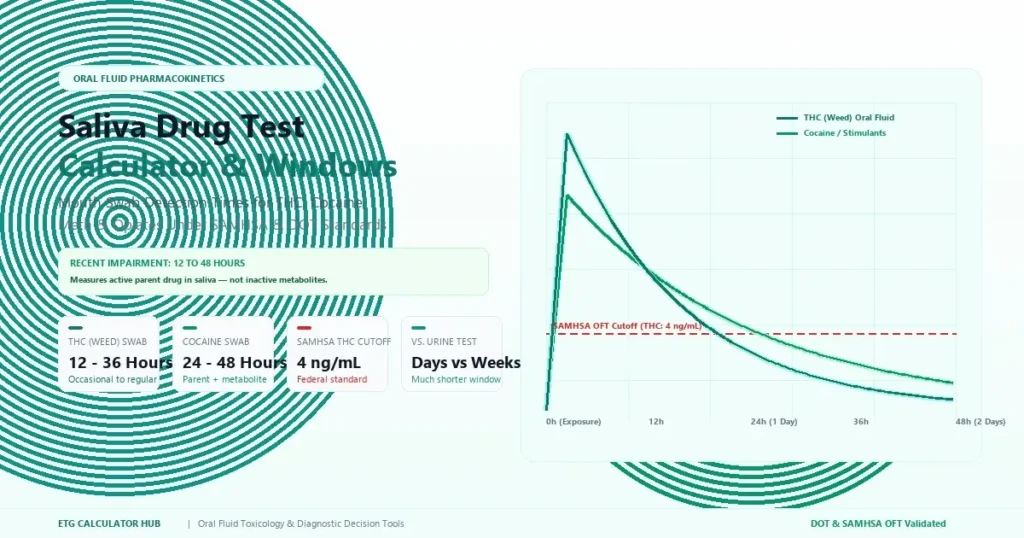
3. Saliva vs. Urine Testing: The Pharmacokinetic Difference
Understanding why employers and law enforcement are increasingly adopting mouth swabs requires looking at the pharmacokinetics of bodily fluids:
Urine Testing (Urinalysis)
   └── Detects: Inactive, processed metabolites (e.g., THC-COOH, Benzoylecgonine)
   └── Detection Window: Days to Weeks (THC: up to 30 days)
   └── Clinical Meaning: Historical past exposure; does NOT indicate active impairment
   └── Collection Drawback: Privacy concerns, restroom adulteration, "shy bladder" syndrome

Oral Fluid Testing (Mouth Swab)
   └── Detects: Active, un-metabolized parent drug (e.g., Delta-9-THC, Parent Cocaine)
   └── Detection Window: Hours to Days (THC: 12 to 36 hours)
   └── Clinical Meaning: Recent use and immediate impairment window
   └── Collection Advantage: 100% directly observed; impossible to substitute with fake urine
4. The Biological Science: How Drugs Transfer into Saliva
Drugs enter the oral cavity through two distinct physiological pathways:
1. Direct Mucosal Deposition (Smoking, Inhaling, Ingestion)
Substances that are smoked, vaped, snorted, or chewed directly coat the oral epithelial mucosal cells. This produces very high initial concentrations that gradually rinse away as the salivary glands secrete fresh fluid.
2. Transcellular Passive Diffusion from Blood
Drugs circulating in the systemic bloodstream cross the capillary walls into the salivary acinar cells and enter saliva. This transfer is governed by:
- Protein Binding: Only free, unbound drug in blood plasma can cross into saliva. Highly bound drugs (like benzodiazepines, which are ~90% protein-bound) appear in saliva at lower concentrations than drugs with low protein binding.
- Saliva pH (Ion Trapping): Saliva pH normally fluctuates between 6.2 and 7.4. Basic drugs (such as amphetamines, meth, and cocaine) become ionized in slightly acidic saliva, becoming “trapped” in oral fluid at concentrations higher than in blood (Saliva-to-Plasma ratio > 1.0).
5. SAMHSA & DOT Federal Oral Fluid Cutoff Standards
Federal regulations establish strict analytical thresholds for initial rapid screening versus confirmatory laboratory testing:
| Drug Class | Initial Immunoassay Screen Cutoff | Confirmatory LC-MS/MS Cutoff |
|---|---|---|
| THC (Marijuana) | 4 ng/mL | 2 ng/mL |
| Cocaine / Benzoylecgonine | 15 ng/mL | 8 ng/mL |
| Amphetamine / Methamphetamine | 15 ng/mL | 10 ng/mL |
| MDMA (Ecstasy) / MDA | 15 ng/mL | 10 ng/mL |
| Opioids (Morphine / Codeine) | 30 ng/mL | 15 ng/mL |
| 6-Acetylmorphine (Heroin Marker) | 4 ng/mL | 2 ng/mL |
| Phencyclidine (PCP) | 10 ng/mL | 5 ng/mL |
Note: Commercial point-of-care rapid testing kits used by small private employers often use higher, less sensitive cutoffs (such as 10 to 25 ng/mL for THC), making clearance times even faster than under federal SAMHSA standards.
6. How to Pass a Mouth Swab Test: Science vs. Myths
Online forums are filled with questionable hacks claiming to beat a saliva test. Here is what scientific data actually demonstrates:
Proven Harm-Reduction Strategies
- Aggressive Oral Hygiene (Brushing & Tongue Scraping): Thoroughly brushing teeth, gums, the inside of cheeks, and tongue scraping removes residual smoked particles embedded in the oral mucosa. This significantly lowers direct residue concentrations.
- Alcohol-Free Antiseptic Mouthwash: Rinsing with an antiseptic or hydrogen peroxide-based oral wash physically clears saliva and epithelial debris.
- Stimulating Salivary Flow (Hydration & Citric Acid): The normal human mouth produces roughly 0.5 to 1.0 mL of fresh saliva every minute. Sucking on sour candies or citrus lozenges triggers rapid salivary secretion, accelerating the flushing of oral fluid.
Common Myths That Fail
- “Detox Gums and Sprays Beat the Lab”: Specialty detox mouth sprays sold online contain hydrogen peroxide or astringent chemicals that temporarily dilute the mouth for 15 to 30 minutes. Once you enter a collection facility and wait, fresh saliva from the bloodstream replenishes the oral cavity with detectable drug molecules.
- “Vinegar or Bleach Rinses”: Extremely dangerous and corrosive to mucosal tissue. Furthermore, forensic collection swabs measure saliva pH and specimen validity; chemical adulterants trigger an immediate specimen invalidation flag.
Explore Our Other Diagnostic Calculators
Explore our complete suite of evidence-based drug clearance and testing calculators:
- Xanax Clearance Calculator — Calculate alprazolam and benzodiazepine half-life and urine detection windows.
- Adderall Clearance Calculator — Model amphetamine excretion times based on urinary pH and dosage.
- Kratom Clearance Calculator — Calculate mitragynine elimination timelines and biphasic clearance.
- THC Clearance Calculator — Estimate cannabinoid detection based on BMI, frequency of use, and body fat percentage.
- Steroid Detection Time Calculator — Calculate PED and anabolic steroid clearance times for athletic drug testing.
- Urine Dilution & Creatinine Calculator — Check specific gravity and creatinine levels to avoid dilute specimen flags.
- Hair Follicle Drug Test Calculator — 90-day forensic detection calculator based on monthly hair growth rates.
- EtG Clearance Time Calculator — Determine ethyl glucuronide alcohol breakdown timelines.
7. Frequently Asked Questions
Can secondhand weed smoke make you fail a saliva test?
Extremely unlikely. Scientific studies by Cone et al. demonstrated that passive exposure to cannabis smoke in realistic, ventilated environments does not produce oral fluid concentrations exceeding the 4 ng/mL SAMHSA cutoff. Only extreme, unventilated exposure (sitting in a small airtight vehicle for hours) produces trace levels that clear within 2 to 4 hours.
Can a mouth swab test detect drugs from a week ago?
No. Saliva testing is chemically incapable of detecting drugs from a week ago. With the exception of ultra-heavy chronic methamphetamine use (which can occasionally linger up to 72 hours), oral fluid is completely clear of detectable parent drugs within 24 to 48 hours.
What happens if you have dry mouth during the test?
Collection swabs require a specific minimum volume of oral fluid (typically 1.0 mL), indicated by a color-changing volume saturation flag on the swab handle. If you have severe cottonmouth, the collector will give you water to rinse and wait 10 to 15 minutes before re-swabbing.
Scientific Studies & Clinical References
- Substance Abuse and Mental Health Services Administration (SAMHSA). (2019). Mandatory Guidelines for Federal Workplace Drug Testing Programs—Oral/Fluid. Federal Register, 84(207), 57536-57610. SAMHSA Guidelines.
- Huestis, M. A., & Cone, E. J. (2004). Relationship of saliva codeine concentrations to plasma concentrations after oral administration. Journal of Analytical Toxicology, 28(8), 652-660.
- Lee, D., & Huestis, M. A. (2014). Current knowledge on cannabinoids in oral fluid. Drug Testing and Analysis, 6(1-2), 88-111. PubMed PMID: 24391136.
- Bosker, W. M., & Huestis, M. A. (2009). Oral fluid testing for drugs of abuse. Clinical Chemistry, 55(11), 1910-1931.
- Cone, E. J., Bigelow, G. E., Herrmann, E. S., et al. (2015). Non-smoker exposure to secondhand cannabis smoke. I. Oral fluid and blood drug concentrations. Journal of Analytical Toxicology, 39(1), 1-12.