
Xanax Clearance Calculator: Detection Time & Half-Life in Urine
Accurately estimate how long Xanax (alprazolam) and its active alpha-hydroxy metabolites remain detectable in urine, saliva, and blood screens based on dose, liver metabolism, and test cutoffs.
| Testing Medium | Cutoff Level | Estimated Level | Time to Clear | Status |
|---|
Pharmacokinetic Baselines
- Average Alprazolam Half-Life: 11.2 Hours (Range: 6.3 – 26.9h)
- Peak Plasma Concentration (Tmax): 1.0 to 2.0 Hours
- Oral Bioavailability: 88% to 92% (High)
- Volume of Distribution (Vd): 0.8 to 1.3 L/kg
- Primary Metabolic Enzyme: Hepatic CYP3A4
Standard Detection Timelines
- Single Therapeutic Dose (0.5 – 1mg): 2 to 4 Days in Urine
- Chronic Daily Therapy (2mg+): 4 to 7 Days in Urine
- Elderly / Cirrhotic Patients: Up to 7 to 9 Days
- Saliva Detection Window: 24 to 48 Hours
- Blood Plasma Detection Window: 24 to 36 Hours
Xanax Clearance Calculator: The Complete Clinical Detection Guide
Whether prescribed Xanax (alprazolam) for generalized anxiety disorder, panic attacks, or preparing for an upcoming clinical or pre-employment drug panel, understanding how benzodiazepines eliminate from the body is essential.
Unlike short-lived stimulants or water-soluble substances, benzodiazepines undergo complex hepatic oxidation and glucuronidation. Our Xanax clearance calculator models the real-world elimination of alprazolam and related benzodiazepines, taking into account dose strength, acute vs. steady-state usage, liver CYP3A4 enzyme health, and laboratory cutoff thresholds.
Below is the clinical science explaining how Xanax metabolizes, why detection windows vary from 2 to 7+ days, and how standard immunoassay cups differ from GC-MS confirmatory analysis.
What Is Xanax and How Does the Body Metabolize It?
Xanax is the brand name for alprazolam, a potent, short-to-intermediate-acting triazolobenzodiazepine. It enhances the inhibitory action of gamma-aminobutyric acid (GABAA) receptors in the brain, inducing rapid sedative and anxiolytic effects.
Following oral ingestion:
- Rapid Absorption: Alprazolam is absorbed rapidly with an oral bioavailability between 88% and 92%. Peak blood plasma concentrations (Tmax) occur within 1 to 2 hours.
- Hepatic Metabolism: The liver’s Cytochrome P450 3A4 (CYP3A4) enzyme system oxidizes alprazolam into two primary active metabolites:
- Alpha-hydroxyalprazolam (α\alphaα-OH): Retains roughly 66% of the clinical potency of alprazolam.
- 4-hydroxyalprazolam: Retains less than 20% potency and circulates in lower concentrations.
- Glucuronide Conjugation: These intermediate metabolites are rapidly conjugated with glucuronic acid to form inactive water-soluble glucuronides.
- Renal Excretion: Approximately 80% of the ingested dose is eliminated into urine, primarily as conjugated metabolites and trace amounts (< 20%) of unchanged parent alprazolam.
Key Pharmacokinetic Takeaway: Because alprazolam relies almost exclusively on the liver’s CYP3A4 enzyme for initial clearance, co-administered medications, liver cirrhosis, or elderly age can drastically delay elimination.
What Is the Half-Life of Xanax (Alprazolam)?
A drug’s elimination half-life (t1/2t_{1/2}t1/2) is the duration required for plasma concentration to decrease by 50%.
In healthy young adults, published clinical data (Greenblatt et al., 1993; FDA Prescribing Information) establishes the mean half-life of alprazolam at approximately 11.2 hours (typical physiological range: 6.3 to 26.9 hours).
The 5.5 Half-Life Clearance Rule
In pharmacology, a substance is considered functionally cleared from systemic circulation after 5 to 6 elimination half-lives (clearing >98% of the initial dose):
Clearance Time=5.5×11.2 hours≈61.6 hours=2.5 Days
While the drug may clear from blood in 2.5 to 3 days, urinary metabolites remain detectable for significantly longer, as kidneys continuously filter and concentrate glucuronide conjugates in the bladder.
Benzodiazepine Comparison: How Xanax Compares to Other “Benzos”
Xanax is classified as an intermediate-acting benzodiazepine. Compare its half-life with other frequently prescribed medications:
| Medication | Active Compound | Elimination Half-Life (t1/2) | Typical Urine Detection Window |
|---|---|---|---|
| Xanax | Alprazolam | 11.2 Hours (6 – 20h) | 2 to 5 Days (up to 7 days chronic) |
| Ativan | Lorazepam | 12 to 16 Hours | 3 to 6 Days |
| Klonopin | Clonazepam | 30 to 40 Hours | 5 to 9 Days |
| Valium | Diazepam | 20 to 100 Hours (Active metabolite: nordiazepam) | 7 to 14+ Days |
| Restoril | Temazepam | 8 to 15 Hours | 2 to 4 Days |
Notice that while Valium lingers for weeks due to its active nordiazepam metabolite, Xanax clears much more rapidly.
Standard Drug Testing Cutoff Levels for Benzodiazepines
Standard employment (DOT/SAMHSA) and clinical drug screenings follow a strict two-tier protocol:
1. Initial Immunoassay Urine Screen (200 – 300 ng/mL Cutoff)
- Most standard 10-panel and 12-panel immunoassay cups use a 200 ng/mL or 300 ng/mL cutoff.
- These test strips use antibodies engineered against oxazepam or nordiazepam. Because alprazolam is a triazolobenzodiazepine, it exhibits lower cross-reactivity with older immunoassay strips.
- High doses or repeated daily dosing are typically required to trigger a positive result on standard rapid cups.
2. Confirmatory GC-MS / LC-MS/MS Screen (100 ng/mL Cutoff)
- If a sample screens presumptive positive, the laboratory performs Gas Chromatography-Mass Spectrometry (GC-MS) or Liquid Chromatography-Tandem Mass Spectrometry (LC-MS/MS).
- The confirmatory cutoff drops to 100 ng/mL (or lower in forensic settings).
- Confirmatory testing hydrolyzes glucuronides and specifically isolates alprazolam and α-hydroxyalprazolam, eliminating any possibility of a false positive.
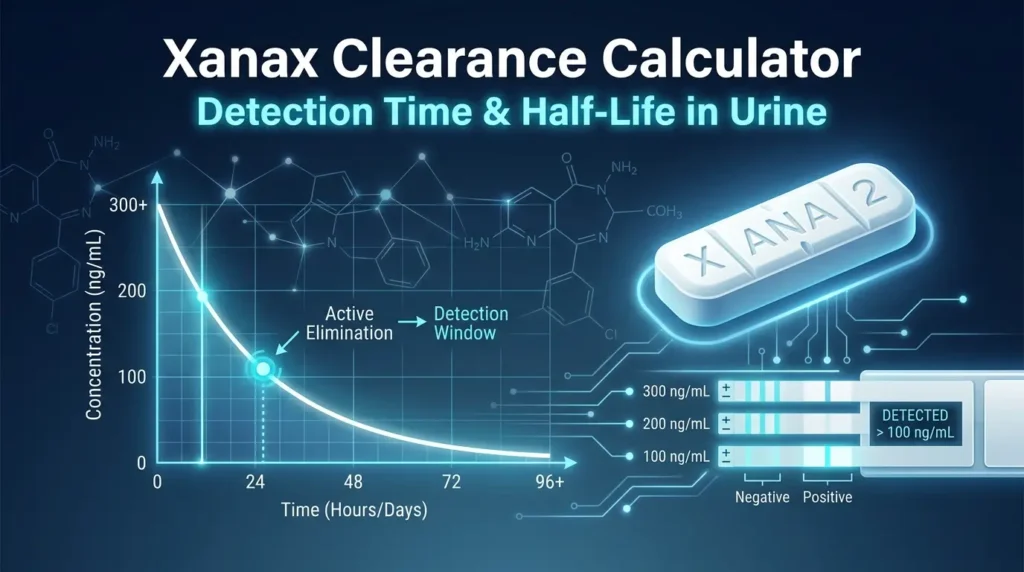
Multi-Matrix Detection Windows (Urine, Blood, Saliva)
Our Xanax clearance calculator estimates clearance across all diagnostic media:
| Diagnostic Matrix | Standard Cutoff Level | Detection Window (Single Dose: 0.5–1mg) | Detection Window (Chronic Daily: 2mg+) |
|---|---|---|---|
| Urine (Standard Screen) | 300 ng/mL | 2 to 3 Days | 4 to 6 Days |
| Urine (Sensitive Screen) | 200 ng/mL | 2 to 4 Days | 5 to 7 Days |
| Urine (GC-MS Confirmation) | 100 ng/mL | 3 to 5 Days | 6 to 8 Days |
| Blood Plasma Screen | 10 ng/mL | 24 to 36 Hours | 48 to 72 Hours |
| Oral Fluid (Saliva) | 5 ng/mL | 24 to 36 Hours | 48 to 60 Hours |
| Hair Follicle Test | 100 pg/mg | Up to 90 Days | Up to 90 Days |
For historical hair test timelines, review our Hair Follicle Drug Test Calculator.
Why Liver Health and Age Extend Xanax Detection
Individual clearance speed fluctuates widely based on physiological factors:
- Elderly Patients (> 65 Years): Hepatic blood flow and CYP3A4 enzyme activity decline with age. In elderly populations, the mean half-life of alprazolam expands from 11.2 hours to 16.3 hours, extending detection by several days.
- Liver Cirrhosis & Alcoholic Liver Disease: Severe hepatic impairment impairs the liver’s ability to oxidize the drug, extending half-life up to 19.7 hours.
- CYP3A4 Inhibitors: Certain medications and dietary compounds inhibit CYP3A4, dramatically slowing Xanax breakdown. Common inhibitors include:
- Antifungals: Ketoconazole, Itraconazole
- Antibiotics: Clarithromycin, Erythromycin
- Acid Reducers: Cimetidine (Tagamet)
- Dietary: Grapefruit and grapefruit juice
- Obesity: Alprazolam is lipophilic with a higher volume of distribution in individuals with higher body fat, increasing clearance time slightly.
Can You Flush Xanax Out of Your System?
No scientific method can miraculously clear Xanax in 24 hours. However, understanding renal physiology helps avoid common pitfalls:
- Excessive Water Consumption: Drinking gallons of water does not accelerate hepatic CYP3A4 enzyme metabolism. While it temporarily dilutes urine, it can dilute your creatinine (< 20 mg/dL) and specific gravity (< 1.003), triggering a “Negative Dilute” rejection. (Check your dilution risk with our Urine Dilution & Creatinine Calculator).
- Avoid CYP3A4 Inhibitors: Steer clear of grapefruit juice, cimetidine, and interacting medications that slow down liver processing.
- Maintain Normal Hydration: Standard water intake ensures optimal renal glomerular filtration without causing specimen dilution.
Scientific Studies & Clinical References
The mathematical algorithms in our Xanax clearance calculator are backed by clinical pharmacology studies:
- Greenblatt D.J. et al. (1993) — Alprazolam kinetics in the elderly: relation to sex and body weight. Archives of General Psychiatry, 50(9), 715-722. PubMed PMID: 8348795.
- Food and Drug Administration (FDA) — Xanax (Alprazolam Tablets) Prescribing Information and Clinical Pharmacology. FDA Reference Label.
- Fraser A.D. (1998) — Urinary screening for alprazolam and its major metabolites by immunoassay and GC-MS. Journal of Analytical Toxicology, 22(6), 481-485.
- Substance Abuse and Mental Health Services Administration (SAMHSA) — Mandatory Guidelines for Federal Workplace Drug Testing Programs. SAMHSA.gov.
Explore Our Other Diagnostic Calculators
Check detection timelines across other substances and clinical testing methods:
- Adderall Clearance Calculator — Calculate amphetamine clearance in urine based on urinary pH and formulation.
- Kratom Clearance Calculator — Calculate mitragynine clearance time and biphasic elimination half-life.
- Urine Dilution & Creatinine Calculator — Assess specific gravity and creatinine dilution risks.
- THC Clearance Calculator — Estimate marijuana elimination timelines based on body fat percentage and lipid storage.
- Hair Follicle Drug Test Calculator — 90-day forensic detection calculator based on monthly hair growth rates.
- EtG Clearance Time Calculator — First-order pharmacokinetic elimination calculator for alcohol urine tests.
Medical & Legal Disclaimer
The Xanax clearance calculator and all materials on this page are provided strictly for educational, scientific, and informational purposes. Actual alprazolam detection windows vary widely based on individual metabolic enzyme activity, liver health, body composition, and testing laboratory sensitivity. This digital tool does not constitute medical advice or legal counsel. If you hold a valid medical prescription for Xanax, provide documentation to your testing facility’s Medical Review Officer (MRO).