
24, 48, or 80 Hours? Why EtG Detection Windows Vary So Much
Search “EtG detection window” and you’ll get three different answers within the first page of results. One site calls 80 hours a myth. Another cites it as a documented maximum. A third splits the difference and says “about 48 hours” without explaining why.
None of them are lying. They’re just describing different scenarios using the same three numbers.
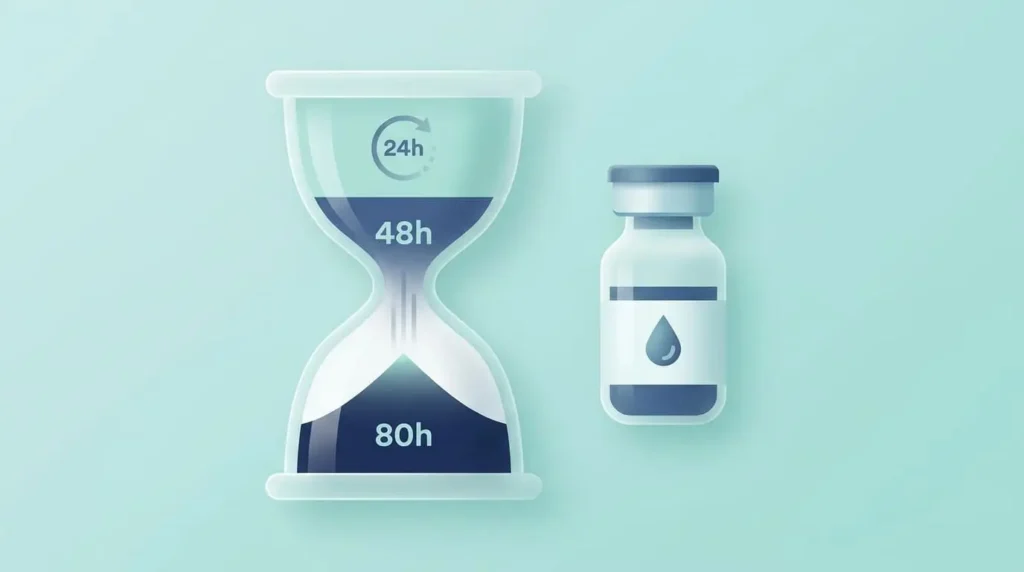
EtG (ethyl glucuronide) is a metabolite your liver produces after processing alcohol. Unlike a breathalyzer, which only catches you while you’re still intoxicated, EtG lingers in urine long after the alcohol itself is gone — which is exactly why it’s used for probation checks, custody evaluations, workplace monitoring, and treatment programs. The detection window most commonly cited is 24 to 80 hours, and the reason that range is so wide comes down to two variables: how much alcohol was consumed, and how sensitive the lab’s cutoff is.
This article breaks down where each number comes from, why credible sources disagree about which one is “real,” and how to reasonably estimate your own window.
What an EtG Test Actually Measures
A breathalyzer or blood alcohol (BAC) test measures alcohol that’s still active in your system — useful for confirming intoxication in the moment, but it clears within 12 to 36 hours as your body metabolizes it.
EtG works differently. As your liver breaks down ethanol, it produces ethyl glucuronide as a byproduct, along with a related compound called ethyl sulfate (EtS). These metabolites don’t cause impairment — they’re simply evidence that alcohol was present in the body recently. Because they clear more slowly than alcohol itself, EtG testing answers a different question: not “are you drunk right now,” but “did you drink at all in the last few days.”
That distinction is why EtG shows up in abstinence monitoring rather than DUI enforcement. Courts use it to verify no-alcohol probation conditions. Family law cases use it in custody disputes. Treatment programs and sober living homes use it to track relapse risk. Employers in safety-sensitive fields — aviation, healthcare, transportation — sometimes fold it into ongoing monitoring programs rather than one-off screening.
Why the Window Isn’t One Number
Here’s the part most articles skip: EtG detection time depends on cutoff level, and the cutoff is set by whoever administers the test — not by some universal standard.
Labs report a result as “positive” only when EtG concentration exceeds a chosen threshold, usually 100, 300, or 500 nanograms per milliliter (ng/mL). A lower cutoff catches smaller traces of alcohol use, which means it stays positive longer. A higher cutoff only flags heavier, more recent exposure, so it clears faster.
| Cutoff Level | Sensitivity | Common Use Case | Approximate Window |
|---|---|---|---|
| 500 ng/mL | Lower sensitivity | Reduces false positives from incidental exposure | ~24–36 hours |
| 300 ng/mL | Moderate | Common in workplace and treatment monitoring | ~24–48 hours |
| 100 ng/mL | Highest sensitivity | Strict abstinence programs (courts, licensing boards) | Up to 72–80 hours in heavy-use cases |
Layer dosage on top of cutoff and the picture gets clearer. One or two drinks tends to clear a 500 ng/mL cutoff within 24 hours. A heavier, multi-day drinking episode tested against a 100 ng/mL cutoff is a genuinely different scenario — and that’s the scenario the “80-hour” figure comes from.
The 80-Hour Debate: Myth, Maximum, or Both?
This is where the internet gets contradictory, and it’s worth addressing directly instead of picking a side and pretending the disagreement doesn’t exist.
Some organizations that run continuous monitoring programs argue the 80-hour window is overstated — in their operational experience, EtG rarely stays detectable past 36 to 40 hours, and they build testing schedules (often every 24 to 48 hours) around that assumption specifically because waiting longer risks missing a drinking event entirely.
Other sources point to clinical research — including a 2020 study by Grodin and colleagues published in Addictive Behaviors Reports, which tested a commercially marketed “80-hour” uEtG product against a community sample of heavy drinkers’ actual reported alcohol use. The product was sold on the premise of detecting drinking up to 80 hours later, and the study found real support for that claim at the edges — it’s genuinely capable of catching some heavier, more recent drinking — even as the same research flagged that accuracy dropped off well before the full 80-hour mark at the manufacturer’s standard cutoff.
Both can be true at once. The disagreement isn’t really about whether 80 hours is possible — it’s about what counts as a “typical” case. Monitoring-program operators are usually describing average, moderate-drinking scenarios at a 500 ng/mL cutoff. Clinical researchers are describing edge cases: heavy or binge drinking tested at 100 ng/mL. Treat 80 hours as a documented upper bound for heavy use under sensitive testing, not a default expectation for one drink on a Tuesday night.
There’s also a data pattern worth understanding if you want a realistic picture rather than a single number. Sensitivity research shows EtG testing catches the large majority of recent drinkers within the first 24 hours, but that detection rate drops off substantially after that — falling well below half by the 24–48 hour mark, and lower still beyond 48 hours. In plain terms: the closer the test happens to the drinking event, the more reliable any given cutoff becomes, and the further out you go, the more the result depends on exactly how much was consumed and how sensitive the lab’s threshold is.
Factors That Push Your Personal Window Longer or Shorter
Two people who had the same three drinks on the same night can produce different results the next morning. Individual variability is real, and it comes from a handful of factors:
- Amount and duration of drinking — a single drink clears faster than a multi-day drinking episode.
- Hydration — affects how concentrated a urine sample is, though it doesn’t speed up actual metabolism (more on this below).
- Liver function — EtG is produced and processed through liver metabolism, so a healthier, faster-working liver clears it sooner.
- Kidney function — EtG is eliminated renally, so reduced kidney function can extend detection.
- Body composition and individual metabolic rate — general variability that affects how any substance is processed.
- The cutoff level chosen by the testing program — still the single biggest factor in what gets reported as “positive.”
EtG itself has a fairly short half-life, roughly two to three hours, meaning concentration drops by about half every few hours. But because a heavy drinking event starts from a much higher initial concentration, it simply takes longer to fall below even a strict cutoff — which is the whole reason detection time scales with dose rather than staying fixed.
A Simple Framework for Estimating Your Own Window
- Find out the cutoff your program uses. This is the most important question you can ask, and testing administrators will usually tell you directly.
- Be honest about the drinking event — one drink, a few drinks, or a multi-day period matters more than any other single factor.
- Account for hydration, but don’t rely on it. Water dilutes a sample’s concentration, but it doesn’t accelerate how fast your body clears EtG — and an overly dilute sample often gets flagged separately as a “dilute” or “invalid” result, which many programs treat as a failure on its own.
- Cross-check against the cutoff table above for a realistic range.
- When the stakes are high — legal, custody, or employment consequences — assume the longer end of the range rather than the shorter one, especially under a 100 ng/mL program.
Manually working through all five steps gets you a rough estimate, but dose, timing, and cutoff interact in ways that are easier to run through a calculator than to eyeball. The EtG calculator at EtG Calculator Hub walks through these same variables — drink count, timing, and cutoff level — and returns a personalized estimate rather than a single blanket number.
EtG vs. Other Alcohol Tests
EtG isn’t the only tool available, and it isn’t always the right one. Here’s how it compares:
| Test | What It Measures | Typical Window |
|---|---|---|
| Breathalyzer (BAC) | Active alcohol impairment | Hours, until BAC returns to zero |
| Blood alcohol test | Active alcohol in bloodstream | ~12–24 hours |
| Urine EtG | Alcohol metabolite (past use) | 24–80 hours |
| Saliva EtG | Recent alcohol metabolite | Up to 12–24 hours |
| Hair EtG | Long-term exposure pattern | Up to 90 days |
| PEth (blood) | Direct alcohol biomarker | 2–4 weeks |
If the goal is confirming whether someone drank in the last few days, urine EtG is the standard choice. If the goal is assessing a longer-term pattern — say, over the last month — PEth or hair testing gives a very different, more panoramic picture. EtS is often run alongside EtG in lab settings as a secondary confirmation marker, since the two metabolites tend to track together and help rule out certain lab-handling false positives.
False Positives and Incidental Exposure
Because EtG at low cutoffs is sensitive to trace amounts of ethanol, a handful of everyday products have been documented as occasional contributors to unexpectedly positive results:
- Alcohol-based hand sanitizer, especially with heavy or repeated use
- Mouthwash containing ethanol
- Certain foods or sauces cooked with wine or liquor
- Some over-the-counter medications or tinctures containing alcohol
If you’re in a strict monitoring program, it’s worth disclosing any ethanol-containing products you use regularly, and switching to alcohol-free versions where possible. This isn’t about hiding anything — it’s about avoiding an avoidable misunderstanding. If you’re unsure whether a specific product or amount could realistically push you over your program’s cutoff, running the numbers through a dedicated EtG detection calculator is a faster gut-check than guessing.
What This Means for Testing Programs and Administrators
For anyone running or overseeing a monitoring program rather than being tested personally, the cutoff decision is really a trade-off. A lower cutoff (100 ng/mL) catches more genuine drinking events but increases the risk of flagging incidental exposure. A higher cutoff (500 ng/mL) reduces false positives but risks missing lighter drinking, particularly if testing isn’t frequent. That’s part of why continuous or frequent monitoring programs often test every 24 to 48 hours — spacing tests too far apart increases the odds a drinking event falls outside the detection window entirely, regardless of which cutoff is used. Typical per-test costs run in the range of $15–$25, with ongoing monitoring programs often totaling a few hundred dollars per month, though exact pricing varies by provider and testing frequency.
Final Takeaway
There’s no single correct answer to “24, 48, or 80 hours” because EtG detection time was never designed to be a fixed number — it’s a range shaped by how much alcohol was consumed and how sensitive the test is set to be. Eighty hours is a real, documented possibility for heavy drinking under a strict cutoff, not a myth invented for marketing — but it’s also not what a typical light-drinking scenario looks like. The most useful thing you can do, whether you’re being tested or administering a program, is confirm the specific cutoff in use and reason from there rather than trusting a single headline number.
Frequently Asked Questions
How long does alcohol stay in your urine for an EtG test? Typically 24 to 80 hours, depending on how much was consumed and which cutoff level the lab or program uses.
Is the 80-hour EtG window real, or is it a myth? It’s real, but it represents an upper-end case — heavy or sustained drinking tested at the most sensitive cutoff (100 ng/mL) — not a typical result for light or moderate drinking.
Can an EtG test detect just one drink? Yes, at sensitive cutoffs a single drink can register, though usually only within the first 24 to 48 hours.
Does drinking water help you pass an EtG test faster? No. Water dilutes the concentration in a sample but doesn’t speed up how your body actually processes EtG, and an overly diluted sample is often flagged separately as invalid.
What’s the difference between EtG and EtS? EtG (ethyl glucuronide) and EtS (ethyl sulfate) are both direct metabolites of alcohol, often tested together because they tend to track each other and can help confirm a result is genuine.
Can hand sanitizer or mouthwash cause a false positive? Heavy or repeated use of alcohol-based hand sanitizer or mouthwash has been documented as a possible cause of low-level positive results, particularly under sensitive cutoffs.
How is EtG different from a breathalyzer test? A breathalyzer measures active alcohol impairment for a matter of hours; EtG detects a metabolite that remains in urine for days after the alcohol itself is gone, making it suited to abstinence monitoring rather than intoxication checks.
Why do different testing programs report different detection windows? Because each program sets its own cutoff level, and that cutoff — more than any other single factor — determines how long a result stays positive.
Conclusion
EtG detection windows vary because the test itself is flexible by design — labs and programs choose a cutoff based on how strict they need to be, and that choice, combined with how much alcohol was actually consumed, produces everything from a same-day negative to an 80-hour positive. Rather than searching for one universal number, the more reliable approach is understanding which cutoff applies to your situation and reasoning from there. If the outcome carries real consequences — legal, professional, or personal — that clarity is worth getting directly from the administering lab or program rather than from a general average.