
EtG Calculator
Estimate urine EtG ranges using drinking details, personal factors, urine dilution, and test cutoff information.
Drinking & personal factors
Estimated EtG concentration range
Central estimate
0 ng/mL
Modeled peak
0 ng/mL
Research-informed concentration window
0 – 0 ng/mL
EtG concentration trend
Why your estimate varies
- Alcohol dose affects the modeled exposure level.
- Drinking duration changes the timing of exposure.
- Body size and sex-related differences affect the population model.
- Hydration and urine dilution can substantially affect measured urine concentration.
- Age and drinking frequency contribute additional uncertainty rather than providing a precise biological correction.
- Laboratory methodology and specimen characteristics can produce results different from a mathematical estimate.
This educational tool should be interpreted alongside published EtG research and laboratory guidance.
National Institute on Alcohol Abuse and Alcoholism (NIAAA) · SAMHSA · CDC Alcohol & Public Health
What Is EtG?
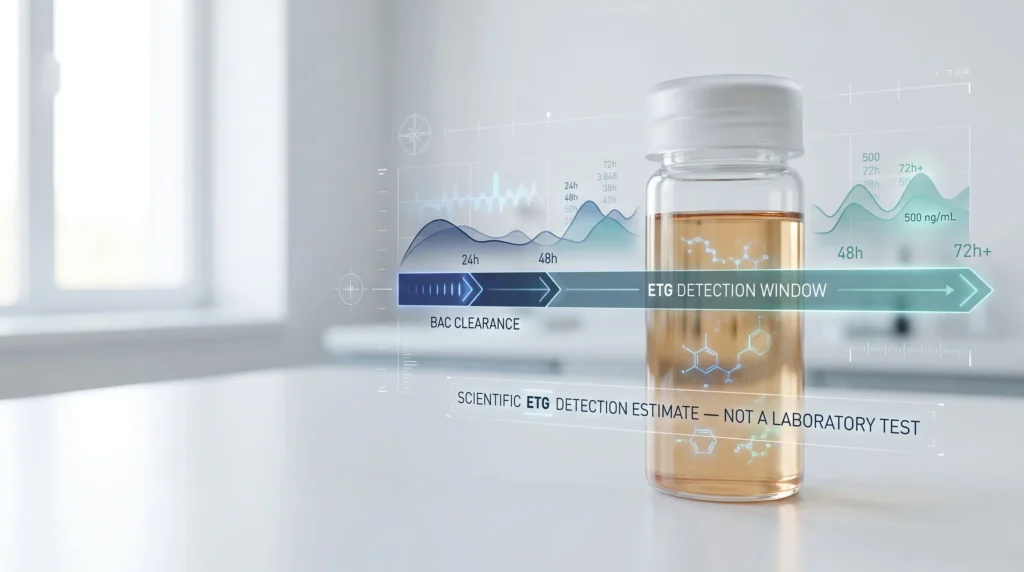
Ethyl glucuronide (EtG) is a byproduct your liver makes when it breaks down alcohol. Alcohol itself clears your bloodstream in about a day — EtG doesn't. It stays measurable in urine much longer, which is why it's the go-to marker for detecting drinking that happened in the recent past, not just current intoxication.
What This EtG Calculator Does
Enter your drinks, body weight, sex, and hours since your last drink, and this EtG calculator models an estimated detection window — how long EtG might still show up in a urine test. It's built on published research patterns, not an analysis of your actual sample, so treat the result as an informed estimate, not a guarantee. Need more input options? Try the Advanced EtG Calculator.
How to Use It
- Standard drinks — your biggest factor.
- Drink type / ABV — or pick Custom for an exact amount.
- Hours since last drink — anchors your whole result.
- Body weight, age, sex — fine-tune the estimate.
- Hydration & test cutoff — match your result to 100 ng/mL, 200 ng/mL, or 500 ng/mL, whichever your test uses.
Reading Your Results
- Detection window — low/high range based on your cutoff.
- Remaining time — how much of that window is left.
- Detection risk — a simple Low/Moderate/High read, not a lab verdict.
Quick Facts
- 1–2 drinks usually clear a standard cutoff within a day or two.
- 6+ drinks in one session often lands in the commonly cited 60–80 hour range.
- Heavy, sustained drinking has been recorded past 90 hours at sensitive cutoffs (Helander et al., 2009).
- Water doesn't speed up clearance — it only dilutes the sample.
- Mouthwash can trigger a positive at sensitive cutoffs (Costantino et al., 2006).
Cutoffs vary by program, especially for probation testing — check your exact threshold with the EtG 100 ng/mL or EtG 300 ng/mL Calculator. Want the decay curve itself? Try the EtG Half-Life Calculator.
How Accurate Is It?
This is a population-based model, not a lab measurement — two people with identical inputs can get different real results. No online calculator, including this one, can predict pass or fail. See how accurate an EtG calculator really is for the full picture. For background on the test itself, NIAAA is a solid starting point.
Disclaimer
Educational tool only — not a medical device, diagnostic test, or legal guidance. Don't use it to make employment, legal, custody, or medical decisions. For anything with real consequences, talk to a certified lab, healthcare provider, or attorney. Full details in our Disclaimer.