
EtG 500 ng/mL Calculator
Enter your drinks and a few details to see your estimated EtG level right now, and whether it’s modeled to be above or below the 500 ng/mL cutoff.
EtG 500 ng/mL Calculator: What This Cutoff Actually Means for You
Not every EtG test is looking for the same thing. Some are built to catch a single drink from two days ago. Others — the ones using a 500 ng/mL cutoff — are built to catch something different: recent, heavier drinking. If that’s the threshold your test uses, our EtG 500 ng/mL calculator is built specifically around it, so you’re not trying to interpret a general-purpose tool against a cutoff it wasn’t designed for.
This guide covers what the 500 ng/mL cutoff actually represents, how it differs from the lower thresholds you’ll see elsewhere on this site, how our calculator estimates your status against it, and what the research says about realistic EtG detection times at this specific level.
Not sure which cutoff applies to you? Check our EtG Cutoff Levels Explained guide first, or try the EtG 100 ng/mL Calculator if your program uses the more sensitive threshold instead.
What Is the EtG 500 ng/mL Calculator?
This tool estimates whether your current EtG level is likely above or below 500 ng/mL, based on your drinks, body weight, biological sex, and hours since your last drink. Rather than giving you a generic detection window, it’s built around one specific, commonly used cutoff — which matters, because the 500 ng/mL threshold behaves quite differently from the more sensitive 100 or 200 ng/mL cutoffs your test might instead be using.
You’ll find this tool useful whether you’re after a quick, realistic EtG calculator for general peace of mind or trying to understand how a specific test result at this cutoff should be interpreted.
What Does the 500 ng/mL Cutoff Actually Mean?
Of the common EtG cutoffs — 100, 200, and 500 ng/mL — 500 is the least sensitive. That’s a deliberate design choice, not a flaw. Lower cutoffs are more likely to flag light drinking, incidental exposure, or alcohol consumed a day or two earlier. A 500 ng/mL cutoff is set high enough to filter most of that out, which means a positive result at this threshold generally points to something more specific: recent, heavier drinking.
This isn’t just a general impression — it’s a documented research finding. A study examining EtG cutoffs specifically found that a threshold around 500 ng/mL was likely to detect only heavy drinking that occurred within roughly the previous day, rather than the wider multi-day window associated with the more sensitive 100 ng/mL cutoff (McDonell et al., 2015, Drug and Alcohol Dependence). That single finding is the backbone of how this calculator’s 500 ng/mL logic is built.
How Our EtG 500 ng/mL Calculator Works
The calculator uses your standard drink count, body weight, and biological sex to estimate whether your session looks more like “light-to-moderate” drinking or a heavy drinking episode, using the same general threshold researchers use: more than 4 drinks in a session for men, or more than 3 for women (a standard definition used across alcohol research, including the McDonell et al. cutoff study referenced above).
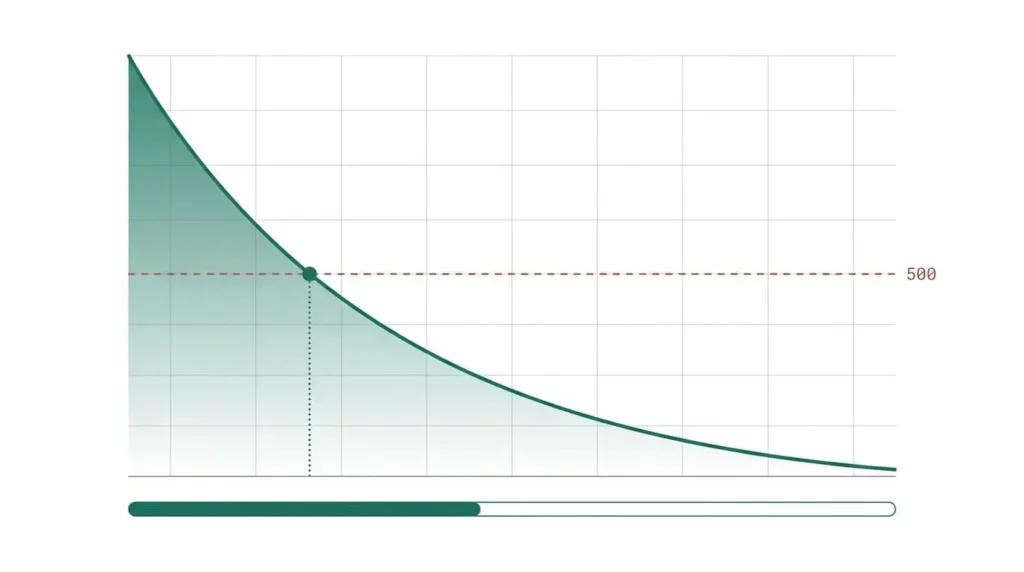
Below that threshold, your estimated level is modeled to stay near or under 500 ng/mL, consistent with research showing this cutoff isn’t reliably triggered by light or moderate drinking. At or above that threshold, the model estimates an initial period above 500 ng/mL, generally clearing within roughly a day for a single heavy session — in line with the “previous day” pattern described in the cutoff research — and extending somewhat longer for heavier or more concentrated drinking. Your body weight and biological sex adjust this estimate using the same alcohol distribution principle (the Widmark method) used throughout pharmacology to account for how the same dose spreads differently through different bodies (Jones, 2019, WIREs Forensic Science).
This is a transparent, research-informed simplification — not a validated clinical formula. No published, peer-reviewed formula converts “drinks + weight + sex” into an exact EtG concentration, because real EtG levels are also shaped by hydration, individual metabolism, and lab-specific assay behavior, none of which a calculator can see. What this tool aims for is a realistic, defensible pattern — matching what research on this specific cutoff has actually found — rather than false precision dressed up as a lab result.
EtG 500 Detection Time: What the Research Shows
Realistic EtG detection times at the 500 ng/mL cutoff vary quite a bit depending on the drinking pattern involved:
- Light-to-moderate drinking (under the heavy-drinking-day threshold): generally does not reliably cross 500 ng/mL at all, or only briefly.
- A single heavy drinking day: research indicates detection at this cutoff typically corresponds to roughly the previous day’s drinking (McDonell et al., 2015).
- Sustained or repeated heavy drinking: clinical studies following alcohol-dependent patients through detoxification recorded EtG detection times at cutoffs including 500 ng/mL ranging from around 40 to 130 hours, with a median in the 66–78 hour range depending on how the detection window was calculated (Helander et al., 2009, Alcohol and Alcoholism). This population reflects sustained heavy drinking, not a single session — worth keeping in mind if your situation involves several heavy days in a row rather than one.
This is a useful contrast to the 100 ng/mL cutoff, where much lighter and older drinking can still register — see our How Long Does EtG Stay in Your Urine? guide for that comparison in more depth.
Who Uses the 500 ng/mL Cutoff?
Cutoff choice is entirely program-specific — a court, probation office, employer, or treatment program each sets its own policy, and this calculator has no way of knowing which one applies to your particular situation. In general, programs that want to specifically flag heavier or more recent drinking — rather than catching any incidental or light exposure — are the ones more likely to use a 500 ng/mL threshold rather than a more sensitive one. If you’re navigating an EtG cutoff for probation specifically, the safest approach is always to confirm the exact policy with your program directly rather than assuming based on general research patterns.
Factors That Affect Your Result
- Number of drinks — the primary driver. Crossing the heavy-drinking-day threshold (4+ for men, 3+ for women in one session) is the main factor separating a likely-negative from a likely-positive result at this cutoff.
- Time since your last drink — the further out you are, the more likely your estimated level has already declined below 500 ng/mL.
- Body weight and biological sex — affect how a given amount of alcohol is distributed through the body, shifting the estimate up or down.
- Metabolic rate — individual variation in how quickly EtG clears means two people with identical drinking patterns can land at meaningfully different points on the curve.
- Hydration — can dilute a urine sample and lower its measured concentration, but doesn’t actually speed up how quickly your body eliminates EtG. This is a distinction worth understanding, not a strategy — see our note on this in the How Accurate Is an EtG Calculator? guide.
Frequently Asked Questions
Is 500 ng/mL a high or low EtG cutoff? It’s the least sensitive of the commonly used cutoffs (100, 200, and 500 ng/mL), meaning it takes more alcohol, or more recent alcohol, to trigger a positive result compared to the lower thresholds.
Can one drink trigger a positive at the 500 ng/mL cutoff? It’s unlikely for most people, based on research showing this cutoff generally requires heavier drinking to reliably cross. It isn’t impossible for every individual in every circumstance, but it’s a meaningfully different picture than at a 100 ng/mL cutoff.
How long does EtG stay above 500 ng/mL after heavy drinking? Research on a single heavy drinking day points to roughly the previous day as the typical window, while studies of sustained heavy drinking during detoxification have recorded detection extending considerably further, up to around 130 hours in some cases (Helander et al., 2009).
Is this calculator accurate for probation or court-ordered testing? It’s an educational estimate, not a program-specific compliance tool. Cutoff policy varies by program, and only your specific testing organization can confirm what applies to your situation.
Why does this calculator differ from the general EtG Calculator? The general EtG Calculator models a range across multiple cutoffs at once. This tool is built around the 500 ng/mL threshold specifically, using research findings that apply to that cutoff in particular rather than a broader average.
What if my test uses a different cutoff? Try our EtG 100 ng/mL Calculator for the more sensitive threshold, or the EtG Cutoff Levels Explained guide to understand which one might apply to you.
Sources
- McDonell, M. G., Skalisky, J., Leickly, E., McPherson, S., Battalio, S., Nepom, J. R., Srebnik, D., Roll, J., & Ries, R. K. (2015). Using ethyl glucuronide in urine to detect light and heavy drinking in alcohol dependent outpatients. Drug and Alcohol Dependence, 157, 184–187. https://pmc.ncbi.nlm.nih.gov/articles/PMC4663163/
- Helander, A., Böttcher, M., Fehr, C., Dahmen, N., & Beck, O. (2009). Detection times for urinary ethyl glucuronide and ethyl sulfate in heavy drinkers during alcohol detoxification. Alcohol and Alcoholism, 44(1), 55–61. https://pubmed.ncbi.nlm.nih.gov/18971292/
- Høiseth, G., Bernard, J. P., Karinen, R., et al. (2007). A pharmacokinetic study of ethyl glucuronide in blood and urine: applications to forensic toxicology. Forensic Science International. https://pubmed.ncbi.nlm.nih.gov/17306943/
- Jones, A. W. (2019). Alcohol, its absorption, distribution, metabolism, and excretion in the body and pharmacokinetic calculations. WIREs Forensic Science, 1(5), e1340. https://doi.org/10.1002/wfs2.1340
Related Tools
- EtG Calculator
- Advanced EtG Calculator
- EtG 100 ng/mL Calculator
- EtG 300 ng/mL Calculator
- EtG Half-Life Calculator
Learn More
- EtG Cutoff Levels Explained
- How Long Does EtG Stay in Your Urine?
- How Accurate Is an EtG Calculator?
Educational estimate only. This calculator and article model generalized patterns based on published research and do not predict the result of a certified laboratory test. This is not medical, legal, or professional advice — consult a qualified professional or certified testing laboratory, or your specific testing program, for anything that depends on an actual test outcome.