
Methadone & EDDP Clearance Calculator
Scientifically estimate urinary clearance times, steady-state trough levels, and EDDP metabolite detection windows for methadone maintenance therapy (MMT) and standard drug screens.
Regimen & Patient Parameters
Pharmacokinetic Analysis & Screen Status
⚕ The Clinic EDDP Compliance Ratio
Methadone clinics specifically quantify EDDP (2-ethylidene-1,5-dimethyl-3,3-diphenylpyrrolidine) alongside parent methadone. Because EDDP can only be formed in vivo by hepatic cytochrome P450 enzymes (CYP3A4/CYP2B6), spiking a urine cup with raw methadone produces high parent methadone with 0 ng/mL of EDDP, triggering an immediate positive flag for sample tampering or specimen diversion.
⚠ Urinary pH Acceleration & Trapping
Methadone has a high pKa of 8.6. In acidic urine (pH ≤ 5.2), nearly 99% of methadone molecules become positively ionized ($\text{R}_3\text{NH}^+$), making them lipid-insoluble and preventing passive reabsorption across the renal tubular epithelium. Highly acidic urine can increase methadone renal clearance by up to 300% to 400% compared to alkaline urine.
Does Methadone Show on Standard Workplace Drug Tests?
Methadone Clearance Calculator
Whether you are participating in an Opioid Treatment Program (OTP), undergoing pain management monitoring, or preparing for an employment or forensic screening, understanding how methadone and its primary metabolite, EDDP, clear from the human body is essential. Unlike short-acting prescription opioids such as oxycodone or hydrocodone, methadone possesses a complex, lipophilic pharmacokinetics profile characterized by extensive tissue storage, a biphasic elimination curve, and profound susceptibility to urinary pH fluctuations.
Use the interactive Methadone & EDDP Clearance Calculator above to model your specific clearance timeline based on dose, chronic maintenance vs. acute exposure, urinary pH, and hepatic enzyme speed.
1. How Long Does Methadone Stay in Your System?
The detection window of methadone is primarily determined by whether the individual has taken an isolated dose or is on a chronic, daily maintenance regimen.
Chronic Daily Maintenance Therapy (MMT)
When taken daily (typically at stabilized doses between 40 mg and 120 mg/day), methadone accumulates extensively in lipid-rich compartments and deep tissue reservoirs throughout the liver, lungs, and adipose tissue. This reservoir creates a constant, slow-release equilibrium back into the systemic circulation.
- Urine: 5 to 7 days after the final dose under standard metabolic conditions, extending up to 10 to 14 days in slow metabolizers or individuals with persistently alkaline urine.
- Blood / Serum: 3 to 5 days (therapeutic trough concentrations typically range between 150 and 600 ng/mL).
- Saliva / Oral Fluid: 24 to 48 hours.
- Hair Follicles: Up to 90 days (standard 1.5-inch proximal head hair segment).
Acute or Single-Dose Exposure
In opioid-naive individuals or those taking an isolated, single analgesic dose:
- Urine: 2 to 4 days before both parent drug and EDDP fall below standard immunoassay cutoffs.
- Blood / Serum: 24 to 48 hours.
- Saliva: 12 to 24 hours.
2. Why Methadone Clinics Specifically Test for EDDP (The Tampering Trap)
In Opioid Treatment Programs (OTPs) and addiction medicine clinics, laboratory protocols routinely screen for both parent methadone and EDDP (2-ethylidene-1,5-dimethyl-3,3-diphenylpyrrolidine). Understanding why this metabolite is prioritized is critical for compliant patients.
The In Vivo Conversion Requirement
Methadone cannot spontaneously degrade into EDDP outside the body. EDDP is formed exclusively through the oxidative N-demethylation of methadone by hepatic cytochrome P450 enzymes (predominantly CYP3A4, CYP2B6, and CYP2C19), followed by immediate spontaneous cyclization.
Methadone
   │
   ▼ (CYP3A4 & CYP2B6 N-Demethylation)
Normethadone (Unstable intermediate)
   │
   ▼ (Spontaneous Intramolecular Cyclization)
EDDP (Primary Urinary Compliance Biomarker)
Specimen Tampering & “Spiking” Detection
A common method of drug test falsification involves an individual adding a few drops of their liquid take-home methadone dose directly into a clean urine specimen to feign compliance.
Clinical toxicologists instantly identify this diversion:
- Legitimate Ingestion (Compliant Patient): Both parent methadone and significant levels of EDDP are present in urine. The EDDP concentration often exceeds that of parent methadone, especially 12 to 24 hours post-dose.
- Spiked / Adulterated Specimen: Extremely high concentrations of parent methadone are detected (often > 10,000 ng/mL) with 0 ng/mL of EDDP. This discordant pattern triggers an immediate laboratory flag for specimen tampering or diversion.
| Clinical Finding | Parent Methadone Level | EDDP Metabolite Level | Diagnostic Interpretation |
|---|---|---|---|
| Compliant Maintenance | Detected (> 300 ng/mL) | Detected (> 100 ng/mL) | Normal, genuine ingestion and hepatic biotransformation. |
| Late Elimination Phase | Negative (< 300 ng/mL) | Detected (> 100 ng/mL) | Drug is washing out; longer-lived EDDP remains above threshold. |
| Suspected Cup Spiking | Massively High (> 5,000 ng/mL) | Absent (0 ng/mL) | Specimen adulterated with raw methadone; non-compliance flag. |
| Rapid CYP Metabolizer | Low / Trace | Substantially Elevated | Patient may suffer withdrawal before 24h trough; may need split dosing. |
3. The Renal pH “Ion-Trapping” Phenomenon
Methadone is a lipid-soluble, basic tertiary amine with an acid dissociation constant (pKa) of 8.6. Because this pKa is close to biological pH ranges, subtle alterations in the acidity or alkalinity of urine dramatically change how the kidneys filter and eliminate the drug.
Acidic Urine (pH < 5.5) Accelerates Clearance
According to the Henderson-Hasselbalch principle, when the surrounding urinary fluid is acidic, basic methadone molecules accept hydrogen ions and become positively charged cations ($\text{R}_3\text{NH}^+$). Ionized molecules cannot cross lipid membranes:
- Renal tubular reabsorption is effectively blocked.
- Up to 30% to 40% of an administered methadone dose is cleared unchanged in the urine within 24 hours (compared to just 3% to 5% under alkaline conditions).
- Result: Elimination half-life drops significantly, and urine detection windows shorten.
Alkaline Urine (pH > 7.5) Prolongs Detection
When urine is alkaline (often caused by vegetarian diets, antacids, or sodium bicarbonate):
- Methadone molecules remain non-ionized and highly lipid-soluble.
- As glomerular filtrate passes through the distal convoluted tubules, methadone passively diffuses back across the tubular epithelium and returns to systemic circulation.
- Result: Renal excretion plummets, systemic half-life prolongs, and urinary clearance is delayed by several days.
4. Standard Drug Screen Panels and Cutoff Thresholds
A frequent source of anxiety is whether methadone will trigger a positive result on standard employment drug screens.
Does Methadone Show on a Standard 5-Panel Test?
No. A standard 5-panel drug screen targets natural and semi-synthetic opiates (morphine, codeine, and heroin via 6-acetylmorphine) calibrated to antibodies targeting the morphinan chemical skeleton. Because methadone is a synthetic opioid belonging to the diphenylheptane class, it produces zero cross-reactivity with standard opiate immunoassay strips.
Which Tests Screen for Methadone?
Methadone detection requires a specialized immunoassay strip (marked MTD):
- Expanded 10-Panel and 12-Panel Tests: Commonly utilized in law enforcement, healthcare staffing, DOT expanded panels, and probation departments.
- Opioid Treatment Program (OTP) Specialized Panels: Include dual test channels for parent methadone and EDDP.
Standard Clinical Cutoff Levels
| Assay Type | Target Analyte | Screening Cutoff | Confirmatory Cutoff (LC-MS/MS) |
|---|---|---|---|
| SAMHSA Federal Screen | Methadone | 300 ng/mL | 100 ng/mL |
| OTP Compliance Panel | EDDP | 100 ng/mL | 50 ng/mL |
| Confirmatory Mass Spec | EDDP & Methadone | 100 ng/mL | 25 – 50 ng/mL |
| Pain Management Screen | Methadone + EDDP | 50 ng/mL | 25 ng/mL |
5. Pharmacokinetic Profile: Peak vs. Trough Levels
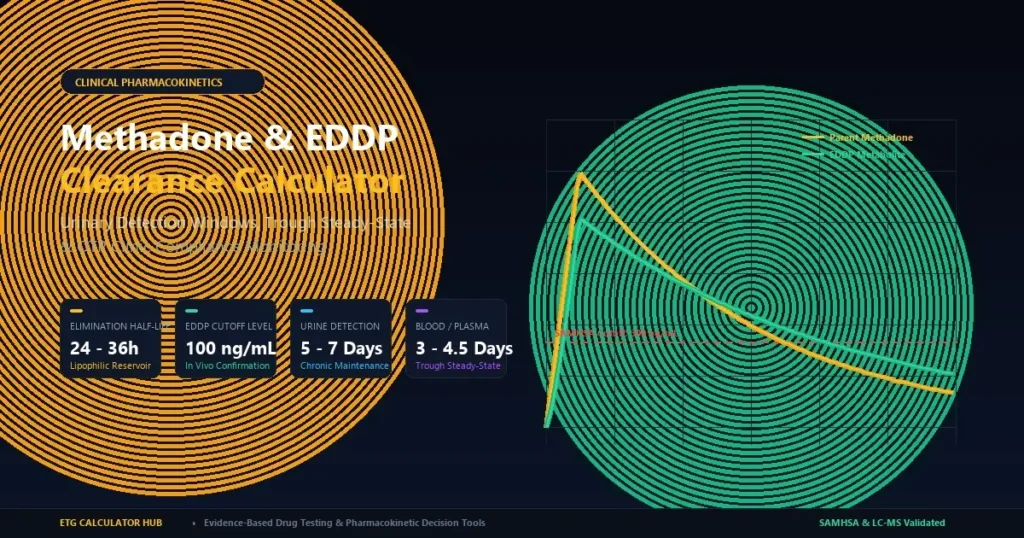
Methadone has an unusually long and variable elimination half-life, ranging from 15 to 60 hours across individuals (with a clinical population mean of 24 to 36 hours).
Dose Ingestion (Oral)
   │
   ├── Peak Plasma Concentration (Tmax): 2.5 to 4.5 Hours Post-Dose
   ├── Alpha Distribution Phase: Rapid transfer to liver, brain, fat (t½α ~ 2–3 Hours)
   ├── Beta Elimination Phase: Slow systemic release from tissue stores (t½β ~ 24–36 Hours)
   └── Trough Concentration (Cmin): Measured at 24 Hours (just prior to next dose)
Factors Altering Clearance Speed
- CYP3A4 and CYP2B6 Inducers: Medications such as rifampin, carbamazepine, phenytoin, and St. John’s Wort induce cytochrome enzymes, accelerating methadone breakdown and potentially precipitating acute opioid withdrawal.
- CYP Inhibitors: Antifungals (fluconazole, voriconazole), cimetidine, fluvoxamine, and heavy grapefruit juice consumption inhibit clearance, elevating plasma levels and prolonging detection times.
- Hepatic Impairment: Because the liver accounts for more than 80% of methadone clearance, advanced cirrhosis or severe hepatitis slows elimination, leading to significant drug accumulation.
- Hydration and Creatinine: Highly diluted urine may temporarily bring metabolite concentrations below screening thresholds; however, specimen validity testing will flag low creatinine (< 20 mg/dL) or abnormal specific gravity as a dilute or invalid sample.
6. Comprehensive Detection Windows by Biological Matrix
| Biological Specimen | Detection Window (Single Dose) | Detection Window (Maintenance / Chronic) | Clinical Purpose |
|---|---|---|---|
| Urine (Immunoassay) | 2 – 4 Days | 5 – 7+ Days (up to 14 days) | Standard workplace, OTP compliance, and probation testing. |
| Blood / Serum | 24 – 48 Hours | 3 – 5 Days | Therapeutic drug monitoring, overdose evaluation, fatal toxicology. |
| Saliva / Oral Fluid | 12 – 24 Hours | 24 – 48 Hours | Roadside sobriety checkpoints, observed point-of-care testing. |
| Hair Follicles | Not recommended for single dose | Up to 90 Days | Long-term history, child custody, forensic evaluations. |
7. Frequently Asked Questions
Can I fail a drug test for opiates if I take methadone?
No. Methadone does not cross-react with standard opiate immunoassay tests. You will only test positive if the panel specifically contains an MTD (Methadone) or EDDP test strip.
Why is my EDDP positive but methadone negative?
This is a standard pharmacokinetic occurrence during late-stage elimination or in rapid metabolizers. Methadone has a shorter half-life in urine than EDDP. As the parent drug clears below the 300 ng/mL threshold, the EDDP metabolite can persist above its 100 ng/mL cutoff for an additional 24 to 72 hours. In an addiction clinic setting, this confirms compliance.
How much water should I drink to clear methadone?
While maintaining proper hydration supports kidney filtration, drinking excessive volumes of water will not accelerate the enzymatic clearance of methadone by the liver. Furthermore, over-hydrating right before a urine test risks a “Negative-Dilute” result, which employers and probation departments typically treat as a presumed positive or require immediate re-testing. Use our Urine Dilution & Creatinine Calculator to check hydration safety parameters.
What is the therapeutic blood level for methadone maintenance?
In opioid treatment programs, the consensus therapeutic trough plasma level (drawn 24 hours after the last dose) is generally accepted to be between 150 ng/mL and 400 ng/mL, with some patients requiring up to 600 ng/mL to fully suppress opioid cravings and eliminate withdrawal symptoms.
Scientific References & Clinical Guidelines
- Substance Abuse and Mental Health Services Administration (SAMHSA). Clinical Guidelines for the Use of Buprenorphine and Methadone in the Treatment of Opioid Addiction. Treatment Improvement Protocol (TIP) Series 43. HHS Publication No. (SMA) 04-3939.
- Ferrari, A., Coccia, C. P., Bertolini, A., & Sternieri, E. (2004). Methadone—metabolism, pharmacokinetics and interactions. Pharmacological Research, 50(6), 551-559.
- George, S., & Braithwaite, R. A. (2002). Use of the EMIT II immunoassay for the detection of methadone and its primary metabolite (EDDP) in human urine. Annals of Clinical Biochemistry, 39(1), 70-72.
- Nilsson, M. I., Widman, M., & Änggård, E. (1982). Effect of urinary pH on the dispositions of methadone in man. European Journal of Clinical Pharmacology, 22(4), 337-342.
- Preston, K. L., Epstein, D. H., & Cone, E. J. (2001). Methadone and metabolite urine concentrations in patients maintained on methadone. Journal of Analytical Toxicology, 25(7), 548-554.