
Ritalin Clearance Calculator
Estimate urinary detection times, elimination half-lives, and metabolite clearance for Ritalin (Immediate-Release) and Concerta (OROS Extended-Release) based on dose, CES1 metabolism, and testing panel.
Formulation & Patient Inputs
Pharmacokinetic Clearance Results
Adjust the inputs to estimate the elimination timeline.
| Testing Matrix | Target Analyte | Detection Window | Your Status |
|---|---|---|---|
| Standard 5 / 10-Panel | Not Included | Not tested | Not Tested |
| Dedicated MPH Urine | Ritalinic Acid (cutoff) | — | — |
| Blood / Plasma | Parent MPH (10 ng/mL) | — | — |
| Saliva Swab | Parent MPH (5 ng/mL) | — | — |
| Hair Follicle Test | Parent MPH (Specialty) | Up to 90 Days | Specialty Lab |
CES1 Hepatic Hydrolysis Mechanics
Unlike Adderall (amphetamine), which depends on CYP2D6 oxidation and urinary pH for renal excretion, methylphenidate is cleared mainly by non-CYP enzymatic hydrolysis through liver carboxylesterase-1 (CES1). Over 80% of an oral dose becomes the inactive metabolite ritalinic acid (alpha-phenyl-2-piperidineacetic acid), which is water-soluble and cleared by the kidneys.
The Concerta OROS Delivery Difference
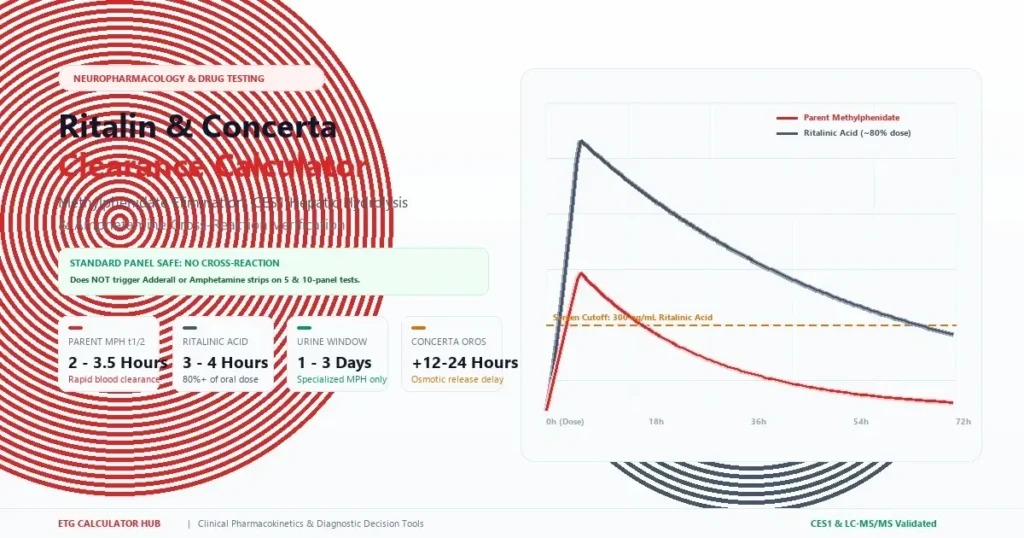
Standard IR Ritalin shows a single sharp peak at 1.5 to 2.5 hours. Concerta uses an Osmotic-controlled Release Oral delivery System (OROS): an immediate-release overcoat delivers about 22% of the dose quickly, while osmotic pressure pushes the remaining 78% through a laser-drilled hole over 10 to 12 hours. This delays peak excretion and extends urinary detection by roughly 12 to 24 hours compared with immediate-release.
Ritalin (Methylphenidate) Clearance Times & Detection Windows: Complete Pharmacology Guide
Whether prescribed Ritalin (immediate-release methylphenidate) or Concerta (OROS extended-release) for ADHD, narcolepsy, or cognitive performance, patients and individuals facing workplace or athletic drug screenings frequently ask: “How long does Ritalin stay in my urine — and will it trigger an Amphetamine or Adderall failure?”
The clinical answer brings immense relief to patients: Methylphenidate is chemically distinct from amphetamines and produces zero cross-reactivity on standard workplace drug screens.
Use the interactive Ritalin Clearance Calculator above to model your specific dose, formulation (IR vs. Concerta OROS), alcohol co-ingestion factors, and testing cutoff windows.
1. How Long Does Ritalin Stay in Your System?
Detection windows depend heavily on whether you are taking immediate-release tablets or long-acting osmotic formulations:
| Diagnostic Matrix | Standard 5/10-Panel Test | Dedicated Methylphenidate Screen | Laboratory Cutoff Threshold |
|---|---|---|---|
| Standard Workplace Urine | 0 Days (NOT TESTED) | N/A | No cross-reaction with amphetamines |
| Dedicated Urine Screen (IR) | N/A | 1 to 2.5 Days (24 to 60 Hours) | 300 ng/mL (Ritalinic Acid) |
| Dedicated Urine Screen (Concerta) | N/A | 2 to 3.5 Days (48 to 84 Hours) | 300 ng/mL (Ritalinic Acid) |
| Blood / Plasma Screen | 0 Days (Not Tested) | 12 to 24 Hours | 10 ng/mL (Parent MPH) |
| Oral Fluid / Saliva Swab | 0 Days (Not Tested) | 12 to 36 Hours | 5 ng/mL (Parent MPH) |
| Hair Follicle Analysis | 0 Days (Not Tested) | Up to 90 Days | Specialized private lab panels |
Primary Takeaway: On standard pre-employment, corporate, and federally mandated DOT 5-panel drug screenings, Ritalin is not tested and will return 100% negative. It only appears on specialized panels that explicitly contain a dedicated “MPH” or “MPD” immunoassay strip.
2. Ritalin vs. Adderall: The Critical Drug Testing Difference
The most pervasive misconception in prescription drug testing is the belief that Ritalin and Adderall trigger the same drug screen result:
Adderall / Vyvanse / Dexedrine
   └── Chemical Class: Phenethylamine (Amphetamine)
   └── Standard 5-Panel Result: POSITIVE (AMP Strip, 500 ng/mL)

Ritalin / Concerta / Focalin
   └── Chemical Class: Piperidine Derivative (Methylphenidate)
   └── Standard 5-Panel Result: NEGATIVE (Zero Cross-Reactivity)
Why Ritalin Does Not Trigger Amphetamine Strips
Commercial rapid immunoassay test cups (such as SAMHSA-5 and corporate 10-panel cups) use polyclonal or monoclonal antibodies engineered to bind specifically to the phenethylamine core structure of amphetamine and methamphetamine.
Methylphenidate has a piperidine ring fused to a phenylacetate group. Because its molecular geometry is completely different:
- It produces 0% cross-reactivity with amphetamine antibodies.
- It will never cause a false-positive on an Adderall, Methamphetamine, or MDMA test strip.
- To detect Ritalin, a toxicology laboratory must order a specialized, dedicated reagent strip specifically targeted to methylphenidate or its urinary metabolite, ritalinic acid.
3. Immediate-Release (Ritalin) vs. Concerta OROS Pharmacokinetics
The formulation of methylphenidate significantly alters how quickly it peaks and clears:
Immediate-Release Ritalin (10 mg, 20 mg)
- Absorption: Rapidly absorbed from the gastrointestinal tract.
- Peak Plasma Level ($T_{\text{max}}$): Reaches peak blood concentrations in 1.5 to 2.5 hours.
- Duration of Clinical Action: 3 to 5 hours.
- Elimination Half-Life ($t_{1/2}$): 2.0 to 3.5 hours.
- Clearance Window: 90% of the dose is metabolized and eliminated within 24 to 48 hours.
Concerta (OROS Extended-Release: 18 mg, 36 mg, 54 mg)
Concerta utilizes the patented Alza OROS (Osmotic-controlled Release Oral delivery System):
- Immediate Overcoat (22%): Dissolves upon ingestion to provide rapid onset within 1 hour.
- Osmotic Push Compartment (78%): Moisture in the gastrointestinal tract expands an internal osmotic polymer push-layer, continuously extruding methylphenidate through microscopic laser-drilled orifices over 10 to 12 hours.
- Ascending Profile: Peak blood concentrations do not occur until 6 to 8 hours post-ingestion.
- Clearance Window: Because drug release continues throughout the day, the elimination curve is shifted forward by 12 to 24 hours, keeping urine levels detectable for 48 to 84 hours (2 to 3.5 days).
4. CES1 Hepatic Hydrolysis & The Dominant Ritalinic Acid Metabolite
Unlike amphetamines—which rely heavily on Cytochrome P450 enzymes (specifically CYP2D6)—methylphenidate is cleared through non-CYP enzymatic pathways:
- Carboxylesterase-1 (CES1): Upon absorption, liver CES1 enzymes rapidly hydrolyze the ester bond of methylphenidate.
- Ritalinic Acid Formation: Over 80% of an oral dose is converted into ritalinic acid ($\alpha$-phenyl-2-piperidineacetic acid).
- Metabolite Properties: Ritalinic acid is completely inactive at dopamine and norepinephrine transporters, producing zero psychological stimulation.
- Urinary Recovery: Less than 1% to 3% of a dose is excreted as unchanged parent methylphenidate; the remaining 80%+ is eliminated in urine as water-soluble ritalinic acid ($t_{1/2} \approx 3.0 – 4.0\text{h}$).
Because parent methylphenidate disappears from urine within 12 to 24 hours, forensic and clinical drug tests target ritalinic acid to establish recent use.
5. The Alcohol Interaction: Transesterification to Ethylphenidate
A critical pharmacokinetic variable included in our calculator is co-ingestion of alcohol (ethanol):
When alcohol is consumed alongside Ritalin or Concerta, the liver enzyme carboxylesterase-1 (CES1) undergoes a reverse transesterification reaction:
- Instead of hydrolyzing methylphenidate to inactive ritalinic acid, CES1 combines the drug with ethanol to synthesize ethylphenidate.
- Pharmacological Impact: Ethylphenidate is an active central nervous system stimulant with potent dopamine reuptake inhibition.
- Clearance Impact: This interaction reduces the clearance rate of parent methylphenidate, increasing peak plasma concentrations by approximately 40% and extending the urinary elimination window by up to 24 hours.
6. Testing Cutoff Levels & Prescription Protections
When an expanded or specialized drug screen is performed, the following cutoffs apply:
| Screening Type | Target Analyte | Initial Screen Cutoff | Confirmatory Cutoff (LC-MS/MS) |
|---|---|---|---|
| SAMHSA Workplace 5-Panel | Not Tested | N/A | N/A |
| Commercial 10 / 12-Panel | Not Tested | N/A | N/A |
| Specialized MPH Immunoassay | Ritalinic Acid | 300 ng/mL | 100 ng/mL |
| Pediatric / Pain Management | Ritalinic Acid | 100 ng/mL | 50 ng/mL |
| Confirmatory Mass Spec | Methylphenidate & Ritalinic Acid | 50 ng/mL | 20 ng/mL |
Your Legal Rights Under ADA Prescription Protection
If an employer or athletics organization orders a specialized panel that detects methylphenidate:
- A certified Medical Review Officer (MRO) will contact you prior to reporting any result.
- Providing proof of a valid prescription for Ritalin, Concerta, or Focalin issued by a licensed physician results in the MRO reporting your test as “PASSED / NEGATIVE” to your employer.
- Under the Americans with Disabilities Act (ADA), employers cannot terminate or refuse to hire an individual for legally taking prescribed medication for a diagnosed medical condition.
7. Frequently Asked Questions
Can Ritalin trigger a false positive for cocaine?
No. While methylphenidate and cocaine share a similar pharmacological mechanism of action (both block dopamine reuptake transporters), their chemical structures are distinct (piperidine vs. tropane alkaloid). Ritalin does not cross-react with benzoylecgonine cocaine test strips.
How can I speed up Ritalin elimination?
Because methylphenidate is cleared primarily by liver CES1 enzymatic hydrolysis rather than direct renal tubular filtration, altering urinary pH (unlike with amphetamines) has only a minor effect on clearance. Staying hydrated supports kidney excretion of ritalinic acid, but excessive over-hydration risks a “Negative-Dilute” specimen invalidation. Use our Urine Dilution & Creatinine Calculator to maintain safe specimen parameters.
How long does Focalin stay in urine?
Focalin contains dexmethylphenidate (the active d-threo enantiomer of racemic methylphenidate). It follows nearly identical metabolic pathways via CES1 to d-ritalinic acid, with a urine detection window of 1 to 2.5 days (24 to 60 hours).
Scientific Studies & Clinical References
- Markowitz, J. S., Zhu, H. J., & Patrick, K. S. (2013). The role of carboxylesterase 1 in the metabolism of methylphenidate: clinical implications. Journal of Clinical Psychopharmacology, 33(5), 651-659.
- Patrick, K. S., Straughn, A. B., Minhinnett, R. R., Yeatts, S. D., & Malcolm, R. J. (2007). Hydrolysis of methylphenidate by human carboxylesterase 1: implications for drug interactions and alcohol co-ingestion. Pharmacotherapy, 27(10), 1362-1371.
- Modi, N. B., Wang, B., & Gupta, S. K. (2000). Single-dose and steady-state pharmacokinetics of an oral extended-release osmotic system formulation of methylphenidate (Concerta). Journal of Clinical Pharmacology, 40(4), 379-388.
- Substance Abuse and Mental Health Services Administration (SAMHSA). Federal Workplace Drug Testing Mandatory Guidelines. HHS Publication. SAMHSA.gov.
- Wong, C. G., & Smith, M. L. (2006). Comparison of immunoassay and GC-MS for detection of methylphenidate and ritalinic acid in urine specimens. Journal of Analytical Toxicology, 30(2), 125-131.