If you are scheduled for an upcoming drug and alcohol screening, the question “Will I pass my EtG test?” is likely creating immense anxiety. Whether the test is court-mandated, required for probation compliance, necessary for professional licensing, or tied to a workplace screening, the stakes could not be higher.
The internet is saturated with conflicting myths—ranging from the infamous “80-hour test” rule to claims that drinking gallons of cranberry juice or taking niacin can flush metabolites overnight. To accurately evaluate your personal probability of passing or failing, you need to understand the underlying pharmacology of Ethyl Glucuronide (EtG).
💡 Quick Calculation: Before reading the clinical breakdown below, you can run your personal numbers through our research-based EtG Pass/Fail Predictor to see your estimated concentration and confidence range across 100, 300, and 500 ng/mL cutoffs.
What Exactly Is an EtG Urine Test?
When you consume an alcoholic beverage, your liver oxidizes approximately 95% to 98% of the ethanol into acetaldehyde and acetate via alcohol dehydrogenase (ADH) enzymes. However, a minor non-oxidative metabolic pathway accounts for roughly 0.02% to 0.06% of the ingested ethanol.
In this secondary pathway, UDP-glucuronosyltransferase enzymes conjugate ethanol with glucuronic acid to produce Ethyl Glucuronide (EtG) and Ethyl Sulfate (EtS).
Unlike ethanol—which evaporates through the lungs and clears from blood and breath within hours—EtG is a highly water-soluble, non-volatile molecule. It is filtered by the kidneys and concentrates in the urinary bladder, providing an extended biological window to detect past alcohol consumption long after you are sober.
The 80-Hour Myth vs. Clinical Reality
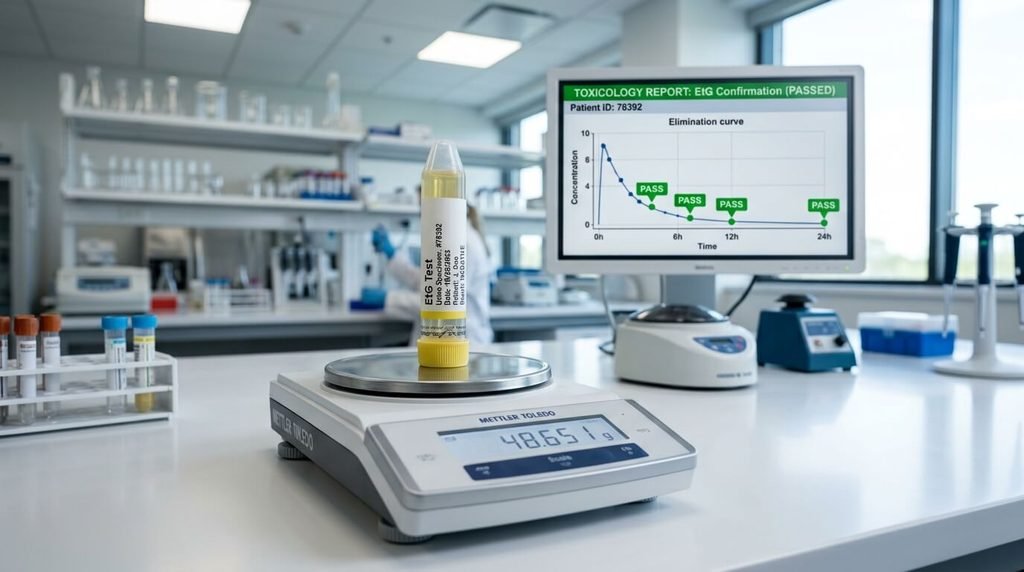
EtG testing is frequently marketed as the “80-hour alcohol test.” Many people assume that having even a single beer means they will automatically fail any test administered within 80 hours. From a clinical toxicology standpoint, this is inaccurate.
Peer-reviewed clinical studies indexed in the National Institutes of Health PubMed Database demonstrate that the 80-hour threshold represents an extreme maximum. It is observed almost exclusively under specific conditions:
- Heavy, multi-day binge drinking (10 or more standard drinks).
- Testing with an ultra-sensitive 100 ng/mL cutoff.
- Severe dehydration, impaired kidney filtration, or delayed urinary voiding.
For light to moderate drinking (1 to 4 standard drinks), the true biological detection window is significantly shorter—often clearing within 24 to 48 hours.
Understanding Laboratory Cutoff Levels (100 vs. 500 ng/mL)
An EtG urine test is not graded on a percentage scale; it produces a binary diagnostic outcome: Negative (Pass) or Positive (Fail). Your result depends entirely on whether your urinary concentration exceeds the laboratory’s predetermined cutoff level measured in nanograms per milliliter (ng/mL):
| Cutoff Level | Testing Setting | Typical Detection Window | Incidental Exposure Risk |
|---|---|---|---|
| 100 ng/mL | Zero-tolerance probation, medical monitoring, transplant lists | 36 – 80 hours | High (Mouthwash, hand sanitizers, food) |
| 300 ng/mL | Drug courts, intermediate forensic monitoring | 24 – 48 hours | Moderate |
| 500 ng/mL | SAMHSA workplace standard, standard criminal probation | 18 – 40 hours | Low (Filters out incidental contact) |
The Substance Abuse and Mental Health Services Administration (SAMHSA) issued formal advisories cautioning against using ultra-low cutoffs (like 100 ng/mL) as sole proof of alcohol consumption. At 100 ng/mL, incidental contact with alcohol-based mouthwashes, hand sanitizers, or fermented kombucha can trigger a false positive. SAMHSA recommends a 500 ng/mL cutoff for workplace and legal testing to verify true beverage consumption.
Drinks vs. Time: Expected Pass/Fail Matrix
To estimate your personal probability of passing, compare your drink volume and time elapsed against this peer-reviewed detection matrix:
| Total Drinks Consumed | Estimated Peak Urine EtG | 12 Hours Elapsed | 24 Hours Elapsed | 36 Hours Elapsed | 48 Hours Elapsed |
|---|---|---|---|---|---|
| 1 Standard Drink (14g ethanol) | 1,000 – 3,500 ng/mL | Fail | Likely Pass (500 cutoff) | Pass | Pass |
| 2 – 3 Standard Drinks | 8,000 – 20,000 ng/mL | Fail | Borderline (Risk at 500) | Likely Pass | Pass |
| 4 – 6 Drinks (Moderate Session) | 25,000 – 60,000 ng/mL | Fail | Fail | Borderline | Likely Pass |
| 8+ Drinks (Heavy Binge) | 100,000+ ng/mL | Fail | Fail | Fail | Borderline (100 cutoff) |
(Note: 1 Standard Drink = 12 oz beer at 5% ABV, 5 oz table wine at 12% ABV, or 1.5 oz spirit at 40% ABV).
Biological Factors That Alter Your Odds
Why do two people drinking the exact same quantity have different results 30 hours later? Multiple biological variables influence your curve:
- Elimination Half-Life (t½):
EtG clears via exponential decay governed by an elimination half-life ranging between 2.0 and 3.5 hours (population average: 2.5 hours). An individual with a 2.0-hour half-life clears metabolites nearly 40% faster than someone with a 3.5-hour half-life. - Biological Sex and Body Composition:
Ethanol distributes throughout total body water. Because women generally have a lower percentage of body water (Widmark distribution factor r = 0.55 vs. 0.68 for men) and lower gastric alcohol dehydrogenase activity, the same number of drinks produces higher peak blood alcohol and greater initial EtG synthesis. - Renal Clearance and Hydration:
EtG is eliminated through glomerular filtration in the kidneys. Healthy kidney function ensures steady clearance. While drinking water helps normal filtration, excessive overhydration drops urinary creatinine below 20 mg/dL, prompting laboratories to report a “Dilute Negative” specimen—which probation officers often treat as a refusal or violation.
What Can Cause an Accidental False Positive?
If your testing agency uses a sensitive 100 ng/mL or 250 ng/mL cutoff, everyday products containing trace alcohol can cause an accidental failure:
- Alcohol-Based Mouthwash: Swishing with antiseptic mouthwash containing 20% to 26% ethanol can produce urinary EtG concentrations over 1,000 ng/mL in samples voided 2 to 4 hours afterward.
- Hand Sanitizers: Intensive application of alcohol hand gels in healthcare or food service environments can absorb transdermally and via vapor inhalation.
- Non-Alcoholic Beers & Kombucha: Beverages labeled “non-alcoholic” can legally contain up to 0.5% alcohol by volume (ABV), producing measurable trace metabolites if consumed in quantity.
- Foods Prepared with Cooking Wine: Heat does not fully evaporate alcohol; bourbon glazes and wine reduction sauces can leave enough residual ethanol to register on sensitive assays.
Defense Tip: If you face a positive result from incidental contact, request a laboratory confirmation test using Liquid Chromatography-Tandem Mass Spectrometry (LC-MS/MS) and ask for an evaluation of Ethyl Sulfate (EtS). EtS is another direct metabolite that is less prone to environmental false positives and bacterial degradation.
Myths vs. Facts: What Actually Clears EtG?
- Myth: Detox teas and flush pills clear EtG overnight.
Fact: Detox kits cannot speed up enzymatic hepatic glucuronidation or renal filtration. They simply dilute urine with water while adding synthetic B-vitamins for yellow color. - Myth: Sweating in a sauna speeds up clearance.
Fact: EtG is excreted through urine, not sweat glands. Sweating heavily without adequate rehydration actually concentrates your urine, which can push a borderline EtG reading above the failure cutoff. - Fact: Time and baseline hydration are the only reliable mechanisms.
Fact: Sustained, normal fluid intake (water and electrolyte beverages) supports baseline kidney filtration while giving your body the required time to clear the metabolite.
How to Calculate Your Pass/Fail Status
Before taking your test, follow this protocol:
- Determine the exact cutoff threshold used by your testing program (ask whether it is 100, 300, or 500 ng/mL).
- Count your total standard drinks consumed.
- Measure the exact hours elapsed since your last drink.
- Input your weight, sex, and drinking duration into our free EtG Pass/Fail Predictor to get a calculated probability score and clearance timeline.
Related Tools and Resources
- EtG Pass/Fail Predictor – Interactive pass probability calculator with confidence modeling.
- EtG Clearance Time Calculator – Live countdown of hours remaining until you drop below cutoffs.
- Advanced EtG Calculator – Multi-drink session modeling.
- EtG Half-Life Calculator – Track half-life elimination step-by-step.