
Kratom Clearance Calculator: Mitragynine Half-Life & Detection Time
Accurately estimate how long Kratom (Mitragyna speciosa) and its primary active alkaloid, mitragynine, remain detectable in urine, blood, and saliva drug screenings.
| Testing Medium | Typical Cutoff | Estimated Level | Detection Window | Status |
|---|
Pharmacokinetic Profiles
- Terminal Half-life (T1/2): 23.8 to 38.3 Hours
- Peak Plasma Concentration (Tmax): 1.0 to 1.5 Hours
- Volume of Distribution (Vd): ~37.9 L/kg (Massive)
- Oral Bioavailability: ~21% to 30%
- Metabolism: Hepatic CYP3A4, CYP2D6, CYP2C9
Detection Timeline Rules
- Single 2g-4g dose: 3 to 5 days
- Chronic daily use: 6 to 9 days
- Heavy multi-dose (20g+): Up to 10-14 days
- Blood detection window: 24 to 48 hours
- Standard 5/10-panel test: Does NOT detect Kratom
Kratom Clearance Calculator: The Complete Mitragynine Detection Guide
With the surging popularity of Kratom (Mitragyna speciosa) across North America and Europe, testing protocols are rapidly adapting. While Kratom has historically bypassed standard employment urine screens, specialized laboratory assays now routinely screen for its primary active alkaloid, mitragynine.
Our Kratom clearance calculator provides an evidence-based pharmacokinetic window tailored to your dose, preparation form (raw powder vs. liquid extract), frequency of use, and personal metabolism.
This comprehensive guide details the unusual pharmacokinetics of mitragynine, why chronic use prolongs clearance up to nine days, and what types of drug tests actually detect Kratom.
What Is Kratom and How Does It Metabolize?
Kratom is a tropical tree native to Southeast Asia containing over 40 distinct bioactive alkaloids. Two compounds account for virtually all of its pharmacological and diagnostic presence:
- Mitragynine: The most abundant alkaloid (comprising ~60% of total alkaloid fraction, or roughly 1.0% to 1.5% of raw dried leaf weight).
- 7-Hydroxymitragynine (7-OH): A potent minor alkaloid present in trace amounts (< 0.05% of leaf weight), but also formed in the liver as an active metabolite of mitragynine via cytochrome P450 enzymes.
The Metabolism Pathway
Following oral consumption (swallowing raw powder, capsules, or tea):
- Absorption: Mitragynine reaches peak concentration in blood plasma (Tmax) rapidly within 1.0 to 1.5 hours.
- Distribution: Unlike alcohol or nicotine, mitragynine has an extraordinarily high Volume of Distribution (Vd≈38 L/kgV_d \approx 38\text{ L/kg}Vd≈38 L/kg) and high lipophilicity (fat solubility). It rapidly leaves the bloodstream and embeds into adipose (fat) tissue and organs.
- Hepatic Clearance: The liver’s CYP3A4, CYP2D6, and CYP2C9 enzymes metabolize mitragynine through hepatic glucuronidation and O-demethylation.
- Excretion: Metabolites and unchanged mitragynine are excreted predominantly through renal filtration into urine and biliary secretion into feces.
Key Forensic Fact: Because mitragynine is heavily lipid-soluble, it behaves pharmacokinetically more like THC than like alcohol. It slowly leaks back out of fat deposits into the bloodstream over days, significantly extending terminal detection in daily consumers.
What Is the Half-Life of Mitragynine?
In early animal studies, mitragynine was thought to have a short 3-to-4 hour half-life. However, landmark human clinical trials conducted by Trakulsrichai et al. (2015) proved that mitragynine exhibits a two-phase (biphasic) elimination curve:
- Distribution Alpha Phase: Initial quick drop as the alkaloid disperses into tissues (~3 to 5 hours).
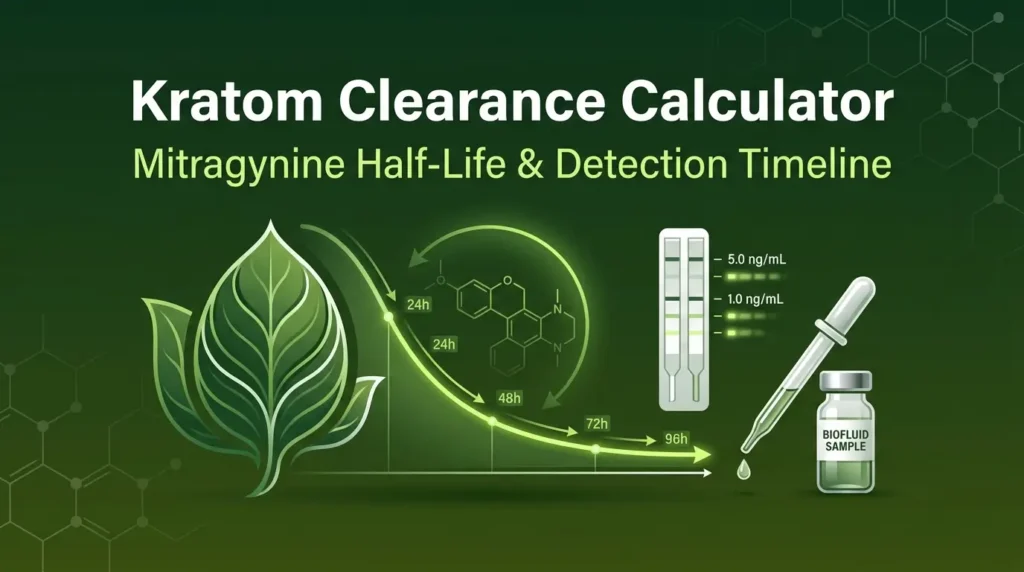
- Terminal Elimination Beta Phase: The actual elimination half-life averages 23.8 to 38.3 hours (mean ~29 hours).
The 5.5 Half-Life Elimination Rule
In clinical pharmacokinetics, it requires approximately 5 to 6 half-lives to clear 97% to 98% of a drug from systemic circulation:
Clearance Time=5.5×29 hours≈160 hours=6.6 Days
This explains why our Kratom clearance calculator yields detection windows between 4 to 9 days for typical doses.
Does Kratom Show Up on a Standard 5-Panel or 10-Panel Drug Test?
No. Kratom does NOT appear on a standard 5-panel, 10-panel, or 12-panel SAMHSA workplace drug test.
Standard drug tests use rapid immunoassay strips targeting:
- Amphetamines
- Cocaine
- Marijuana (THC-COOH)
- Opiates (specifically Morphine, Codeine, Heroin)
- Phencyclidine (PCP)
- Benzodiazepines (in 10/12-panel)
- Barbiturates / Methadone (in 10/12-panel)
The Opiate vs. Opioid Confusion
Although mitragynine binds to μ-opioid receptors in the central nervous system, it has a completely different chemical structure than classical morphinan opiates. It is an indole alkaloid related structurally to yohimbine. It does not produce morphine metabolites and does not trigger a true positive on standard opiate screens.
When IS Kratom Tested?
Kratom is detected under specific circumstances:
- Specialized Kratom Immunoassays / LC-MS/MS Panels: Ordered routinely in addiction rehabilitation centers, pain management clinics, probation/parole programs, and military or specialized civil service evaluations.
- Expanded 10-Panel Panels: Some private corporate test providers now offer an “Expanded 10-Panel with Kratom” add-on.
- False Positive Confirmatory Screen: Early immunoassay cups historically triggered rare false positives for methadone. In such cases, GC-MS confirmation automatically clears the result as negative for illicit drugs.
Detection Windows by Testing Modality
| Diagnostic Matrix | Standard Laboratory Cutoff | Detection Window (Single Dose) | Detection Window (Daily User) |
|---|---|---|---|
| Urine (Specialized LC-MS/MS) | 1.0 ng/mL | 3 to 5 Days | 6 to 9 Days (up to 12 days) |
| Urine (Expanded Screen) | 5.0 ng/mL | 2 to 4 Days | 5 to 7 Days |
| Blood Plasma Screen | 2.0 ng/mL | 24 to 48 Hours | 3 to 4 Days |
| Oral Fluid / Saliva | 1.0 ng/mL | 24 to 36 Hours | 48 to 72 Hours |
| Standard 5/10-Panel Workplace | N/A | Undetected | Undetected |
For general guidance on urine concentration validity, see our Urine Dilution & Creatinine Calculator.
Why Detection Is Significantly Longer in Daily Users
If you consume Kratom once on a weekend, your body processes that isolated bolus in a few days. However, daily Kratom use alters clearance in two ways:
- Lipid Saturation: Due to high lipophilicity, daily dosing causes mitragynine to accumulate in body fat faster than liver enzymes can clear it. Once dosing stops, the drug leaches back into blood over an extended timeframe.
- Enzyme Inhibition: Mitragynine is a known inhibitor of CYP2D6 and CYP3A4. Chronic consumption can partially down-regulate its own clearance pathway, stretching half-life toward 38+ hours.
Can You Speed Up Kratom Clearance?
Many commercial detox kits claim to “flush Kratom out in 24 hours.” Scientifically, these claims are false. However, understanding the clearance pathway allows you to support your body’s natural elimination:
- Complete Abstinence: The essential step. Even minor “taper” doses reset the elimination clock.
- Cardiovascular Exercise: Since mitragynine accumulates in fat, moderate cardio burns adipose tissue over days—though vigorous exercise within 24 hours of a test should be avoided to prevent a temporary metabolite spike in urine.
- Hydration: Maintaining normal hydration ensures consistent glomerular filtration rate (GFR). Do not over-hydrate right before testing, as low creatinine (< 20 mg/dL) flags your sample as dilute.
Scientific Studies & Clinical References
The mathematical modeling in our Kratom clearance calculator is grounded in peer-reviewed pharmacokinetics:
- Trakulsrichai S. et al. (2015) — Pharmacokinetics of mitragynine in man. Drug Design, Development and Therapy, 9, 2421-2429. PubMed PMID: 25931440.
- Kamble S.H. et al. (2019) — Exploration of the In Vitro and In Vivo Metabolism and Pharmacokinetics of Mitragynine. Drug Metabolism and Disposition, 47(3), 241-250. PubMed PMID: 30528439.
- Cinosi E. et al. (2015) — Following “the Roots” of Kratom: A Review of the Phytochemistry, Pharmacological Effects and Toxicity. Current Topics in Medicinal Chemistry, 15(19), 19-35.
- Philipp A.A. et al. (2011) — Characterization of metabolites of the plant alkaloid mitragynine in human urine using LC-MS/MS. Journal of Mass Spectrometry, 46(3), 229-236.
Explore Our Other Substance Testing Calculators
Cross-reference your elimination windows across other prescription and recreational substances:
- Adderall Clearance Calculator — Calculate prescription amphetamine clearance in urine based on urinary pH and formulation.
- THC Clearance Calculator — Estimate marijuana elimination timelines based on body fat percentage and lipid storage.
- Urine Dilution & Creatinine Calculator — Check if your water intake will cause an invalid dilute sample.
- Hair Follicle Drug Test Calculator — 90-day forensic detection calculator based on 0.5-inch monthly hair growth.
- Cotinine Clearance Calculator — Measure nicotine metabolite elimination for life insurance and clinical screens.
Medical & Legal Disclaimer
The Kratom clearance calculator and all materials on this page are provided strictly for educational, scientific, and informational purposes. Actual mitragynine elimination times vary significantly depending on product purity, unregulated alkaloid concentrations, individual liver health, body composition, and testing laboratory sensitivity. This digital tool does not constitute medical advice or legal counsel. Consult a qualified physician or clinical toxicologist regarding substance cessation or testing inquiries.