
EtG vs. Regular Alcohol Urine Test
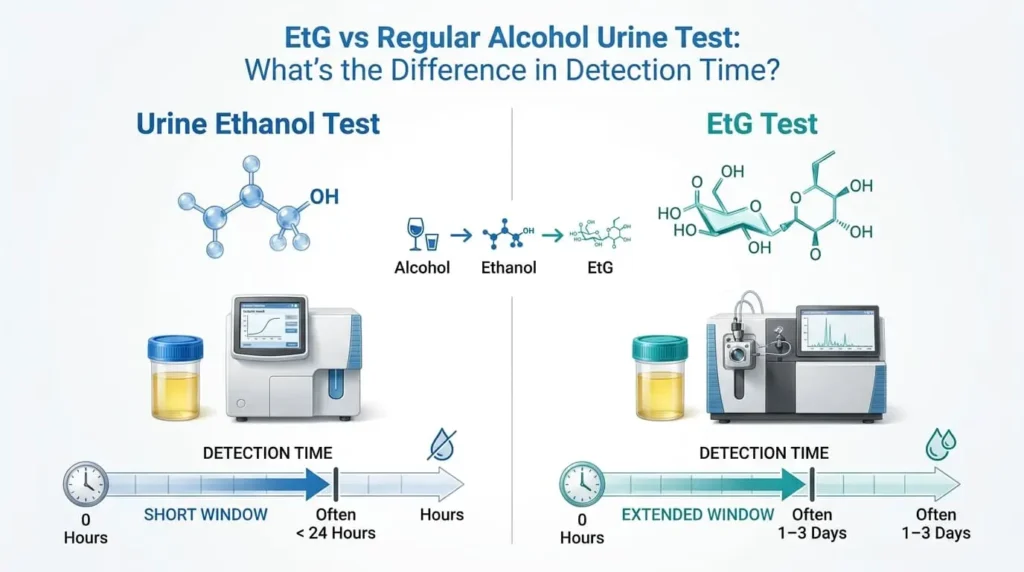
EtG testing detects ethyl glucuronide, an alcohol metabolite, while a regular urine alcohol test may detect ethanol itself. Because EtG remains after ethanol clears, EtG generally has a longer detection window. The exact window depends on the cutoff, timing, amount consumed, and test method.
EtG vs. Urine Alcohol Test
The biggest difference is what the test measures.
A urine alcohol or urine ethanol test looks for ethanol, the alcohol itself. An EtG urine test looks for ethyl glucuronide (EtG), a metabolite produced when the body processes ethanol.
| Feature | Urine Alcohol / Ethanol | EtG Urine Test |
|---|---|---|
| Measures | Ethanol | Ethyl glucuronide |
| Type | Parent compound | Alcohol metabolite |
| Detection concept | Usually shorter | Generally longer |
| Typical timeframe | Hours | Often 1–3 days; some test configurations can detect longer |
| Main purpose | Detect ethanol itself | Detect recent alcohol exposure |
| Common methods | Laboratory-specific | Immunoassay and/or LC-MS/MS |
| Cutoff | Laboratory-specific | Laboratory-specific |
| Measures intoxication? | No | No |
| Establishes exact drinking time? | No | No |
Mayo Clinic Laboratories states that alcohol in urine is normally detectable for only a few hours, while its EtG screening test describes EtG as detectable in urine for 1–3 days. A separate Mayo EtG/EtS testing configuration states that these metabolites can be detected for up to 5 days using a 500 ng/mL cutoff.
These are test-specific detection ranges, not guarantees for every person.
What Is a Regular Alcohol Urine Test?
A regular urine alcohol test generally refers to testing for ethanol directly in a urine specimen.
Ethanol is the substance found in alcoholic drinks. It is the parent compound from which metabolites such as EtG and EtS are produced.
This creates an important distinction:
- Urine ethanol: Is ethanol itself detectable?
- EtG: Is ethyl glucuronide, a metabolite of ethanol, detectable?
Because ethanol and its metabolites have different elimination and detection patterns, the results can differ depending on when the urine sample is collected.
A urine ethanol result can therefore become negative while EtG remains detectable.
What Is an EtG Urine Test?
EtG stands for ethyl glucuronide.
EtG is a direct metabolite of ethanol formed when ethanol undergoes enzymatic conjugation with glucuronic acid. It can be detected in urine after alcohol consumption and, less commonly, after certain types of external alcohol exposure.
EtG testing is commonly used for recent alcohol exposure and abstinence monitoring.
Depending on the testing program, it may be used in:
- Treatment and recovery monitoring
- Clinical testing
- Workplace programs
- Probation and court-related monitoring
- Justice-system testing
- Research
Mayo Clinic Laboratories specifically lists EtG and EtS testing for monitoring abstinence in clinical and justice-system settings.
For authoritative laboratory information, Mayo Clinic Laboratories explains how EtG and EtS testing differs from direct urine alcohol testing, including detection windows, testing methods, cutoffs, and interpretation. Their laboratory guidance is especially useful when you need to understand the difference between screening and confirmatory testing.
Why Does EtG Last Longer Than Alcohol in Urine?
The answer is metabolism.
After alcohol is consumed, ethanol is processed by the body. A small portion is converted into metabolites including ethyl glucuronide (EtG) and ethyl sulfate (EtS).
The simplified process is:
- Alcohol is consumed.
- Ethanol enters the body.
- Ethanol is metabolized.
- Some ethanol is converted into EtG and EtS.
- These metabolites enter the urine.
- A urine specimen is collected.
- The laboratory tests the specimen.
- The result is compared with the applicable cutoff.
So EtG is not leftover alcohol. It is a metabolic marker associated with ethanol exposure.
How Long Does EtG Stay in Urine?
There is no universal EtG detection timer.
Mayo Clinic Laboratories describes EtG as detectable in urine for approximately 1–3 days for its EtG screening test. Its separate chain-of-custody EtG/EtS testing information states that EtG and EtS can be detected for up to 5 days at a 500 ng/mL cutoff.
The actual detection period can vary with:
- Amount of alcohol consumed
- Timing of alcohol exposure
- Time between drinking and collection
- EtG cutoff
- Laboratory method
- Urine concentration
- Individual biological factors
- Specimen validity
This is why an online article should not promise that a particular person will test positive or negative at a specific hour.
Is EtG an 80-hour test?
Not as a guaranteed rule.
The phrase “80-hour EtG test” is commonly used because EtG can remain detectable for several days. But 80 hours is not a universal cutoff point.
A laboratory may use a different cutoff or testing method, and individual detection varies.
For example, Mayo’s published information gives a 1–3 day detection description for one screening test and up to 5 days for another configuration at a stated cutoff.
What Factors Affect EtG Detection Time?
1. Alcohol exposure
The amount and pattern of alcohol exposure can influence the amount of EtG produced.
However, an EtG concentration should not be used to calculate an exact number of drinks.
2. Time since drinking
EtG concentrations change as time passes. A sample collected relatively soon after exposure is different from one collected days later.
3. Testing cutoff
The cutoff determines the concentration threshold used by the laboratory.
A lower cutoff can identify lower concentrations than a higher cutoff.
4. Testing method
Screening immunoassays and definitive LC-MS/MS testing are different analytical approaches.
5. Urine concentration
Fluid intake and other biological factors can affect urine testing. Laboratory testing may also evaluate specimen validity measures such as creatinine or specific gravity.
6. Individual variation
Biological differences mean two people can have different EtG concentrations after similar alcohol exposure.
EtG Cutoffs: 100 vs. 200 vs. 300 vs. 500 ng/mL
One of the most important things to understand about EtG testing is the cutoff concentration.
The cutoff is the threshold used by a particular testing protocol when determining how a result is classified.
| Cutoff | General meaning |
|---|---|
| 100 ng/mL | Lower threshold that can identify lower EtG concentrations |
| 200 ng/mL | Lower threshold than 300 or 500 ng/mL |
| 300 ng/mL | Intermediate threshold used in some testing contexts |
| 500 ng/mL | Higher threshold; lower concentrations may fall below it |
These values should not be treated as interchangeable.
For example, Mayo currently lists a 500 ng/mL immunoassay screening cutoff for one EtG test. Its LC-MS/MS confirmation uses EtG and EtS reporting thresholds of 250 ng/mL and 100 ng/mL, respectively, in that testing configuration.
If you want to explore cutoff-specific estimates, see:
Use these as educational estimation tools, not as guarantees of an individual laboratory result.
EtG vs. EtS: What’s the Difference?
EtG is ethyl glucuronide, while EtS is ethyl sulfate.
Both are metabolites associated with ethanol exposure.
Some laboratory testing protocols measure both because they can provide additional information when evaluating recent alcohol exposure.
Mayo’s chain-of-custody testing uses LC-MS/MS to analyze EtG and EtS.
The two biomarkers are related, but they are not the same test.
How Does an EtG Test Work?
A typical EtG testing process can be summarized as follows:
- Urine collection — A urine specimen is collected according to the testing protocol.
- Screening — An immunoassay may initially screen for EtG.
- Cutoff comparison — The result is evaluated against the applicable threshold.
- Confirmation — A positive screen may be confirmed using LC-MS/MS.
- Reporting — The laboratory reports the result according to its testing method and protocol.
Mayo describes an EtG screening test in which a positive immunoassay screen is followed by LC-MS/MS confirmation and quantification.
Can EtG Be Positive When Urine Alcohol Is Negative?
Yes.
This is one of the main reasons EtG testing can detect alcohol exposure longer than direct urine ethanol testing.
For example:
Urine ethanol: Negative
EtG: Positive
This can happen because ethanol itself may no longer be detectable while its metabolite remains above the applicable EtG cutoff.
The two tests are measuring different substances.
Can Urine Alcohol Be Positive When EtG Is Negative?
It can occur under certain circumstances because the tests measure different analytes and use different analytical thresholds.
The timing of collection, cutoff, specimen characteristics and laboratory method can all influence the relationship between ethanol and EtG results.
For that reason, an apparent mismatch should be interpreted using the actual laboratory report rather than a generic detection chart.
Does a Positive EtG Mean Someone Was Intoxicated?
No.
EtG is a marker of alcohol exposure, not an impairment test.
A positive EtG result does not establish:
- Current intoxication
- Blood alcohol concentration
- Exact drinking time
- Exact number of drinks
- Driving impairment
Mayo states that an EtG screening result indicates potential presence of EtG and does not necessarily correlate with the extent of physiological or psychological effects.
Can Mouthwash or Hand Sanitizer Affect EtG?
Certain alcohol-containing products can contribute to detectable EtG or EtS.
Mayo specifically lists hand sanitizers and mouthwash among products that may result in detectable EtG or EtS levels.
This does not mean that every incidental exposure will produce a positive result. Interpretation depends on the amount and type of exposure, timing, cutoff and laboratory method.
Low-level results therefore need to be interpreted in context.
EtG Testing for Probation and Court Monitoring
EtG and EtS can be used for abstinence monitoring in justice-system settings.
Court-related testing may also require chain of custody.
Chain of custody documents the handling of a specimen from collection through laboratory analysis. This is important when a result may be used in legal proceedings.
A court-ordered test should therefore be interpreted according to the requirements of the specific program, laboratory and jurisdiction.
An ordinary consumer EtG test is not automatically equivalent to a formal chain-of-custody test.
EtG Testing for Workplace and Treatment Programs
EtG testing may also be used for workplace or treatment monitoring.
However, testing requirements can differ.
A program may specify:
- The biomarker being tested
- The cutoff
- Collection procedure
- Laboratory
- Confirmation method
- Reporting requirements
If a testing program specifies a particular cutoff, that requirement matters more than a generic online detection window.
Which Test Should You Use?
The answer depends on the question being asked.
| Goal | Relevant test |
|---|---|
| Detect ethanol itself | Urine ethanol |
| Detect recent alcohol exposure for longer | EtG |
| Monitor abstinence | EtG and/or EtS may be used |
| Confirm a screening result | Laboratory-specific confirmation |
| Court-related testing | Follow the required chain-of-custody protocol |
| Determine current impairment | EtG is not an impairment test |
There is no universally “better” test. Each test answers a different question.
Common EtG Testing Mistakes
Mistake 1: Treating 80 hours as guaranteed
EtG does not follow a fixed 80-hour timer.
Mistake 2: Assuming every laboratory uses 500 ng/mL
Cutoffs vary by testing protocol.
Mistake 3: Confusing EtG with BAC
EtG does not measure current blood alcohol concentration or intoxication.
Mistake 4: Assuming an EtG number equals drinks consumed
EtG concentration cannot reliably be converted into an exact number of drinks.
Mistake 5: Ignoring the testing method
A screening immunoassay and LC-MS/MS confirmation are different analytical processes.
Mistake 6: Treating an online calculator as a laboratory test
An online calculator can provide an educational estimate, but it cannot reproduce an individual’s laboratory analysis.
Can an EtG Calculator Predict a Negative Test?
No calculator can guarantee an individual laboratory result.
An educational calculator can help demonstrate how factors such as time, alcohol exposure and cutoff can affect an estimated detection window.
If you want to explore these variables, you can use the ETG Calculator or the site’s cutoff-specific tools.
For more information about the limitations of estimates, see EtG Calculator Accuracy and Limitations.
The actual laboratory result should always take priority over an online estimate.
Frequently Asked Questions
How long does EtG stay in urine?
EtG can remain detectable longer than urine ethanol. Mayo describes approximately 1–3 days for one EtG screening test, while another Mayo configuration states up to 5 days at a 500 ng/mL cutoff.
How long does alcohol stay detectable in urine?
Direct urine alcohol is generally detectable for a much shorter period than EtG. Mayo describes urine alcohol as normally detectable for only a few hours.
Is EtG the same as an alcohol urine test?
No. EtG testing measures ethyl glucuronide, while a direct urine alcohol test measures ethanol itself.
Does EtG detect alcohol longer than a regular urine test?
Generally, yes. EtG can remain detectable after ethanol itself is no longer detectable in urine.
Is EtG an 80-hour test?
Not exactly. Eighty hours is a commonly quoted estimate, not a guaranteed detection period.
What does a positive EtG mean?
A positive EtG result indicates that EtG was detected according to the laboratory’s testing criteria. It does not establish exact drinking time, number of drinks or intoxication.
Does EtG prove intoxication?
No. EtG is an alcohol-exposure biomarker, not an impairment test.
What is an EtG cutoff?
An EtG cutoff is the concentration threshold used by a particular laboratory or testing protocol when interpreting the test.
Can mouthwash affect EtG?
Alcohol-containing mouthwash and hand sanitizer can contribute to detectable EtG or EtS in some circumstances.
Is EtG used for probation?
Yes. EtG and EtS testing can be used for abstinence monitoring in justice-system settings. Court-related testing may also require documented chain of custody.
Conclusion
The difference between an EtG test and a regular alcohol urine test comes down to what the laboratory measures.
Urine ethanol detects alcohol itself, while EtG detects ethyl glucuronide, a metabolite produced after alcohol exposure. Because EtG remains after ethanol clears, it generally provides a longer detection window.
However, there is no guaranteed EtG detection time. The result can depend on the cutoff, testing method, timing, alcohol exposure, urine characteristics and individual factors.
The commonly quoted “80-hour EtG test” should therefore be viewed as a general concept—not a guaranteed deadline.
For educational estimates, you can explore the ETG Calculator and cutoff-specific tools such as the 100 ng/mL EtG Calculator and 300 ng/mL EtG Calculator.
For clinical, workplace, probation or court-related decisions, always rely on the applicable testing protocol and the actual laboratory report rather than an online estimate.