
Hair Follicle Drug Test Calculator: Detection Window & Growth Timeline
Determine the exact detection window for your hair drug test based on hair growth rate, sample type (scalp vs. body hair), sample length, and drug consumption history.
| Substance | Screen Cutoff | Confirmation Cutoff | Incorporation Tendency | Your Risk Profile |
|---|
Hair Growth Biology
- Average monthly growth 0.5 in (1.3 cm)
- Standard lab cut 1.5 in (3.8 cm)
- Scalp standard window 90 Days
- Root emergence delay 5 to 7 Days
- Active growth phase Anagen (85%)
- Resting phase Telogen (15%)
Substance Incorporation Rates
- Cocaine & Amphetamines High (Melanin bound)
- Opiates Moderate-High
- Nicotine / Cotinine Moderate
- Alcohol (EtG) Direct Keratin (Low-Mod)
- THC-COOH (Marijuana) Very Low (Lipophilic)
- Single-use weed Rarely detected
Standard Hair Cutoff Levels
- THC-COOH 1.0 pg/mg (Screen)
- EtG (Alcohol) 30 pg/mg (Abstinence)
- Cocaine 500 pg/mg
- Opiates / Morphine 2000 pg/mg
- Amphetamines 500 pg/mg
- Cotinine 1000 pg/mg
Factors Affecting Detection
- Hair Melanin / Color Darker binds more
- Cosmetic Bleaching Decreases by 40-60%
- Excessive Sweating External transfer
- Body hair source Extends window to 1yr
- Sample length > 1.5 in Expands window past 90d
- Laboratory method GC-MS / LC-MS/MS
How far back does a hair follicle drug test really go?
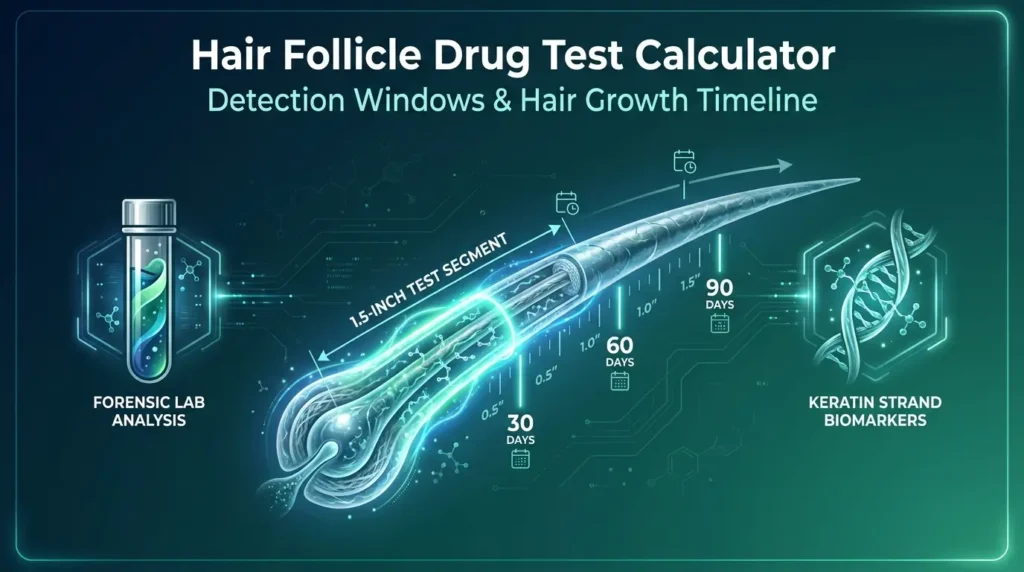
For standard head hair, labs universally cut and test the 1.5 inches (3.8 cm) closest to the scalp. Because human head hair grows at an average rate of 0.5 inches per month, this 1.5-inch segment represents a strict 90-day detection window. Any hair longer than 1.5 inches is typically trimmed away and discarded by the testing facility unless a specialized historical profile is specifically ordered.
Can a hair drug test detect drug use from yesterday?
No. Hair drug tests have an inherent 5 to 7-day “blind spot.” When you consume a substance, it travels through your bloodstream into the hair follicle bulb buried deep under your scalp. It takes roughly 5 to 7 days for the newly formed keratinized hair containing those metabolites to physically grow above the scalp surface where scissors can collect it.
Why does body hair have a 12-month detection window?
Unlike head hair—which stays in an active growing phase (anagen) 85% of the time—body hair (from arms, legs, or chest) spends up to 50–60% of its lifecycle in a dormant resting phase (telogen). A single strand of body hair may stop growing and remain on your skin for 6 to 12 months before shedding, capturing drug exposures that occurred up to a full year prior.
Will a single isolated use show up on a hair test?
Infrequent, single-use events (especially with cannabis) frequently go undetected on hair follicle screens. THC-COOH incorporates into hair keratin very inefficiently compared to other substances like cocaine or amphetamines. Generally, consistent or multiple uses within a 90-day window are required to deposit sufficient metabolite concentration to exceed standard laboratory screening cutoffs (1.0 pg/mg).
Hair Follicle Drug Test Calculator: The Science-Backed Detection Guide
Among all drug testing methods, hair follicle drug testing is the most feared and misunderstood. While urine, blood, and saliva tests detect recent exposure over hours or days, hair testing provides a forensic timeline spanning months.
Our hair follicle drug test calculator uses the exact biological criteria employed by accredited toxicological laboratories (such as Quest Diagnostics, Labcorp, and Psychemedics) to determine your realistic detection window.
Whether you’re concerned about marijuana (THC), alcohol (EtG), nicotine (cotinine), opioids, or stimulants, this guide breaks down the hair growth cycle, the critical root blind-spot, and the laboratory cutoffs that determine pass vs. fail.
How Does a Hair Follicle Drug Test Work?
When you ingest, inhale, or consume any substance, it enters your bloodstream. As blood circulates through your scalp, it nourishes the papilla—the living tissue structure at the base of every hair follicle.
- Metabolite Incorporation: Drug metabolites (like THC-COOH or Ethyl Glucuronide) pass from the bloodstream into the active growing cells inside the hair bulb.
- Keratinization: As these cells divide and push upwards, they harden into solid keratin protein fibers. The drug metabolites become permanently trapped inside the core cortex of the hair shaft.
- Continuous Growth: The hair continues growing away from your scalp like a physical timeline, carrying the encapsulated chemical record with it.
Key Forensic Fact: The test does not actually extract the living “bulb” or “follicle” buried beneath your skin (that would require a painful surgical biopsy). Instead, technicians cut approximately 100–120 strands of hair flush against the scalp line.
The 1.5-Inch Rule: Why 90 Days Is the Industry Standard
A widespread misconception is that a hair drug test reviews your entire lifetime of hair growth. In standard employment, judicial, and DOT-regulated hair testing, this is false.
Human head hair grows at a remarkably consistent biological rate of approximately 0.5 inches (1.3 cm) per month (average range: 0.4 to 0.6 inches).
The Math Behind the 90-Day Cutoff:
0.5 inches/month1.5 inches (Standard Cut)=3.0 months=90 Days
When your hair sample arrives at the laboratory:
- Technicians align the root ends of the cut fibers.
- They measure exactly 1.5 inches from the root end.
- Any hair longer than 1.5 inches is cut away and discarded.
Unless a court order or specialized forensic inquiry explicitly demands a historical timeline (segmental analysis), standard testing facilities evaluate only the past 90 days.
The 5-to-7 Day “Blind Spot”: What Hair Tests Cannot See
While hair testing excels at uncovering long-term patterns, it possesses a significant biological limitation: it cannot detect substance use that occurred within the past week.
- When you consume a drug today, it binds to the hair matrix underneath your skin.
- The average human scalp has about 3 to 4 millimeters of hair buried inside the follicle sheath before it surfaces.
- It takes 5 to 7 days for the newly formed, drug-containing hair to physically emerge above the skin surface where scissors can reach it.
If your last exposure occurred 2 or 3 days ago, that segment remains safely underground. For detecting intoxication or use within the past 48 hours, urine or saliva tests are vastly superior.
To understand short-term detection windows, use our THC Clearance Calculator or EtG Clearance Time Calculator.
Scalp Hair vs. Body Hair: The 12-Month Difference
If an applicant has a shaved head, baldness, or hair shorter than 1.5 inches, collection technicians are instructed to gather body hair (from the chest, armpits, arms, or legs).
This completely changes the detection timeline.
| Feature | Head / Scalp Hair | Body Hair (Chest, Leg, Arm) |
|---|---|---|
| Growth Rate | ~0.5 inches / month | ~0.25 to 0.35 inches / month |
| Growing Phase (Anagen) | ~85% of hair (2 to 7 years) | ~30% to 50% of hair (short burst) |
| Dormant Phase (Telogen) | ~15% (lasts 2–3 months) | 50% to 70% (lasts up to 12 months) |
| Effective Detection Window | Strictly ~90 Days | Up to 180 – 365 Days |
Body hair grows much slower and spends most of its lifecycle “resting” in your skin without falling out. A single strand of arm or chest hair could have formed 8 months ago and remained stationary on your body.
Important Warning: If a lab tests body hair, your detection window expands from a 3-month window up to a full 12-month window.
Standard Laboratory Cutoff Levels (Screening vs. Confirmation)
Hair testing uses a strict two-tier testing protocol: an initial screening by ELISA (enzyme-linked immunosorbent assay), followed by liquid or gas chromatography-tandem mass spectrometry (LC-MS/MS or GC-MS) confirmation.
The Substance Abuse and Mental Health Services Administration (SAMHSA) and Society of Hair Testing (SoHT) establish these standard cutoffs:
| Tested Substance | Primary Target Analyte | Initial Screen Cutoff | Confirmation Cutoff |
|---|---|---|---|
| Marijuana (THC) | THC-COOH metabolite | 1.0 pg/mg | 0.1 pg/mg |
| Alcohol (EtG) | Ethyl Glucuronide | 30 pg/mg | 30 pg/mg |
| Cocaine | Cocaine & Benzoylecgonine | 500 pg/mg | 500 pg/mg |
| Opiates / Morphine | Morphine, Codeine, 6-MAM | 2,000 pg/mg | 2,000 pg/mg |
| Amphetamines / Meth | Amphetamine, Methamphetamine | 500 pg/mg | 500 pg/mg |
| Nicotine (Cotinine) | Cotinine | 1,000 pg/mg | 500 pg/mg |
Units: pg/mg = picograms of drug per milligram of hair.
The EtG Hair Alcohol Test Thresholds:
- < 7 pg/mg: Negative / Complete abstinence confirmed.
- 7 – 30 pg/mg: Social / Light drinking (does not indicate chronic excessive consumption).
- > 30 pg/mg: Chronic, excessive alcohol consumption (equivalent to 60+ grams of pure ethanol daily).
Does a Single Use Show Up on a Hair Test?
One of the most frequent questions entered into our hair follicle drug test calculator is whether an isolated, single use will trigger a positive test.
For most drugs—particularly cannabis (THC)—the answer is generally NO.
- Poor THC Incorporation: THC-COOH is highly lipophilic (fat-soluble) and binds poorly to hair keratin compared to basic, water-soluble drugs like cocaine or nicotine.
- Threshold Dilution: A single joint or edible distributes a very small amount of metabolite across days of hair growth, almost always falling below the 1.0 pg/mg screening cutoff.
- Chronic Accumulation Required: Hair tests are intentionally calibrated by forensic toxicologists as lifestyle tests to identify repeated, habitual use, not a single accidental exposure 80 days ago.
Exception: Hard stimulants (cocaine, methamphetamine) incorporate much more aggressively into melanin. Heavy single doses of stimulants can occasionally trigger positive results on confirmation screens.
Scientific Studies & Clinical References
The calculations and logic in our hair follicle drug test calculator are derived directly from published forensic toxicology literature:
- Society of Hair Testing (SoHT) (2019) — Consensus Guidelines for the Detection of Drugs and Alcohol in Hair. SoHT.org.
- Pragst F., Balikova M.A. (2006) — State of the art in hair analysis for detection of drug and alcohol abuse. Clinica Chimica Acta, 370(1-2), 17-49. PubMed PMID: 16595284.
- Substance Abuse and Mental Health Services Administration (SAMHSA) — Mandatory Guidelines for Federal Workplace Drug Testing Programs (Hair). SAMHSA.gov.
- Kronstrand R. et al. (2001) — Incorporation of substances into hair: effect of melanin and pigmentation. Forensic Science International, 123(2-3), 87-94.
Explore Our Other Clinical Testing Calculators
Cross-reference your elimination windows with our full suite of research-backed calculators:
- THC Clearance Calculator — Estimate urine, saliva, and blood detection timelines for marijuana based on body fat percentage.
- EtG Clearance Time Calculator — Calculate alcohol metabolite clearance in urine after binge or moderate drinking.
- Urine Dilution & Creatinine Calculator — Check if your fluid intake will cause an invalid or dilute urine sample.
- Cotinine Clearance Calculator — Nicotine clearance calculator for insurance and pre-employment testing.
Medical & Forensic Disclaimer
The hair follicle drug test calculator and accompanying guide are provided strictly for educational, analytical, and informational purposes. Hair growth rates, chemical porosity, hair pigmentation, cosmetic bleaching, and specimen collection practices create individual variability. This digital tool does not constitute official legal or clinical advice and cannot guarantee specific laboratory outcomes. Consult a certified forensic toxicologist or medical review officer (MRO) for formal inquiries.