
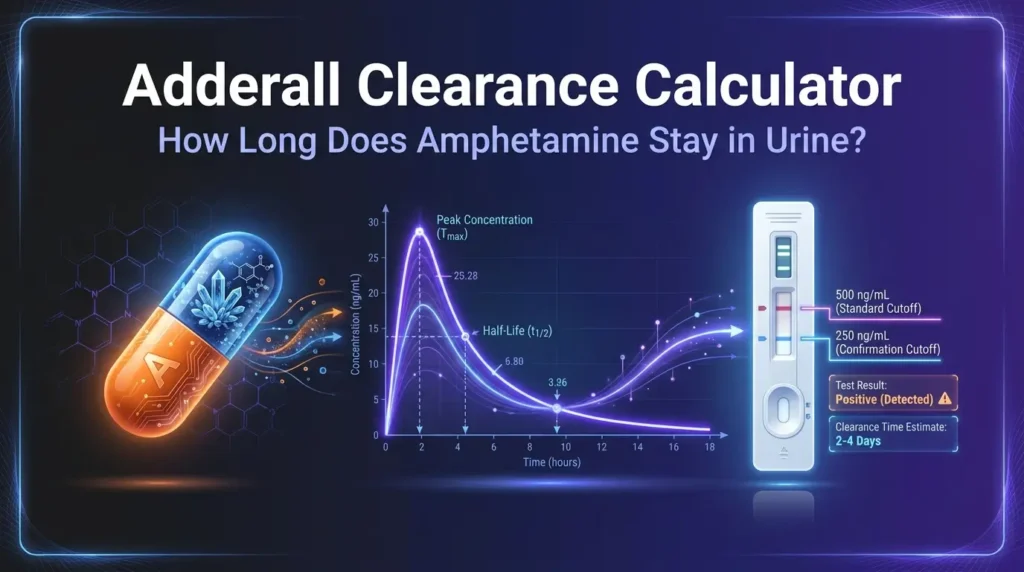
Adderall Clearance Calculator: How Long Does Amphetamine Stay in Urine?
Calculate precise elimination timelines for Adderall (mixed amphetamine salts) and prescription amphetamines. Calibrated with clinical pharmacokinetic half-life, formulation release kinetics, and urinary pH filtration mechanics.
| Testing Modality | Standard Cutoff | Estimated Current Level | Time to Clear | Status |
|---|
Pharmacokinetic Fundamentals
- d-Amphetamine half-life 9 to 11 Hours
- l-Amphetamine half-life 11 to 14 Hours
- Adderall IR Peak (Tmax) ~3 Hours
- Adderall XR Peak (Tmax) ~7 Hours
- Oral Bioavailability > 75%
- Volume of Distribution (Vd) 3.5 to 4.6 L/kg
Impact of Urinary pH
- Acidic Urine (pH < 6.0) 7 – 8 Hour Half-Life
- Normal Urine (pH 6.0 – 7.0) 10 – 12 Hour Half-Life
- Alkaline Urine (pH > 7.5) 16 – 20 Hour Half-Life
- Vitamin C / Ascorbic Acid Accelerates elimination
- Sodium Bicarbonate / Tums Delays elimination
- Renal Excretion Fraction 30% – 70% unchanged
Standard Drug Testing Cutoffs
- SAMHSA Workplace Screen 500 ng/mL
- GC-MS / LC-MS Confirmation 250 ng/mL
- Oral Fluid (Saliva) Screen 50 ng/mL
- Blood Plasma Screen 20 ng/mL
- Hair Follicle (90 Days) 500 pg/mg
Key Clearance Milestones
- Single 20mg IR dose Typically clear in 48-72h
- Chronic 40mg XR therapy Requires 3 to 5 days
- Saliva window 24 to 48 hours
- Blood plasma window 24 to 36 hours
- Elimination Model First-Order Kinetics
How long does Adderall stay in your urine?
For most individuals, Adderall remains detectable in urine for 48 to 72 hours (2 to 3 days) following a single immediate-release (IR) dose at the standard SAMHSA cutoff of 500 ng/mL. With daily, long-term therapeutic use or higher doses of Adderall XR (extended-release), detection can extend to 3 to 5 days (72 to 120 hours).
Why does urine pH dramatically change Adderall clearance time?
Amphetamine is a weak base with a pKa of 9.9. In an acidic urinary environment (pH below 6.0), amphetamine molecules become ionized, preventing their reabsorption by renal tubules and forcing rapid excretion into urine with a half-life of roughly 7 hours. In alkaline urine (pH above 7.5), amphetamine remains non-ionized and is readily reabsorbed into circulation, extending half-life up to 18–20 hours.
What is the difference between Adderall IR and Adderall XR detection?
Adderall IR releases the entire dose immediately, peaking in blood within roughly 3 hours. Adderall XR utilizes a dual-bead mechanism where 50% is released immediately and 50% is delayed by roughly 4 hours, peaking around 7 hours post-dose. Because the input curve is delayed, Adderall XR typically remains detectable for approximately 12 to 16 hours longer than an equivalent IR dose.
Does drinking water or taking baking soda affect an Adderall test?
Drinking water will dilute urine and lower creatinine concentration, but it does not speed up hepatic metabolism. In contrast, taking baking soda (sodium bicarbonate) alkalizes urine, which actually slows excretion and keeps amphetamine in your bloodstream longer. Consuming vitamin C (ascorbic acid) acidifies urine and accelerates clearance.
Adderall Clearance Calculator: The Complete Clinical Elimination Guide
Whether prescribed Adderall for ADHD or preparing for a standard pre-employment drug screen, determining how long amphetamine remains detectable is one of the most critical toxicology questions.
Our Adderall clearance calculator models the exact pharmacokinetic behavior of mixed amphetamine salts. Unlike oversimplified charts that provide generic “2 to 4 days” estimates, this tool factors in dosage, formulation type (Immediate Release vs. Extended Release), renal function, and the single most powerful physiological driver of amphetamine excretion: urinary pH.
Here is the scientific breakdown of how Adderall metabolizes in the human body, how drug testing cutoffs work, and what steps actually influence clearance.
What Is Adderall and How Is It Metabolized?
Adderall is a pharmaceutical preparation composed of mixed amphetamine salts in a specific 3:1 ratio:
- d-amphetamine (dextroamphetamine): 75%
- l-amphetamine (levoamphetamine): 25%
While d-amphetamine provides the primary central nervous system (CNS) stimulant and cognitive effects, l-amphetamine possesses stronger peripheral cardiovascular effects and a slightly longer half-life:
- d-amphetamine half-life: approximately 9 to 11 hours
- l-amphetamine half-life: approximately 11 to 14 hours
Following oral ingestion, amphetamine is absorbed efficiently via the gastrointestinal tract with a bioavailability exceeding 75%. Once in the bloodstream, it undergoes dual elimination:
- Hepatic Metabolism: The liver metabolizes approximately 30% to 50% of the dose via cytochrome P450 enzymes (primarily CYP2D6) into inactive metabolites such as 4-hydroxyamphetamine and norephedrine.
- Renal Excretion: Between 30% and 70% of the active amphetamine is excreted completely unchanged directly into urine through the kidneys.
Key Takeaway: Because a massive portion of Adderall leaves your body intact through your kidneys, your renal filtration rate and urine chemistry dictate detection times more than liver metabolism alone.
Why Urine pH Is the #1 Factor in Adderall Elimination
Most online drug test guides ignore the single most decisive factor in amphetamine pharmacokinetics: urinary pH.
Amphetamine is a weak base with a pKa of approximately 9.9. In pharmacology, the ionization state of a weak base depends directly on the acidity or alkalinity of the surrounding fluid (the Henderson-Hasselbalch principle).
1. Acidic Urine (pH < 6.0) — Rapid Elimination
When urine is acidic (promoted by high protein intake, cranberry juice, or ascorbic acid/vitamin C):
- Amphetamine molecules become ionized (protonated).
- Ionized molecules cannot passively cross the lipid membranes of the renal tubule cells.
- Reabsorption into the bloodstream is blocked.
- The drug is flushed rapidly into urine, reducing half-life to approximately 7 to 8 hours.
2. Alkaline Urine (pH > 7.5) — Trapped in the Body
When urine is alkaline (promoted by antacids, sodium bicarbonate, or a strict vegetarian diet):
- Amphetamine molecules remain non-ionized (lipophilic).
- The non-ionized drug easily diffuses back across renal tubular membranes into systemic circulation.
- Half-life dramatically extends up to 18 to 20 hours, keeping the drug in your system nearly twice as long.
Our Adderall clearance calculator includes urinary pH selection so you can see this clinically documented variance in action.
Adderall IR vs. Adderall XR: How Formulation Alters the Window
The release mechanism of your medication determines when peak concentration occurs:
| Metric | Adderall IR (Immediate Release) | Adderall XR (Extended Release) |
|---|---|---|
| Mechanism | Instant dissolution in stomach | 50% immediate beads, 50% delayed-release beads |
| Peak Blood Level (Tmax) | ~3 hours post-dose | ~7 hours post-dose |
| Duration of Clinical Effect | 4 to 6 hours | 10 to 12 hours |
| Detection Extension | Baseline | +12 to 18 hours longer than equivalent IR |
Because Adderall XR releases half of its dose roughly 4 hours after ingestion, the elimination countdown begins later in the day. An individual taking 30 mg of XR will test positive longer than an individual taking 30 mg of IR taken at the same time.
Standard Drug Testing Cutoffs for Amphetamine
When an employer, probation department, or medical facility orders a 5-panel, 10-panel, or 12-panel drug test, amphetamines are standardly included.
Testing facilities employ a two-step verification process established by federal SAMHSA guidelines:
1. Initial Immunoassay Screen (500 ng/mL Cutoff)
The initial urine screen uses an antibody-based test (ELISA or EMIT). The federal workplace cutoff established by SAMHSA and the Department of Transportation (DOT) is 500 ng/mL.
- If your urine concentration is 480 ng/mL, the test reads NEGATIVE.
- If your concentration is 510 ng/mL, it triggers a presumptive positive and moves to confirmation.
2. Confirmatory GC-MS / LC-MS Screen (250 ng/mL Cutoff)
If the immunoassay screen is presumptive positive, the laboratory runs a confirmatory test using Gas Chromatography-Mass Spectrometry (GC-MS) or Liquid Chromatography-Tandem Mass Spectrometry (LC-MS/MS).
- The confirmatory cutoff drops to 250 ng/mL.
- This test isolates the exact molecular fingerprint of d- and l-amphetamine, distinguishing prescription Adderall from over-the-counter nasal inhalers (l-desoxyephedrine) or pseudoephedrine.
Multi-Matrix Detection Windows (Urine, Saliva, Blood, Hair)
Our Adderall clearance calculator evaluates detection across all primary diagnostic mediums:
| Testing Modality | Typical Detection Window | Primary Use Case |
|---|---|---|
| Urine (500 ng/mL) | 48 to 72 Hours (up to 5 days for chronic/high dose) | Employment, probation, sports screening |
| Urine GC-MS (250 ng/mL) | 72 to 96 Hours (up to 6 days for alkaline urine) | Forensic verification, medical compliance |
| Oral Fluid / Saliva (50 ng/mL) | 24 to 48 Hours | Roadside DUI testing, rapid workplace screen |
| Blood Plasma (20 ng/mL) | 24 to 36 Hours | Hospital emergency settings, accident investigations |
| Hair Follicle (500 pg/mg) | Up to 90 Days | Historical pre-employment, judicial testing |
For hair testing windows, consult our specialized Hair Follicle Drug Test Calculator.
Does Drinking Water Clear Adderall Faster?
Drinking water stimulates urine output and temporarily dilutes the concentration of amphetamine in your bladder. However:
- Hydration does not accelerate metabolic elimination: Drinking excess gallons of water does not force your liver or kidneys to clear amphetamine faster.
- Dilution risks specimen invalidation: Commercial drug testing labs automatically check for urine creatinine (must be ≥20 mg/dL) and specific gravity (must be ≥1.003). If you over-hydrate, your sample will be flagged as “Negative Dilute,” which often requires an immediate retest under direct observation.
To calculate whether your fluid intake will trigger an invalid dilute sample, use our Urine Dilution & Creatinine Calculator.
Scientific Studies & Clinical References
The mathematical models in our Adderall clearance calculator are based on clinical pharmacology literature:
- Beckett A.H., Rowland M. (1965) — Urinary excretion of amphetamine: effect of urinary pH and urine flow. Journal of Pharmacy and Pharmacology, 17(10), 628-639. PubMed PMID: 5835928.
- Food and Drug Administration (FDA) — Adderall (Mixed Salts of a Single-Entity Amphetamine Product) Prescribing Information and Clinical Pharmacology. FDA Label Document.
- Substance Abuse and Mental Health Services Administration (SAMHSA) — Mandatory Guidelines for Federal Workplace Drug Testing Programs (Urine). SAMHSA Guidelines.
- Angrist B. et al. (1987) — The effects of urinary acidification and alkalinization on amphetamine disposition and pharmacodynamics in humans. Psychopharmacology, 91(1), 74-78.
Explore Our Other Diagnostic Calculators
Check your detection windows across other substances and clinical testing methods:
- THC Clearance Calculator — Calculate marijuana elimination timelines based on body fat percentage and lipid solubility.
- Hair Follicle Drug Test Calculator — 90-day forensic detection calculator based on hair growth rates and cut lengths.
- Cotinine Clearance Calculator — Track nicotine metabolite clearance for health and life insurance medical screens.
- EtG Clearance Time Calculator — Pharmacokinetic elimination calculator for ethyl glucuronide (alcohol urine marker).
- Urine Dilution & Creatinine Calculator — Test specimen validity, specific gravity, and dilution markers.
Medical & Legal Disclaimer
The Adderall clearance calculator and all materials on this page are provided strictly for educational, analytical, and informational purposes. Elimination rates vary based on individual genetic CYP2D6 enzyme activity, acute hydration, renal health, diet, and concurrent medications. This digital tool does not provide medical advice, diagnosis, or treatment, and cannot guarantee laboratory drug testing results. If you hold a valid medical prescription for Adderall, provide your documentation to the testing facility’s Medical Review Officer (MRO).