
Ketamine Clearance Calculator: How Long Does Ketamine Stay in Urine?
Pick your details below. Results update instantly. Ketamine T½ 2-3 h, norketamine T½ ~12 h.
Advanced: liver function / CYP3A4
Calculating…
Ketamine Clearance Calculator: The Complete Clinical Detection Guide
Whether administered clinically as an intravenous infusion for treatment-resistant depression, prescribed as intranasal esketamine (Spravato), used in surgical anesthesia, or facing a specialized drug screening, understanding how ketamine clears the human body is essential.
While parent ketamine clears from the bloodstream relatively fast, its downstream metabolites—specifically norketamine and dehydronorketamine—persist much longer in urine. Our ketamine clearance calculator calculates realistic elimination timelines across urine, blood, oral fluid (saliva), and hair, taking into account dosage, administration route, metabolic rate, and screening cutoff thresholds.
Below is an in-depth clinical review of how ketamine is absorbed and metabolized, why detection windows vary significantly between single and chronic usage, and whether ketamine triggers standard employment drug panels.
What Is Ketamine and How Is It Metabolized?
Ketamine (2-(2-chlorophenyl)-2-(methylamino)cyclohexan-1-one) is a dissociative anesthetic and rapid-acting antidepressant that functions primarily as a non-competitive antagonist of the N-methyl-D-aspartate (NMDA) receptor.
Following administration, ketamine undergoes extensive hepatic biotransformation:
- Hepatic N-Demethylation: In the liver, microsomal Cytochrome P450 enzymes—predominantly CYP3A4 and CYP2B6 (with minor contributions from CYP2C9)—demethylate ketamine into its primary active metabolite: Norketamine (NK).
- Hydroxylation to Dehydronorketamine: Norketamine is subsequently hydroxylated by liver enzymes into secondary metabolites, primarily 6-hydroxynorketamine and dehydronorketamine (DHNK).
- Glucuronidation & Renal Excretion: These intermediate metabolites undergo phase II glucuronide conjugation, making them polar and water-soluble. The kidneys filter and excrete approximately 90% to 95% of the total dose in urine, primarily as conjugated norketamine and dehydronorketamine, with less than 2% to 4% excreted as unchanged parent ketamine.
Key Pharmacokinetic Takeaway: Because the body rapidly transforms ketamine into norketamine, urine drug testing facilities do not simply test for parent ketamine. They target norketamine, which has a significantly longer elimination half-life and remains detectable for days after ketamine itself has vanished from blood.
Ketamine Half-Life: Parent Drug vs. Metabolites
Understanding drug clearance requires distinguishing between the parent drug and its active breakdown products:
1. Parent Ketamine Half-Life ($t_{1/2}\alpha$ and $t_{1/2}\beta$)
- Distribution Phase ($t_{1/2}\alpha$): 10 to 15 minutes. Ketamine is highly lipophilic and rapidly shifts from blood into brain and vascularized tissues.
- Terminal Elimination Phase ($t_{1/2}\beta$): 2.0 to 3.0 hours in healthy adults.
- Following the 5.5 half-life clearance rule, parent ketamine drops below 98% of circulating levels in approximately 11 to 16.5 hours.
2. Norketamine Elimination Half-Life ($t_{1/2}$)
- Norketamine Half-Life: Approximately 12.0 hours (ranging from 10 to 14 hours depending on hepatic clearance).
- Retains roughly 20% to 30% of ketamine’s anesthetic potency.
- Because norketamine takes roughly 66 hours (2.75 days) to eliminate down to 1% in blood, its urinary concentration remains elevated above laboratory cutoffs for 2 to 4 days following a single moderate dose, and up to 7 days with chronic or heavy administration.
Bioavailability Comparison by Administration Route
The route of administration fundamentally determines how much active drug reaches systemic circulation and the ratio of parent ketamine to first-pass metabolites:
| Route of Administration | Typical Bioavailability (%) | Peak Plasma Time ($T_{\text{max}}$) | Clinical & Pharmacokinetic Notes |
|---|---|---|---|
| Intravenous (IV) | 100% | Immediate (1–2 min) | Used in surgical anesthesia and clinical infusion protocols. Bypasses first-pass metabolism entirely. |
| Intramuscular (IM) | 93% | 5 to 15 minutes | High absorption rate, very close to IV kinetics. Rapid systemic distribution. |
| Intranasal (IN) | 40% – 50% | 15 to 30 minutes | Standard route for Spravato (esketamine nasal spray). Moderate first-pass swallowing occurs. |
| Sublingual / Troche | 25% – 30% | 30 to 45 minutes | Common for at-home compounded ketamine therapy. Portions are swallowed and absorbed gastrointestinally. |
| Oral (Ingested) | 17% – 24% | 45 to 90 minutes | Extensive first-pass hepatic metabolism degrades the majority of the dose directly into norketamine before entering systemic circulation. |
Higher oral and sublingual doses generate relatively higher ratios of norketamine, which can slightly prolong urinary detection compared to a low-dose IV infusion.
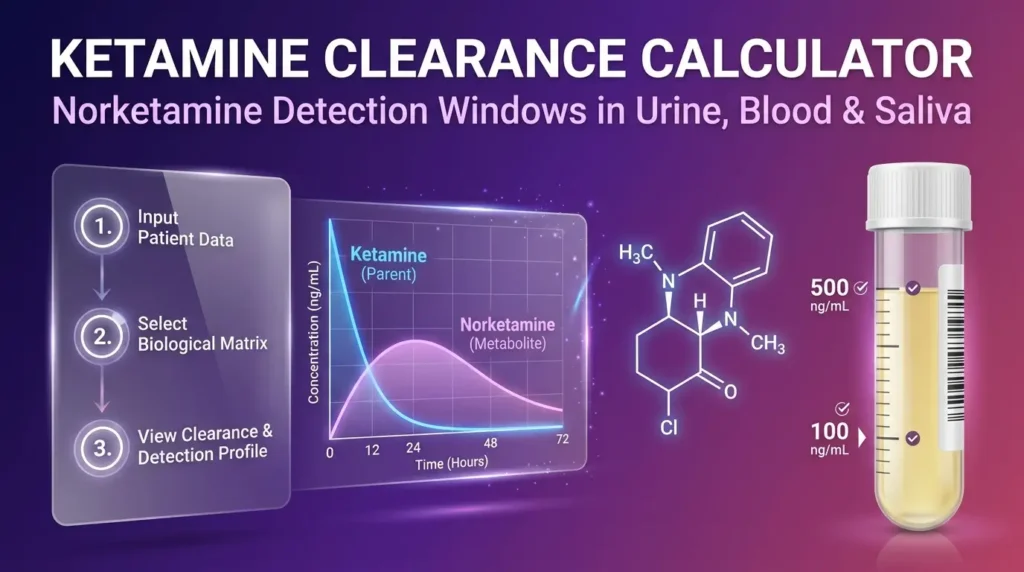
Multi-Matrix Detection Windows (Urine, Blood, Saliva, Hair)
Our ketamine clearance calculator predicts detection timeframes across all common analytical testing matrices:
| Diagnostic Matrix | Standard Laboratory Cutoff | Detection Window (Single Dose) | Detection Window (Repeated / Chronic) |
|---|---|---|---|
| Urine (Screening Immunoassay) | 500 ng/mL | 24 to 48 Hours (1–2 Days) | 3 to 5 Days |
| Urine (Confirmatory GC-MS/LC-MS) | 100 ng/mL | 48 to 72 Hours (2–3 Days) | 5 to 7+ Days |
| Blood / Serum Screen | 10 ng/mL | 12 to 24 Hours | 24 to 48 Hours |
| Oral Fluid (Saliva) | 10 ng/mL | 12 to 24 Hours | 24 to 36 Hours |
| Hair Follicle Analysis | 0.1 ng/mg (100 pg/mg) | Up to 90 Days | Up to 90 Days |
For forensic hair analysis timelines and follicle collection protocols, consult our Hair Follicle Drug Test Calculator.
Does Ketamine Show Up on Standard Drug Tests?
A common question is whether ketamine triggers standard employment or probationary drug screenings:
1. Standard 5-Panel Drug Test: NO
Standard federal workplace drug tests (DOT / SAMHSA 5-panel) screen exclusively for:
- Amphetamines (Adderall, Methamphetamine, MDMA)
- Cannabinoids (THC)
- Cocaine metabolites
- Opiates (Codeine, Morphine, Heroin)
- Phencyclidine (PCP)
Ketamine is chemically related to phencyclidine (both are arylcyclohexylamines), but ketamine does not reliably cross-react with modern PCP immunoassays. Modern immunoassay antibodies are specifically targeted to PCP’s piperidine ring, yielding negligible false-positive cross-reactivity with ketamine under standard clinical conditions.
2. Standard 10-Panel and 12-Panel Tests: TYPICALLY NO
Most standard 10-panel and 12-panel rapid cup tests add benzodiazepines, barbiturates, methadone, oxycodone, and buprenorphine—but still do not include ketamine.
3. When Is Ketamine Tested?
Ketamine is detected only when:
- An expanded comprehensive forensic panel (14-panel, 16-panel, or custom hospital tox screen) is ordered.
- Specialized ketamine immunoassay dip cards (calibrated to a 500 ng/mL or 1,000 ng/mL threshold) are used.
- Confirmatory testing is performed via Liquid Chromatography-Tandem Mass Spectrometry (LC-MS/MS) specifically requesting ketamine and norketamine analytes.
- Military, pain management compliance monitoring, or specialized court/probation protocols explicitly mandate ketamine screening.
Factors That Influence Ketamine Clearance Speed
Several physiological and external variables influence how fast ketamine and its metabolites leave the system:
- Liver Enzyme Activity (CYP3A4 & CYP2B6): Because the liver performs near-total clearance of ketamine, individuals with liver cirrhosis, hepatitis, or impaired hepatic blood flow experience extended clearance times.
- Frequency & Chronicity of Use: Single clinical infusions clear rapidly. However, frequent recreational use causes tissue accumulation in adipose tissue and induces metabolic tolerance, prolonging urinary norketamine clearance up to 5 to 7 days.
- Urinary Flow and Hydration: While extreme over-hydration cannot force liver enzymes to work faster, normal kidney filtration ensures consistent metabolite excretion. Over-diluting urine before a test may lower creatinine below acceptable levels (< 20 mg/dL), resulting in a “Negative Dilute” specimen. Check your sample integrity with our Urine Dilution & Creatinine Calculator.
- Co-administered Medications: Drugs that inhibit CYP3A4 (such as ketoconazole, clarithromycin, or grapefruit juice) can reduce ketamine clearance and elevate blood plasma levels. Conversely, CYP inducers (like rifampin or St. John’s Wort) may accelerate parent ketamine breakdown.
Scientific Studies & Clinical References
The mathematical clearance models in our ketamine clearance calculator are developed from peer-reviewed pharmacokinetic and clinical toxicology literature:
- White P.F., Way W.L., Trevor A.J. (1982) — Ketamine—its pharmacology and therapeutic uses. Anesthesiology, 56(2), 119-136. PubMed PMID: 7057038.
- Dillon F.X., et al. (1992) — Ketamine elimination kinetics and active urinary metabolites in human subjects. Clinical Pharmacokinetics, 22(4), 289-301. PubMed PMID: 1550607.
- Food and Drug Administration (FDA) — Spravato (Esketamine) Nasal Spray Prescribing Information and Clinical Pharmacology. FDA Reference Application.
- Substance Abuse and Mental Health Services Administration (SAMHSA) — Mandatory Guidelines for Federal Workplace Drug Testing Programs. SAMHSA.gov.
- Cheng P.S., et al. (2007) — Simultaneous determination of ketamine and its metabolites in urine by liquid chromatography-tandem mass spectrometry. Journal of Chromatography B, 852(1-2), 443-449.
Explore Our Other Diagnostic Calculators
Explore our complete suite of evidence-based drug clearance and testing calculators:
- Xanax Clearance Calculator — Calculate alprazolam and benzodiazepine half-life and urine detection windows.
- Adderall Clearance Calculator — Model amphetamine excretion times based on urinary pH and dosage.
- Kratom Clearance Calculator — Calculate mitragynine elimination timelines and biphasic clearance.
- THC Clearance Calculator — Estimate cannabinoid detection based on BMI, frequency of use, and body fat percentage.
- Steroid Detection Time Calculator — Calculate PED and anabolic steroid clearance times for athletic drug testing.
- Urine Dilution & Creatinine Calculator — Check specific gravity and creatinine levels to avoid dilute specimen flags.
- Hair Follicle Drug Test Calculator — 90-day forensic detection calculator based on monthly hair growth rates.
- EtG Clearance Time Calculator — Determine ethyl glucuronide alcohol breakdown timelines.
Medical & Legal Disclaimer
The ketamine clearance calculator and all supporting clinical materials on this website are created exclusively for educational, scientific, and informational purposes. Actual detection windows vary between individuals based on liver enzyme activity, metabolic health, body mass index, hydration, and the specific laboratory methodology employed. This tool does not provide medical diagnosis, clinical advice, or legal counsel. If you are undergoing prescribed ketamine or esketamine (Spravato) therapy under physician care, provide valid documentation to your clinic or Medical Review Officer (MRO).