
Breathalyzer vs Blood Alcohol Calculator: BAC to BrAC Conversion
Convert a breath reading to estimated blood alcohol, or estimate from your drinks. Statutory ratio 2,100:1, average elimination 0.015% per hour.
Advanced: blood-to-breath partition ratio
Legal & medical disclaimer: Educational reference only. Do not use estimates to decide whether you can drive. Impairment begins above 0.000%, and real BAC depends on food, health, genetics and instrument calibration. Always use a sober driver.
Breathalyzer vs Blood Alcohol Calculator: The Complete Forensic & Legal Guide
Whether evaluating a recent roadside breath test, preparing for a legal court proceeding, or deciding whether it is legally safe to operate a motor vehicle the morning after drinking, understanding how breathalyzers estimate blood alcohol is critical.
A common assumption is that a breathalyzer measures your true blood alcohol concentration (BAC). In reality, a breathalyzer never touches your blood. Instead, it captures deep alveolar air from your lungs and mathematically predicts what your blood alcohol should be based on a fixed statutory ratio. Under real-world conditions, biological variability, stomach acid reflux, mouth alcohol, and body temperature can cause breathalyzer readings to differ significantly from a laboratory venous blood draw.
Our breathalyzer vs blood alcohol calculator bridges this scientific gap, allowing you to convert breathalyzer readings (BrAC) into true venous blood BAC, model forensic margins of error, and calculate exact hour-by-hour clearance countdowns to reach legal driving thresholds and complete 0.000% sobriety.
Breath vs. Blood: The 2,100:1 Partition Ratio Explained
The mathematical bridge connecting breath to blood is governed by Henry’s Law, a principle of physical chemistry stating that at a constant temperature, the concentration of a volatile gas dissolved in a liquid is directly proportional to the partial pressure of that gas in the air above the liquid.
In forensic breath testing:
- When alcohol circulates through pulmonary capillaries surrounding the alveoli (microscopic air sacs in the lungs), ethanol molecules evaporate across the alveolar membrane into trapped lung air.
- Under statutory legal standards in the United States, Canada, and the United Kingdom, breathalyzers are mechanically calibrated to assume a blood-to-breath partition ratio of 2,100 to 1.
- This statutory constant assumes that 2,100 milliliters of alveolar deep-lung breath contain exactly the same amount of alcohol as 1 milliliter of circulating blood:
$$\text{Blood BAC (%)} = \frac{\text{Breath Alcohol Concentration (mg/L)} \times 2.1}{10}$$
The Biological Reality: Humans Are Not Machines
While breathalyzers treat every human as having an identical 2,100:1 ratio, decades of clinical peer-reviewed research (Dubowski, 1985; Jones, 2010) prove that actual human partition ratios vary widely between 1,750:1 and 2,400:1.
- Individuals with a Low Ratio (e.g., 1,750:1): The breathalyzer overestimates true blood alcohol by 15% to 20%. A driver with an actual legal blood BAC of 0.070% may falsely blow a 0.084% on a police breathalyzer!
- Individuals with a High Ratio (e.g., 2,400:1): The breathalyzer underestimates true blood alcohol by roughly 12% to 15%.
Can a Breathalyzer Overestimate Your True Blood Alcohol?
Yes. In forensic litigation and forensic toxicology, breathalyzers are well documented to produce readings higher than simultaneous venous blood draws under several specific physiological circumstances:
| Condition / Skew Variable | Physiological Mechanism | Magnitude of Reading Error |
|---|---|---|
| Low Biological Partition Ratio | Genetic / physiological pulmonary diffusion ratio below 2,100:1 | Overestimates blood BAC by 10% to 20% |
| Mouth Alcohol Contamination | Alcohol trapped in dental work, dentures, or throat mucosa | Inflates breath reading by +0.02% to +0.08%+ |
| Gastroesophageal Reflux (GERD) | Acidic stomach alcohol vapors belched into esophagus | Can trigger massive false readings exceeding 0.15% |
| Elevated Body Temperature (Fever) | Increased pulmonary temperature increases ethanol volatility | +6.5% inflation per 1°C (1.8°F) fever above 37°C |
| Rising Blood Alcohol Curve | Arterial blood (feeding lungs) is higher than venous blood (arm draw) | Breath test exceeds venous blood draw by 10% to 25% |
Critical Skew Factors: Mouth Alcohol, GERD, and Fever
If your breathalyzer reading seems surprisingly high compared to the number of drinks consumed, one of three major forensic artifacts is frequently responsible:
1. Residual Mouth Alcohol (The 20-Minute Observation Rule)
When you drink an alcoholic beverage, use alcohol-containing mouthwash, or use an oral medication, pure ethanol coats the mucosal tissues of your mouth, gums, and tongue.
- Police testing protocols legally mandate an uninterrupted 15 to 20-minute observation deprivation period prior to administering a breath test.
- If a subject burps, regurgitates, hiccups, or consumed alcohol within 20 minutes, raw mouth alcohol enters the device’s chamber, producing an artificially astronomical reading that bears zero relationship to systemic blood intoxication.
2. Gastroesophageal Reflux Disease (GERD) & Acid Reflux
Individuals suffering from chronic acid reflux, hiatal hernias, or heartburn frequently have gastric contents and alcohol vapors refluxing into the esophagus. Even a tiny micro-belch immediately prior to blowing can flood the breathalyzer with undigested stomach alcohol vapors, invalidating the result.
3. Body Temperature & Fever
Henry’s Law is temperature-dependent. Police breath testing instruments are calibrated assuming normal human deep-body core temperature of 37.0°C (98.6°F).
- Published clinical data confirms that for every 1.0°C increase in body temperature, the blood-to-breath ratio shifts, causing the instrument to read approximately 6.5% higher.
- An individual blowing with a high fever (e.g., 102.2°F / 39°C) will register a breathalyzer reading roughly 13% higher than their true blood alcohol level.
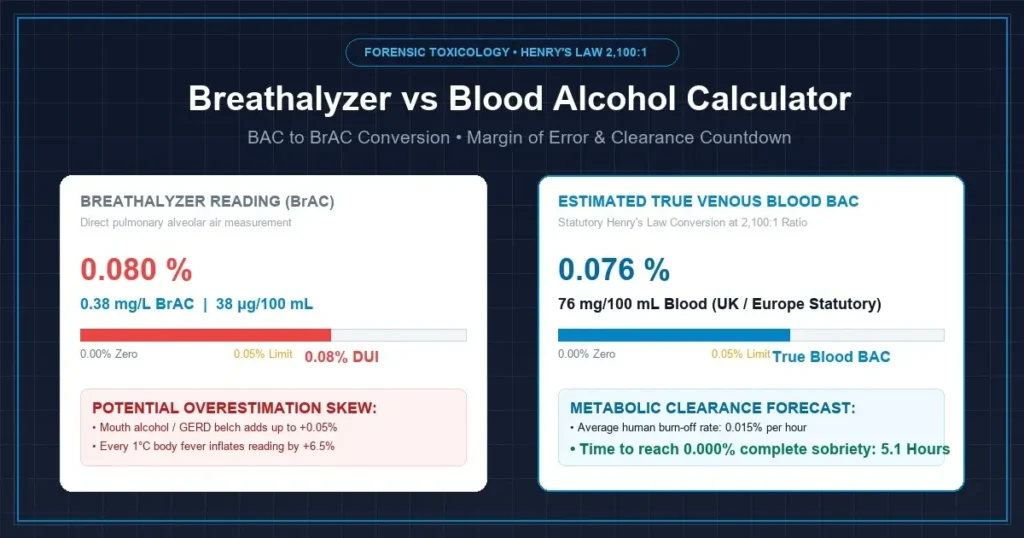
The Rising Blood Alcohol Curve (Absorption Phase Bias)
Timing relative to your last drink dictates whether breath or blood is higher:
- Absorption / Rising Phase (0 to 60 Minutes After Last Sip):
- Alcohol is actively absorbing from the stomach into the portal vein and heart, pumping directly into the pulmonary artery to the lungs.
- During this phase, arterial blood delivering alcohol to your lungs has a higher concentration than the venous blood in your arms.
- As a result, breathalyzer readings can be 10% to 25% higher than a simultaneous venous blood draw taken from your arm.
- Post-Absorptive / Elimination Phase (75+ Minutes After Drinking):
- Alcohol is completely distributed throughout total body water.
- Arterial and venous blood reach equilibrium, and breath readings closely mirror or fall slightly below venous blood.
Widmark Formula: Calculating Clearance & Sober Time
The human liver metabolizes ethanol primarily via the enzyme alcohol dehydrogenase (ADH), which operates under zero-order elimination kinetics (clearing a fixed amount of alcohol per hour regardless of blood concentration).
Standard Metabolic Clearance Rate ($\beta_{60}$):
In forensic science, the average rate of alcohol elimination ($\beta$) is modeled as:
$$\beta = 0.015%\text{ BAC per hour (Range: } 0.013% – 0.020%\text{ per hour)}$$
Estimating Exact Time to Reach Sober:
If an individual has a true blood BAC of 0.076%:
$$\text{Hours to 0.000%} = \frac{0.076%}{0.015% / \text{hour}} \approx \mathbf{5.1\text{ Hours}}$$
Our breathalyzer vs blood alcohol calculator automatically projects this decay curve, giving you the exact clock time when your system will drop below legal driving limits (0.08%, 0.05%, 0.04%, and 0.02%) and when you will reach complete 0.000% sobriety.
Global Legal Driving Limits: 0.08%, 0.05%, 0.04%, 0.02%
Driving laws vary drastically across jurisdictions and driver classifications:
| Legal Limit Threshold | Applicable Jurisdiction & Driver Categories | Typical Symptoms & Impairment |
|---|---|---|
| 0.08% BAC (80 mg/100 mL) | Standard adult non-commercial drivers in 49 US States, UK, Canada | Reduced muscle coordination, impaired judgment, slower reaction times |
| 0.05% BAC (50 mg/100 mL) | Utah (USA), Australia, Scotland, Germany, France, most of Europe | Exaggerated behavior, reduced alertness, release of inhibitions |
| 0.04% BAC (40 mg/100 mL) | Commercial Motor Vehicle Drivers (CDL), airline pilots | Detectable loss of concentration, minor divided-attention deficits |
| 0.02% / 0.00% Zero Tolerance | Drivers Under 21, Probationers, Ignition Interlock Device (IID) users | Even a single sip or trace mouthwash triggers an interlock lockout |
International Unit Conversions: % BAC, mg/L, and μg/100mL
Depending on the country or testing instrument, blood and breath alcohol are reported in distinct statutory scientific units:
| Unit of Measurement | Common Jurisdictions | Mathematical Conversion from 0.08% BAC |
|---|---|---|
| % BAC (g/100 mL) | United States, Canada | 0.080% BAC |
| mg/100 mL (mg%) | United Kingdom, Ireland, Continental Europe | 80 mg / 100 mL Blood |
| mg/L BrAC | Australia, New Zealand, Continental Europe | 0.38 mg / L Breath |
| μg/100 mL BrAC | United Kingdom (Statutory Breath Limit) | 35 to 38 μg / 100 mL Breath |
| Promille (‰) | Germany, Scandinavia, Eastern Europe | 0.80 ‰ (g/kg) |
Scientific Studies & Clinical References
The mathematical conversions and forensic principles in our breathalyzer vs blood alcohol calculator are based on clinical literature and federal standards:
- Jones A.W. (2010) — Evidence-based survey of the elimination rates of ethanol from blood with applications in forensic casework and toxicology. Forensic Science International, 200(1-3), 1-20. PubMed PMID: 20478148.
- Dubowski K.M. (1985) — Absorption, distribution and elimination of alcohol: highway safety aspects. Journal of Studies on Alcohol, Supplement No. 10, 98-108. PubMed PMID: 3889108.
- Hlastala M.P. (1998) — The alcohol breath test: a review of the physical and physiological assumptions. Physiological Measurement, 19(3), R1-R22. PubMed PMID: 9531818.
- National Highway Traffic Safety Administration (NHTSA) — Model Specifications for Evidential Breath Alcohol Measurement Devices. Federal Register. NHTSA.gov.
- Mason M.F., Dubowski K.M. (1976) — Breath-alcohol analysis: uses, methods, and legal aspects. Journal of Forensic Sciences, 21(1), 9-41.
Explore Our Other Alcohol & Drug Testing Calculators
Explore our comprehensive portfolio of clinical alcohol and drug testing tools:
- Blood Alcohol Concentration (BAC) Calculator — Calculate theoretical Widmark alcohol absorption based on weight and drinks.
- EtG Clearance Time Calculator — Real-time countdown to clear urine ethyl glucuronide alcohol cutoffs.
- Drinks to Fail EtG Calculator — Find your maximum safe drink limit to avoid failing an EtG urine test.
- ETG Pass/Fail Predictor — Evidence-based clinical probability scoring for alcohol urine panels.
- EtG Half-Life Calculator — Model exponential metabolite decay curves.
- Urine Dilution & Creatinine Calculator — Check specific gravity and creatinine to prevent negative dilute flags.
- Cocaine Clearance Calculator — Calculate benzoylecgonine and alcohol-cocaethylene detection windows.
- MDMA Clearance Calculator — Calculate ecstasy elimination and CYP2D6 autoinhibition timelines.
Legal & Medical Disclaimer
The breathalyzer vs blood alcohol calculator and all supporting clinical materials on this website are provided strictly for educational, scientific, and harm-reduction purposes. Never use digital calculations or software estimations to evaluate your fitness to operate a motor vehicle, watercraft, or commercial machinery. Alcohol impairs motor skills, perception, and reaction times at all levels above 0.000%. Certified evidential chemical tests administered by law enforcement or accredited laboratories supersede all theoretical calculations. Always designate a completely sober driver.