
BAC Calculator
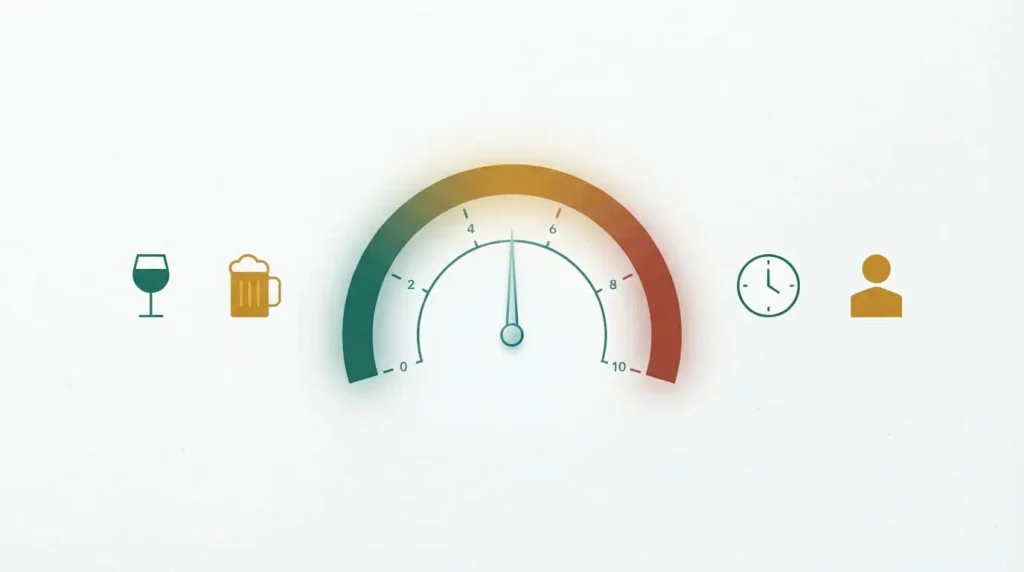
A quick dial view of your estimated blood alcohol concentration, using the Widmark method.
BAC Calculator: Estimate Your Blood Alcohol Concentration Instantly
Wondering how many drinks it takes to hit 0.08%, or how long you need to wait before you're safely under the legal limit? Our BAC calculator gives you a fast, visual estimate of your blood alcohol concentration based on your body weight, biological sex, how much you've had to drink, and how much time has passed. Below, we break down exactly what BAC means, how the calculator works, and how to read your results.
What Is BAC (Blood Alcohol Concentration)?
Blood alcohol concentration, or BAC, is the percentage of alcohol present in your bloodstream. A BAC of 0.08% means that 0.08% of your blood volume is pure alcohol. This single number is the standard that law enforcement, medical professionals, and researchers use to describe alcohol intoxication, and it's the basis for legal driving limits in most countries.
BAC rises as you drink and falls as your liver metabolizes the alcohol out of your system. Because that rise and fall depends on several personal factors, the same four drinks can produce very different BAC levels in two different people.
How Our BAC Calculator Works
This calculator uses the Widmark formula, the most widely referenced method for estimating blood alcohol concentration from a known amount of alcohol consumed. The formula accounts for:
- Total alcohol consumed, measured in standard drinks (about 14 grams of pure ethanol each — roughly a 12 oz beer, a 5 oz glass of wine, or a 1.5 oz shot of liquor)
- Body weight, since alcohol distributes through your total body water — a heavier person generally reaches a lower peak BAC from the same number of drinks
- Biological sex, because average body water percentage differs between men and women, which changes how concentrated the alcohol becomes
- Elimination rate, the speed at which your liver processes alcohol out of your bloodstream, typically averaging around 0.015% per hour, though this varies by individual
- Time elapsed, both how long you spent drinking and how many hours have passed since your last drink
The calculator first estimates your peak BAC — the highest point your blood alcohol would reach right after you finish drinking — then applies a steady, linear decline to model elimination over time, which reflects how the body actually clears alcohol (a roughly constant rate, rather than speeding up or slowing down as levels drop).
You can use our free EtG Calculator
Reading Your Results
The gauge shows your estimated current BAC as a percentage, along with a status indicator:
- At 0.00% — no measurable alcohol remaining, based on the inputs given
- Below 0.08% — under the most common legal driving limit in the U.S., though still potentially impaired
- At or above 0.08% — at or above the legal limit in most U.S. states
The timeline underneath estimates how many hours it will take to drop below 0.08% and how many hours until your BAC returns to zero, based on your current inputs.
What Affects Your BAC Besides Drinks and Weight?
The calculator focuses on the core Widmark inputs, but real-world BAC can shift based on additional factors worth knowing about:
- Food intake — drinking on an empty stomach speeds up alcohol absorption and can raise peak BAC
- Drink strength — a "standard drink" assumes typical alcohol content; craft beers, fortified wines, and strong cocktails often contain more than one standard drink's worth of alcohol
- Rate of consumption — spacing drinks out over several hours produces a lower peak than drinking the same amount quickly
- Medications and health conditions — certain medications and liver conditions can slow alcohol metabolism
- Individual metabolism — elimination rates commonly range from about 0.012% to 0.020% per hour from person to person, which is why the calculator lets you choose slow, average, or fast elimination
Legal BAC Limits: What You Should Know
In most U.S. states, the legal limit for driving is 0.08% BAC for drivers 21 and older, with stricter limits for commercial drivers (typically 0.04%) and zero-tolerance policies for drivers under 21. Limits vary internationally — many countries set the limit lower, around 0.05% or 0.02%, and some enforce a strict 0.00% for all drivers. Always check the specific law in your state or country, since this calculator uses the common 0.08% reference point as a general guide, not a legal standard for your location.
How Long Does Alcohol Stay in Your System?
As a rough rule of thumb, the body eliminates alcohol at an average of one standard drink's worth of BAC increase per hour. That means someone with a BAC of 0.08% might take roughly five to six hours to return to 0.00%, though this depends heavily on the factors listed above. The only thing that reliably lowers BAC is time — coffee, cold showers, and food will not speed up elimination, even if they make you feel more alert.
Frequently Asked Questions
Is this BAC calculator accurate? It provides a statistical estimate based on the Widmark method, which is widely used in research and forensic contexts. However, it cannot account for your unique physiology, stomach contents, hydration, or drink strength precisely, so treat the number as an educational estimate rather than an exact measurement.
Can I use this to decide if I'm okay to drive? No. This tool is for educational purposes only and should never be used to make decisions about driving, operating machinery, or any activity requiring sobriety. The only reliable way to confirm your BAC is a breathalyzer or blood test administered by a professional or law enforcement.
Why does biological sex affect the calculation? On average, women have a higher percentage of body fat and lower percentage of body water than men of similar weight. Since alcohol dissolves in body water, this typically results in a higher BAC for women than men after consuming the same number of drinks at the same body weight.
What counts as one standard drink? In the U.S., one standard drink contains about 14 grams of pure alcohol — roughly a 12 oz regular beer (5% ABV), a 5 oz glass of wine (12% ABV), or a 1.5 oz shot of distilled spirits (40% ABV).
Why did my BAC estimate change when I adjusted "drinking duration"? Spreading the same number of drinks over a longer period gives your body more time to start eliminating alcohol before you finish drinking, which lowers the estimated peak compared to consuming everything quickly.
This calculator is meant to build awareness, not replace medical guidance. For a deeper look at how alcohol moves through your bloodstream and affects your body over time, the National Institute on Alcohol Abuse and Alcoholism (NIAAA) offers research-based information on alcohol's short- and long-term effects, and is a good next stop if you want to understand the science behind the numbers this tool produces.
A Note on Responsible Use
This calculator is built for education and awareness — helping you understand how alcohol metabolism works, not to greenlight risky decisions. If you're estimating your BAC because you're planning to drive, the safest choice is always to arrange a ride, use public transit, or wait it out with a sober friend rather than relying on any calculator's number.