
Clonazepam & 7-Aminoclonazepam Clearance Calculator
Estimate urine detection windows, elimination half-life, and the chance a standard immunoassay misses clonazepam, based on published nitrobenzodiazepine metabolism studies.
Clinical & Exposure Inputs
Pharmacokinetic Diagnostics & Risk
Estimated Detection Windows by Diagnostic Matrix
| Testing Matrix | Standard Cutoff | Estimated Detection Window |
|---|---|---|
| Standard Multi-Drug Cup | 200 – 300 ng/mL | 1 – 3 Days (often missed) |
| Clonazepam-Specific Dip Card | 50 – 100 ng/mL | 3 – 6 Days |
| Confirmatory LC-MS/MS | 20 – 40 ng/mL | 5 – 10 Days |
| Blood / Serum Screen | 10 – 20 ng/mL | 2 – 4 Days |
| Oral Fluid (Saliva) | 1 – 5 ng/mL | 1 – 3 Days |
| Hair Follicle Analysis | 0.1 ng/mg | Up to 90 Days (1.5 in. hair) |
Clonazepam (Klonopin) Clearance Times & Detection Windows: The Clinical Pharmacology of 7-Aminoclonazepam
Clonazepam (marketed under brand names including Klonopin and Rivotril) is one of the most widely prescribed long-acting benzodiazepines in the world, approved by the FDA for the treatment of panic disorder, agoraphobia, Lennox-Gastaut syndrome, and various seizure disorders.
Despite its extensive medical use, clonazepam presents one of the most perplexing challenges in clinical toxicology and forensic drug testing: patients taking therapeutic Klonopin regularly test completely negative on standard workplace and emergency department drug screens.
Understanding the pharmacokinetic clearance of clonazepam requires looking beyond the parent molecule and examining its primary urinary metabolite, 7-aminoclonazepam. Use the interactive Clonazepam & 7-Aminoclonazepam Clearance Calculator above to model your specific dose, usage history, and metabolic factors against laboratory cutoff thresholds.
1. How Long Does Clonazepam Stay in Your System?
The detection window for clonazepam depends heavily on whether exposure was a single acute dose or continuous daily maintenance therapy, as well as the diagnostic technology used:
| Diagnostic Specimen Matrix | Acute / Single Dose (0.5 – 1 mg) | Chronic Daily Therapy (>2 weeks) | Standard Laboratory Cutoff Level |
|---|---|---|---|
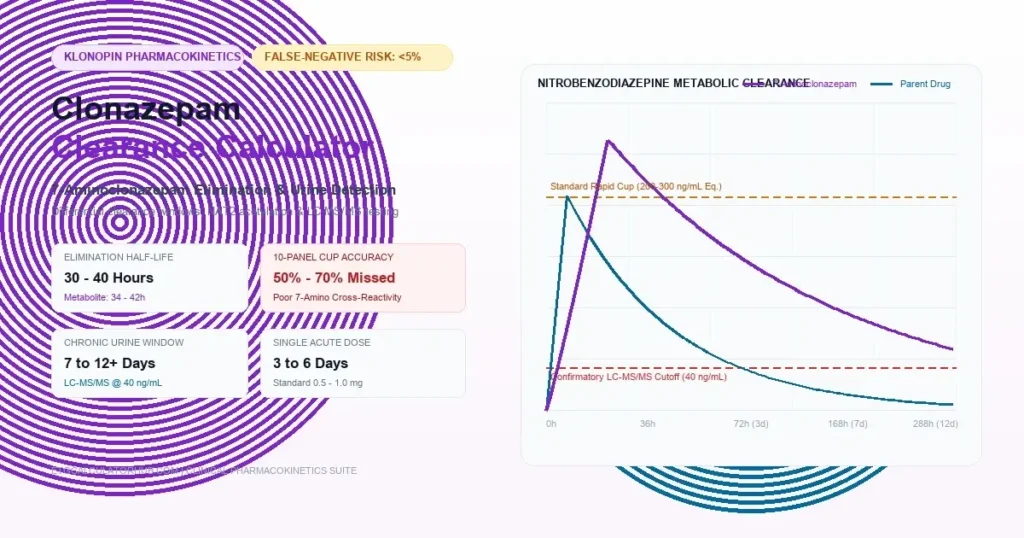
| Standard 10-Panel Rapid Cup | 0 to 24 Hours (70%+ False Negative) | 1 to 3 Days (50%+ False Negative) | 200 – 300 ng/mL (Oxazepam calibrator) |
| Clonazepam-Specific Immunoassay | 2 to 4 Days | 4 to 7 Days | 50 – 100 ng/mL (Dedicated antibody) |
| Confirmatory LC-MS/MS Urine | 3 to 6 Days | 7 to 12+ Days | 20 – 40 ng/mL (7-Aminoclonazepam) |
| Blood / Plasma Screen | 1 to 3 Days (24 – 72 Hours) | 3 to 5 Days | 10 – 20 ng/mL (Parent Clonazepam) |
| Oral Fluid (Saliva Swab) | 1 to 2 Days (24 – 48 Hours) | 2 to 4 Days | 1.0 – 5.0 ng/mL |
| Hair Follicle Analysis | Not reliable for acute single doses | Up to 90 Days | 0.1 ng/mg (1.5-inch proximal sample) |
Key Clinical Takeaway: On standard rapid point-of-care drug test cups, clonazepam is frequently undetectable due to cross-reactivity failure. When verified using definitive Liquid Chromatography-Tandem Mass Spectrometry (LC-MS/MS), 7-aminoclonazepam remains detectable for up to 12 days following chronic administration.
2. The “False Negative” Crisis on Standard Benzodiazepine Immunoassays
The single most critical clinical aspect of clonazepam drug testing is the high rate of false-negative results on standard urine immunoassays.
Standard Benzodiazepine Immunoassay (EMIT / Lateral Flow Cup)
   ├── Primary Calibrator: Oxazepam / Nordiazepam
   ├── Cross-Reactivity Target: 1,4-Benzodiazepine with 7-Chloro Group
   ├── Cross-Reactivity with Clonazepam: ~10% to 20%
   └── Cross-Reactivity with 7-Aminoclonazepam: < 5% (Often < 1%)
Why Do Standard Drug Cups Miss Klonopin?
Point-of-care test cups (such as standard SAMHSA-compliant 5-panel, 10-panel, or 12-panel rapid urine cups) utilize polyclonal or monoclonal antibodies engineered to bind oxazepam or nordiazepam at cutoffs of 200 ng/mL or 300 ng/mL.
- Urinary Composition: In human urine, less than 0.5% of a clonazepam dose is excreted unchanged as parent clonazepam. Over 90% of urinary drug molecules exist as 7-aminoclonazepam.
- Structural Incompatibility: Clonazepam is a nitrobenzodiazepine. During hepatic metabolism, its nitro group ($-NO_2$) at position 7 is enzymatically reduced to an amino group ($-NH_2$).
- The Antibody Mismatch: Standard test cup antibodies require an electronegative group (such as chlorine in diazepam/oxazepam or nitro in intact clonazepam) to achieve high-affinity binding. The positive basic character of the 7-amino group causes near-total loss of antibody recognition.
Peer-Reviewed Clinical Evidence
Multiple landmark clinical studies have documented this diagnostic gap:
- Fraser & Zamecnik (2003) evaluated urine specimens from patients prescribed clonazepam and found that the standard CEDIA, EMIT II, and Abbott FPIA immunoassay kits failed to detect over 65% of positive samples that were subsequently confirmed by GC-MS.
- West et al. (2006) in the Journal of Pain & Palliative Care Pharmacotherapy evaluated pain clinic patients taking Klonopin and demonstrated that 70.6% tested negative on standard point-of-care immunoassay cups despite having confirmed concentrations of 7-aminoclonazepam in their urine exceeding 500 ng/mL.
- Pesce et al. (2012) concluded in Pain Physician that point-of-care immunoassay testing is clinically inadequate for monitoring clonazepam adherence, requiring direct chromatographic confirmation (LC-MS/MS).
3. Pharmacokinetic Profile: Absorption, Biotransformation & Half-Life
Clonazepam possesses intermediate-to-long pharmacokinetic dynamics characterized by high bioavailability and extensive hepatic metabolism:
Absorption & Distribution
- Bioavailability: Rapidly and almost completely absorbed following oral administration, with systemic bioavailability of $\approx 90%$.
- Time to Peak Concentration ($T_{\max}$): Peak plasma concentrations ($C_{\max}$) occur between 1 and 4 hours post-ingestion.
- Volume of Distribution ($V_d$): Clonazepam is moderately lipophilic ($\log P \approx 2.4$), with a volume of distribution ranging from 1.5 to 4.4 L/kg. It is approximately 85% bound to plasma proteins (predominantly albumin).
The Metabolic Pathway: CYP3A4 and NAT2
Clonazepam undergoes biotransformation in the liver via two sequential enzymatic steps:
Clonazepam (Parent Drug)
       │
       ▼ [Hepatic Nitroreduction via Cytochrome P450 3A4]
7-Aminoclonazepam (Major Urinary Metabolite, t½ = 34–42 hrs)
       │
       ▼ [N-Acetylation via N-Acetyltransferase 2 (NAT2)]
7-Acetamidoclonazepam (Secondary Inactive Metabolite)- Phase I Nitroreduction (CYP3A4): Hepatic CYP3A4 enzymes reduce the 7-nitro functional group into 7-aminoclonazepam. This metabolite has virtually no anticonvulsant activity but represents the definitive biomarker for toxicology confirmation.
- Phase II Acetylation (NAT2): 7-aminoclonazepam is subsequently acetylated by $N$-acetyltransferase 2 into 7-acetamidoclonazepam. Patients who possess the genetically determined “slow acetylator” phenotype retain higher urinary concentrations of 7-aminoclonazepam for extended periods.
Elimination Half-Lives ($t_{1/2}$)
- Parent Clonazepam Elimination Half-Life: 30 to 40 hours (reference range: 20 to 50 hours).
- 7-Aminoclonazepam Metabolite Half-Life: 34 to 42 hours. Because the metabolite is formed continuously as parent drug clears, its apparent elimination half-life is often rate-limited by parent metabolism.
- Elderly / Hepatic Impairment: In individuals over age 65 or those with compromised hepatic function, elimination half-life can prolong significantly to 50 to 65+ hours.
4. Steady-State Accumulation Dynamics
Because clonazepam’s elimination half-life (34 hours) exceeds the standard once- or twice-daily dosing interval (12 to 24 hours), the drug accumulates significantly in systemic circulation before reaching pharmacokinetic steady state ($C_{ss}$).
The Accumulation Index ($R$)
The theoretical accumulation ratio $R$ is governed by the dosing interval ($\tau = 24\text{ hours}$) and elimination rate constant ($k = \frac{\ln 2}{t_{1/2}} \approx 0.0204\text{ h}^{-1}$):
$$R = \frac{1}{1 – e^{-k \tau}} = \frac{1}{1 – e^{-(0.0204)(24)}} \approx \frac{1}{1 – 0.613} \approx 2.58$$
This demonstrates that during continuous daily therapy:
- Circulating blood and tissue concentrations are 2.5 to 2.8 times higher than after a single isolated dose.
- Steady state is achieved after 5 to 7 half-lives, representing 7 to 10 days of consistent daily dosing.
- Once discontinued, clearance takes proportionally longer because the total body drug burden is nearly triple that of an acute dose.
5. Comparison: Clonazepam vs. Other Benzodiazepines
Benzodiazepines differ dramatically in half-life, active metabolites, and detection characteristics:
| Benzodiazepine | Active Metabolite(s) | Elimination Half-Life ($t_{1/2}$) | Standard Cup Detection | Confirmatory Urine Window |
|---|---|---|---|---|
| Clonazepam (Klonopin) | 7-Aminoclonazepam | 30 – 40 Hours | Poor (<5% Cross-Reactivity) | 7 to 12 Days |
| Alprazolam (Xanax) | $\alpha$-Hydroxyalprazolam | 11 – 15 Hours | Moderate (Good at 200 ng/mL) | 3 to 5 Days (See Xanax Clearance Calculator) |
| Diazepam (Valium) | Nordiazepam, Oxazepam, Temazepam | 40 – 100+ Hours | Excellent (Calibrator compound) | 10 to 28+ Days |
| Lorazepam (Ativan) | Lorazepam Glucuronide | 10 – 20 Hours | Moderate to Poor | 3 to 6 Days |
6. How to Ensure Testing Accuracy: Clinical Best Practices
If you are undergoing drug testing for employment, probation, or pain management compliance while taking clonazepam:
- Disclose Your Prescription in Advance: Always provide valid medical documentation to the Medical Review Officer (MRO) before specimen collection.
- Request LC-MS/MS Confirmation: If you are in a pain management program where a “negative” test result suggests non-compliance (failing to take prescribed medication), insist on Liquid Chromatography-Tandem Mass Spectrometry confirmation targeting 7-aminoclonazepam at a 20 ng/mL or 40 ng/mL cutoff.
- Avoid Over-Hydration: Consuming extreme amounts of water will dilute your urine creatinine below 20 mg/dL, resulting in a “Negative-Dilute” specimen. You can check your dilution risk using our Urine Dilution Calculator.
7. Frequently Asked Questions
Can Klonopin show up on a standard 5-panel or 10-panel drug test?
Standard 5-panel drug screens (SAMHSA-5) do not test for benzodiazepines at all; they only test for amphetamines, cocaine, opiates, PCP, and THC. Standard 10-panel and 12-panel screens do include a benzodiazepine (BZO) panel, but because the panel targets oxazepam, it produces a false-negative result in 50% to 70% of clonazepam users.
How many days does it take to get 0.5 mg of Klonopin out of urine?
Following a single 0.5 mg dose in a healthy adult, 7-aminoclonazepam levels drop below standard LC-MS/MS detection thresholds (40 ng/mL) in 3 to 5 days. On a standard rapid immunoassay cup, it may never register positive at all due to poor antibody binding.
Does Clonazepam show up in mouth swab (saliva) tests?
Yes, clonazepam transfers from blood into oral fluid via passive diffusion, though salivary concentrations are lower than plasma levels. Oral fluid tests can detect parent clonazepam for 24 to 72 hours post-ingestion.
What causes clonazepam to clear faster or slower?
Hepatic CYP3A4 enzyme activity is the primary determinant. Potent CYP3A4 inhibitors (such as fluconazole, clarithromycin, or grapefruit juice) slow metabolism, prolonging clearance. Conversely, enzyme inducers (like carbamazepine, phenytoin, or St. John’s wort) accelerate metabolism. Additionally, elderly patients and those with liver disease exhibit extended elimination windows.
Scientific Studies & Clinical References
- Fraser, A. D., & Zamecnik, J. (2003). Impact of antibodies on the detection of clonazepam and its primary metabolite, 7-aminoclonazepam, by immunoassays. Journal of Analytical Toxicology, 27(6), 344-348. PubMed PMID: 14510767.
- West, R., Pesce, A., West, C., et al. (2006). Comparison of clonazepam and 7-aminoclonazepam cross-reactivity on four point-of-care immunoassay devices. Journal of Pain & Palliative Care Pharmacotherapy, 20(2), 29-37. PubMed PMID: 16900251.
- Pesce, A., Rosenthal, M., West, R., et al. (2012). An evaluation of the clinical utility of immunoassay screening for clonazepam in pain management patients. Pain Physician, 15(3 Suppl), ES201-ES219. PubMed PMID: 22622912.
- Greenblatt, D. J., Miller, L. G., & Shader, R. I. (1987). Clonazepam pharmacokinetics: Clinically relevant aspects. Psychopharmacology Bulletin, 23(1), 35-41.
- Substance Abuse and Mental Health Services Administration (SAMHSA). (2022). Clinical Drug Testing in Primary Care. Technical Assistance Publication (TAP) 32. HHS Publication No. (SMA) 12-4668.