
The Clinical Science of Passing an EtG Alcohol Urine Test: Cutoffs, Metabolism, and Clearance Kinetics
Quick Summary: Ethyl Glucuronide (EtG) is a minor direct metabolite of ethanol created by UDP-glucuronosyltransferase enzymes in the liver. While ethanol clears the blood within hours at a constant zero-order rate ($0.015\text{–}0.020\text{ g/dL/hr}$), EtG exhibits first-order exponential decay with a median elimination half-life of 2.5 to 3.5 hours. Passing an EtG test requires sufficient time for peak urinary concentrations (which can reach 50,000+ ng/mL) to fall below your laboratory’s cutoff (100, 300, or 500 ng/mL).
Calculate Your Exact Elimination Timeline
Do not rely on generic charts or unverified myths. Use our interactive clinical pharmacokinetic calculator to model your drinks, gender, weight, and testing cutoff: Open EtG Pass/Fail Predictor →
1. What Is Ethyl Glucuronide (EtG)?
When an individual consumes beverage alcohol (ethanol), more than 90% to 95% is oxidized by hepatic alcohol dehydrogenase (ADH) and aldehyde dehydrogenase (ALDH) into acetaldehyde and acetate.
However, a small fraction (approximately 0.5% to 1.5%) undergoes Phase II enzymatic conjugation with glucuronic acid via hepatic UDP-glucuronosyltransferase (UGT) enzymes (primarily UGT1A9 and UGT2B7). This reaction produces Ethyl Glucuronide (EtG) and Ethyl Sulfate (EtS).
Beverage Ethanol Ingestion
   │
   ├── > 95% Phase I Oxidation (ADH / ALDH) ───> Acetaldehyde ───> Carbon Dioxide + Water
   │
   └── ~ 1% Phase II Glucuronidation (UGT) ────> Ethyl Glucuronide (EtG) ───> Renal Excretion
Why Do Courts and Employers Test for EtG?
- Zero-Order vs. First-Order Elimination: Ethanol clears the blood at a rapid, linear rate of about 1 standard drink per hour. Once your Blood Alcohol Concentration (BAC) hits 0.00%, ethanol can no longer be detected in breath or blood.
- The Extended Diagnostic Window: EtG is water-soluble, highly stable, and eliminated exponentially through glomerular filtration, persisting in urine long after parent alcohol has completely vanished.
2. The 80-Hour Myth vs. Real-World Clearance Timelines
Commercial testing laboratories frequently advertise the EtG test as the “80-hour alcohol test.” However, clinical pharmacokinetic studies by Wurst et al. (2003) and Jatlow et al. (2014) demonstrate that an 80-hour detection window occurs only under extreme circumstances:
| Drinking Level | Standard Drinks | Peak Urine EtG (ng/mL) | Real Clearance Time (500 ng/mL Cutoff) | Strict 100 ng/mL Cutoff |
|---|---|---|---|---|
| Very Light | 1 – 2 Beers / Wine | 1,000 – 4,000 | 18 to 24 Hours | 24 to 36 Hours |
| Moderate | 3 – 5 Drinks | 5,000 – 25,000 | 30 to 42 Hours | 40 to 52 Hours |
| Heavy / Binge | 6 – 10 Drinks | 30,000 – 80,000+ | 48 to 60 Hours | 60 to 72 Hours |
| Chronic Binge | 12+ Drinks / Days | 100,000+ | 60 to 72 Hours | 72 to 84+ Hours |
Clinical Reality: In healthy individuals consuming moderate amounts of alcohol, EtG clears below standard 500 ng/mL cutoffs within 36 to 48 hours. Only massive, multi-day binge drinking can produce detectable EtG approaching 72 to 80 hours.
3. Laboratory Cutoff Thresholds: 100 vs. 300 vs. 500 ng/mL
The single most critical variable determining whether you pass an EtG test is the cutoff threshold set by your monitoring authority:
1. The 500 ng/mL Cutoff (SAMHSA & Court Standard)
- Clinical Significance: Recommended by the Substance Abuse and Mental Health Services Administration (SAMHSA) to protect individuals from false accusations.
- Why It Matters: A 500 ng/mL cutoff reliably rules out incidental environmental exposure (e.g., alcohol-based hand sanitizers, mouthwash, non-alcoholic beers, and food cooked with wine).
2. The 100 to 250 ng/mL Cutoff (Zero-Tolerance / Abstinence Programs)
- Clinical Significance: Used in strict physician health programs, military courts, and high-stakes child custody monitoring.
- Testing Risk: At 100 ng/mL, the window of detection is extended by an extra 12 to 24 hours. Furthermore, routine exposure to high-alcohol mouthwashes or cleaning products can trigger a false positive at this low threshold.
4. The Half-Life Equation: How Fast EtG Concentrations Drop
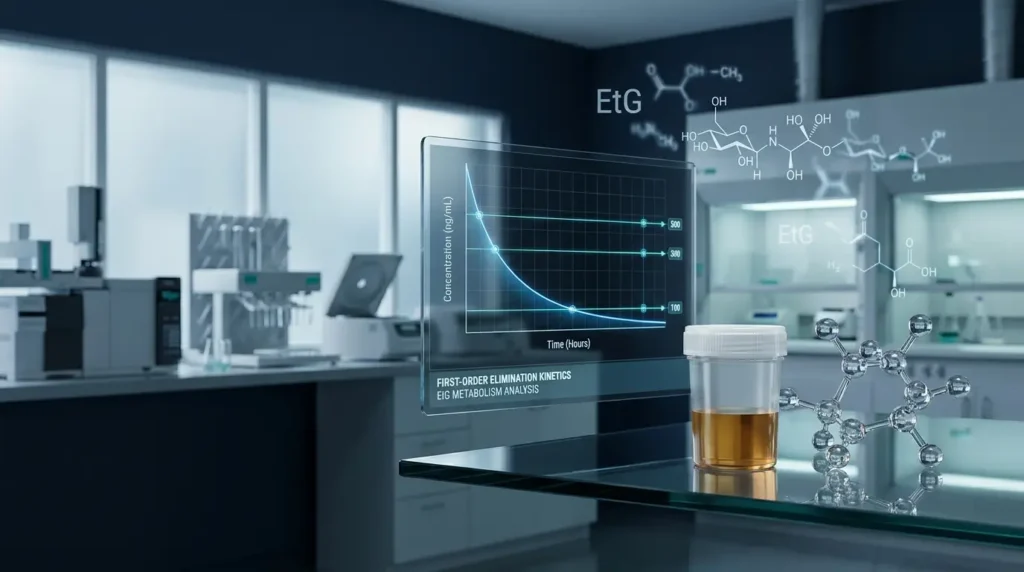
EtG elimination follows first-order kinetics with a median half-life ($t_{1/2}$) of 2.5 to 3.5 hours (averaging ~3.0 hours in healthy adults). Every 3 hours, your circulating EtG concentration is sliced in half:
$$C(t) = C_0 \times \left(\frac{1}{2}\right)^{\frac{t}{t_{1/2}}}$$
For example, if your peak urinary EtG concentration reaches 32,000 ng/mL:
- 0 Hours post-peak: 32,000 ng/mL (FAIL)
- 3 Hours: 16,000 ng/mL (FAIL)
- 6 Hours: 8,000 ng/mL (FAIL)
- 9 Hours: 4,000 ng/mL (FAIL)
- 12 Hours: 2,000 ng/mL (FAIL)
- 15 Hours: 1,000 ng/mL (FAIL)
- 18 Hours: 500 ng/mL (BORDERLINE at standard cutoff)
- 21 Hours: 250 ng/mL (PASS at 500 ng/mL cutoff)
- 24 Hours: 125 ng/mL (PASS at 300 ng/mL cutoff)
- 27 Hours: 62.5 ng/mL (PASS at 100 ng/mL cutoff)
You can verify your personal half-life decay rate using our EtG Half-Life Calculator.
5. Urine Dilution: The Trap of “Negative-Dilute” Rejections
A pervasive internet myth advises drinking gallons of water prior to testing to “flush out” EtG. While consuming fluid increases urine volume and temporarily lowers the measured concentration of EtG, it triggers a catastrophic laboratory failure: specimen dilution.
Certified drug testing laboratories conduct mandatory Specimen Validity Testing (SVT):
- Creatinine Check: Normal urinary creatinine is between 20 and 300 mg/dL. If excessive hydration drives creatinine below 20 mg/dL, the specimen is flagged as dilute.
- Specific Gravity Check: Normal urine specific gravity is between 1.003 and 1.035. Excessive fluid intake drops this below 1.002.
Urine Specimen Validity Matrix
   ├── Creatinine ≥ 20 mg/dL & Specific Gravity ≥ 1.003 ──> VALID SPECIMEN
   └── Creatinine < 20 mg/dL & Specific Gravity < 1.002 ──> NEGATIVE-DILUTE (REJECTED)
In probation, parole, and custody testing, a “Negative-Dilute” is legally treated as a presumptive positive or test refusal. Always evaluate your hydration safety margins using our Urine Dilution Calculator.
6. How to Ethically and Scientifically Optimize Clearance
If you are facing an EtG test, understand that there are no magic pills, detox drinks, or quick fixes that chemically destroy EtG molecules:
- Cease All Alcohol Ingestion Immediately: Glucuronidation continues as long as ethanol circulates in your blood. Peak EtG is reached 4 to 8 hours after your last drink.
- Maintain Normal, Steady Hydration: Drink 16 to 24 ounces of water every 3 to 4 hours to maintain healthy glomerular filtration without dropping creatinine below 20 mg/dL.
- Avoid Incidental Sources: During the 48 hours prior to testing, eliminate alcohol-based mouthwashes (Listerine), fermented foods (kombucha, sauerkraut), vanilla extracts, and excessive ethanol-based aerosol sanitizers.
- Void Multiple Times Before the Test: The first morning void contains overnight concentrated metabolites. Always empty your bladder at least twice on test day before providing your official specimen.
Frequently Asked Questions
Can hand sanitizer cause a positive EtG test?
At the standard 500 ng/mL cutoff, incidental hand sanitizer use will not cause a positive result. However, clinical studies show that intensive occupational use (such as nurses applying hand sanitizer 30+ times daily) can produce urinary EtG levels between 50 and 200 ng/mL, which can trigger a false-positive on strict 100 ng/mL zero-tolerance panels.
Does exercise sweat out EtG?
No. EtG is a water-soluble polar conjugate excreted primarily through the kidneys via glomerular filtration. Strenuous exercise does not accelerate EtG clearance and can cause mild dehydration, which concentrates urinary metabolites and increases the likelihood of a positive result.
What is the difference between EtG and EtS?
Ethyl Sulfate (EtS) is a parallel Phase II metabolite created by sulfotransferase enzymes. Reference laboratories test for both EtG and EtS via LC-MS/MS. Because EtS is not susceptible to bacterial synthesis or degradation, measuring both biomarkers prevents false-positive claims caused by bacterial bladder infections.
Scientific Studies & Clinical References
- Wurst, F. M., Skipper, G. E., & Weinmann, W. (2003). Ethyl glucuronide—the direct ethanol metabolite on the threshold from science to routine use. Addiction, 98(Suppl 2), 51–61. PubMed PMID: 14984243.
- Jatlow, P., Agro, A., Wu, R., et al. (2014). Ethyl glucuronide and ethyl sulfate assays in clinical trials, interpretation, and limitations: results of a dose-ranging study and review of the literature. Alcoholism: Clinical and Experimental Research, 38(7), 2056–2065. PubMed PMID: 24890675.
- Substance Abuse and Mental Health Services Administration (SAMHSA). (2014). The Role of Biomarkers in the Treatment of Alcohol Use Disorders. Advisory Bulletin, SMA 12-4686.
- Høiseth, G., Bernard, J. P., Karinen, R., et al. (2007). A pharmacokinetic study of ethyl glucuronide in blood and urine: applications to forensic toxicology. Forensic Science International, 172(2–3), 119–124. PubMed PMID: 17276632.