
Lisdexamfetamine (Vyvanse) Clearance Calculator
Estimate urine detection windows and d-amphetamine elimination timelines. The model covers the red blood cell conversion of the prodrug, urine pH-dependent excretion, and amphetamine immunoassay cutoffs, based on published pharmacokinetic research.
Clinical & Exposure Inputs
Pharmacokinetic Diagnostics & Detection Status
Lisdexamfetamine is cleaved by enzymes in red blood cells into d-amphetamine, so it shows up on amphetamine tests only through that product. Vyvanse produces only the d-isomer, while mixed amphetamine salts such as Adderall produce both d and l, which laboratories and medical review officers can use when interpreting a result. Urine pH is the biggest driver of window length.
Standard urinary pH gives a baseline d-amphetamine half-life of about 10 to 12 hours.
Estimated Detection Windows by Testing Matrix
| Testing Matrix | Cutoff (d-Amp) | Estimated Detection Window |
|---|---|---|
| Older AMP Cup | 1,000 ng/mL | 1.5 – 2.5 Days |
| Standard AMP Cup | 500 ng/mL | 2 – 4 Days |
| High-Sensitivity AMP Strip | 300 ng/mL | 2.5 – 5 Days |
| Confirmatory LC-MS/MS | 100 ng/mL | 3 – 6 Days |
| Blood / Plasma Screen | 20 ng/mL | 12 – 24 Hours |
| Oral Fluid (Mouth Swab) | 25 ng/mL | 24 – 48 Hours |
| Hair Follicle | 0.3 ng/mg | Up to 90 Days |
Lisdexamfetamine (Vyvanse) Clearance Times & Detection Windows: The Clinical Pharmacology of Enzymatic Prodrug Hydrolysis
Lisdexamfetamine dimesylate—widely prescribed under the brand name Vyvanse—is a therapeutically innovative central nervous system (CNS) stimulant approved by the FDA for the treatment of Attention-Deficit/Hyperactivity Disorder (ADHD) and moderate-to-severe Binge Eating Disorder (BED).
Unlike conventional stimulant medications like Adderall (mixed amphetamine salts) or Dexedrine, Vyvanse was engineered specifically as an inactive prodrug. It cannot exert stimulant effects, cross-react with drug testing strips, or bind dopamine transporters until it undergoes enzymatic hydrolysis inside circulating human red blood cells, releasing free dextroamphetamine (d-amphetamine).
Use the interactive Lisdexamfetamine (Vyvanse) Clearance Calculator above to simulate your personalized clearance curve, rate-limited RBC hydrolysis kinetics, urinary pH excretion effects, and laboratory drug panel detection windows.
1. How Long Does Vyvanse Stay in Your System?
Urinary detection of Vyvanse is governed almost exclusively by the elimination of its active cleavage product, d-amphetamine:
| Diagnostic Specimen Matrix | Acute Single Dose (30–50 mg) | Chronic Daily Therapy (50–70 mg/day) | Standard Cutoff Threshold |
|---|---|---|---|
| Parent Lisdexamfetamine (Urine) | < 5 Hours (Rapid Clearance) | < 8 Hours | Specialized Research Assay Only |
| Standard AMP Cup (SAMHSA) | 1.5 to 2.5 Days (36–60 Hours) | 2 to 3.5 Days | 1,000 ng/mL (Federal Workplace) |
| Standard Commercial AMP Panel | 2 to 4 Days (48–96 Hours) | 3 to 5 Days | 500 ng/mL (Standard Healthcare & Corporate) |
| High-Sensitivity Rapid Strip | 2.5 to 4.5 Days | 4 to 6 Days | 300 ng/mL (Probation & Pain Clinics) |
| Confirmatory LC-MS/MS | 3 to 5 Days | 4 to 7+ Days | 100 ng/mL (Quantified d-Amphetamine) |
| Blood / Plasma Screen | 12 to 24 Hours | 24 to 36 Hours | 20 ng/mL |
| Oral Fluid (Mouth Swab) | 24 to 48 Hours | 36 to 60 Hours | 25 ng/mL (See Saliva Drug Test Calculator) |
| Hair Follicle Analysis | Not reliable for acute doses | Up to 90 Days | 0.3 ng/mg (1.5-inch proximal sample) |
Key Pharmacokinetic Takeaway: Parent lisdexamfetamine has an elimination half-life of under 1 hour and becomes undetectable in urine within 5 hours. However, the active metabolite it releases—d-amphetamine—persists in urine for 2 to 5 days under normal physiological conditions, and up to 7 to 8 days in individuals with highly alkaline urine.
2. The Prodrug Mechanism: Why Vyvanse is Unique
The molecular architecture of Vyvanse ((2S)-2,6-diamino-N-[(1S)-1-methyl-2-phenylethyl]hexanamide) consists of the active stimulant dextroamphetamine covalently bound to the essential amino acid L-lysine via an amide linkage.
Lisdexamfetamine Molecule (Inactive Prodrug)
       │
       │  [Absorbed Intact across GI Tract via PEPT1 Transporters]
       ▼
Systemic Circulation (Enters Red Blood Cells)
       │
       │  [Enzymatic Cleavage via Erythrocyte Aminopeptidases]
       ├─────────────────────────────────┐
       ▼                                 ▼
Active d-Amphetamine (Stimulant)    L-Lysine (Natural Amino Acid)
(t½ = 7–22h, pH dependent)          (Utilized in normal protein synthesis)
Enzymatic Cleavage in Erythrocytes (Not Liver, Not Stomach)
A common misconception is that Vyvanse is activated by liver enzymes or stomach acid. Landmark research by Pennick (2010) demonstrated that:
- Red Blood Cell Lysis: Cleavage of the L-lysine bond occurs primarily within erythrocytes (red blood cells), mediated by high-capacity aminopeptidase enzymes.
- Rate-Limited Hydrolysis: The conversion of lisdexamfetamine to d-amphetamine occurs gradually at a fixed enzymatic velocity, preventing the sharp, euphoric plasma spikes associated with immediate-release amphetamines.
- The “Ceiling Effect”: Above therapeutic doses (>70 mg), the red blood cell aminopeptidases become saturated, yielding diminishing incremental plasma concentrations and providing inherent abuse deterrence.
Gastrointestinal Immunity: Vyvanse vs. Adderall
Unlike Adderall (a mixture of neutral amphetamine salts whose absorption is heavily manipulated by stomach acidity):
- Stomach pH Has Zero Impact: Food, antacids, proton pump inhibitors (PPIs like omeprazole), or acidic citrus juices in the stomach do not alter the absorption of lisdexamfetamine.
- Lisdexamfetamine is absorbed intact across the intestinal epithelium via carrier-mediated PEPT1 peptide transporters before entering red blood cells for activation.
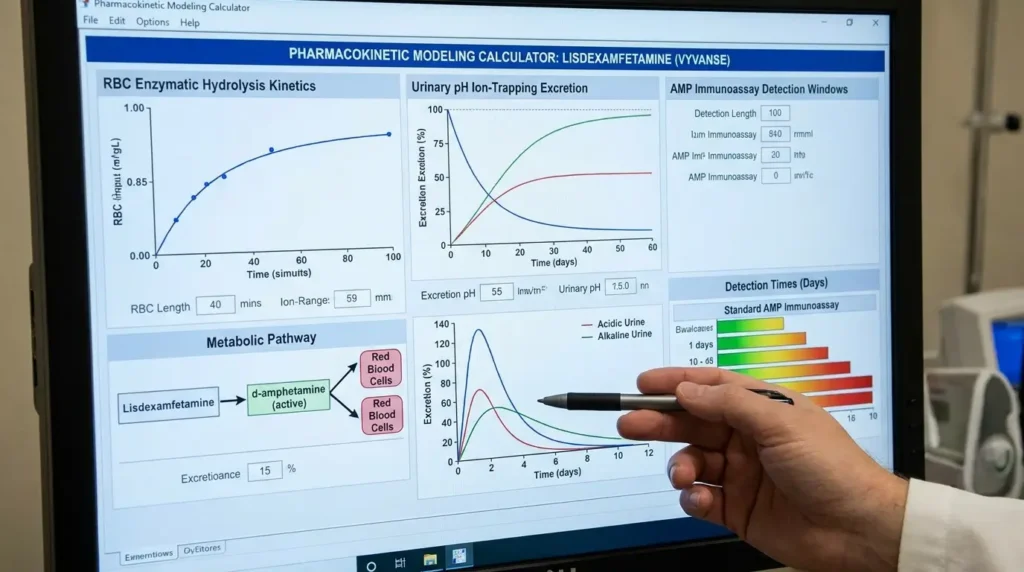
3. Urine pH: The Single Most Critical Clearance Variable
While gastric pH does not alter Vyvanse absorption, urinary pH is the single most powerful factor governing how fast d-amphetamine leaves your body.
Amphetamine is a basic amine compound with a dissociation constant ($\text{p}K_a \approx 9.9$). At physiological pH levels, the balance between ionized (charged) and unionized (lipid-soluble) amphetamine shifts dramatically according to the Henderson-Hasselbalch equation:
$$pH = pK_a + \log\left(\frac{[\text{Unionized}]}{[\text{Ionized}]}\right)$$
1. Acidic Urine (pH 4.5 – 5.5) — Accelerated Clearance
- Mechanics: In acidic urine, nearly 100% of amphetamine molecules become ionized (cationic). Ionized molecules cannot cross cell membranes and are chemically trapped inside the renal tubule (ion trapping).
- Outcome: Passive tubular reabsorption is blocked, and up to 70% of the dose is rapidly excreted unchanged in urine.
- Elimination Half-Life: Reduced to $\approx 7\text{ hours}$.
- Causes: High-protein diets, strenuous anaerobic exercise, ammonium chloride, and mega-doses of ascorbic acid (Vitamin C).
2. Alkaline Urine (pH 7.5 – 8.5) — Prolonged Detection
- Mechanics: In alkaline urine, amphetamine molecules become unionized (electrically neutral). Unionized amphetamine is highly lipid-soluble and freely diffuses across the tubular epithelium back into the bloodstream (tubular reabsorption).
- Outcome: Only 1% to 5% of the dose is excreted unchanged, forcing the body to wait for slow hepatic CYP2D6 aromatic hydroxylation.
- Elimination Half-Life: Prolonged to $16\text{ to }28\text{ hours}$.
- Causes: Sodium bicarbonate (baking soda), antacids (calcium carbonate, Alka-Seltzer, Tums), potassium citrate, and vegetarian or plant-based alkaline diets.
Testing Risk: Consuming sodium bicarbonate or antacids can double or triple your urine detection window, causing you to test positive for amphetamine days after the drug would normally have cleared.
4. Does Vyvanse Show on Standard Drug Tests?
Direct Cross-Reactivity on the AMP Panel
Yes. While parent lisdexamfetamine does not bind immunoassay antibodies, the d-amphetamine it generates is 100% reactive on commercial amphetamine test strips:
- Immunoassay Detection: Commercial point-of-care 5-panel, 10-panel, and 12-panel drug screens feature an “AMP” strip calibrated to cutoffs of 500 ng/mL (standard commercial) or 1,000 ng/mL (SAMHSA federal cutoff).
- No Distinction Between Adderall and Vyvanse: Rapid test cups only detect the presence of amphetamine; they cannot determine whether the detected molecule originated from Vyvanse, Adderall, Dexedrine, or illicit methamphetamine.
- D- vs. L-Enantiomer Chromatography: If an employer or court requires confirmatory testing, specialized chiral LC-MS/MS testing can distinguish between pure d-amphetamine (produced by Vyvanse or Dexedrine) and a 3:1 d/l-amphetamine mixture (produced by Adderall). Compare your kinetics using our Adderall Clearance Calculator.
- Contrast with Ritalin: Unlike Vyvanse, methylphenidate does not convert to amphetamine and produces zero cross-reactivity on AMP panels (see our Ritalin Clearance Calculator).
5. Elimination Half-Life: LDX Prodrug vs. d-Amphetamine
| Pharmacokinetic Parameter | Parent Lisdexamfetamine (LDX) | Active d-Amphetamine (from Vyvanse) |
|---|---|---|
| Elimination Half-Life ($t_{1/2}$) | < 1.0 Hour (Mean ~0.8h) | 10.0 to 12.0 Hours (Normal pH) |
| Acidic Urine Half-Life (pH < 5.5) | < 1.0 Hour | ~7.0 Hours |
| Alkaline Urine Half-Life (pH > 7.5) | < 1.0 Hour | 16.0 to 28.0 Hours |
| Time to Peak Concentration ($T_{\max}$) | 1.0 to 1.5 Hours | 3.5 to 5.0 Hours |
| Primary Elimination Route | Erythrocyte enzymatic hydrolysis | Renal glomerular filtration & excretion |
| Duration in Urine | < 5 to 8 Hours | 2 to 5 Days (Up to 8 Days) |
6. How to Ensure Drug Testing Accuracy with Vyvanse
If you take prescribed Vyvanse and are scheduled for an employment, court, or athletic drug screening:
- Provide a Valid Prescription Before Collection: Inform the collection facility and Medical Review Officer (MRO) that you have a legal prescription for lisdexamfetamine. When the screening laboratory detects amphetamine, the MRO will contact you to verify your pharmacy records, certifying your test as “Negative (Prescription Verified)”.
- Avoid Large Doses of Antacids: Refrain from taking sodium bicarbonate, Alka-Seltzer, or excessive calcium carbonate antacids in the 48 hours prior to testing, as urinary alkalization severely impedes natural amphetamine excretion.
- Maintain Healthy Hydration: Avoid extreme water-loading to flush the drug, which causes urinary creatinine to plummet below 20 mg/dL and triggers a “Negative-Dilute” specimen rejection. Assess your hydration safety with our Urine Dilution Calculator.
7. Frequently Asked Questions
Can Vyvanse be detected on a mouth swab (saliva) drug test?
Yes. D-amphetamine transfers from systemic circulation into saliva through passive transcellular diffusion. Salivary concentrations of d-amphetamine reflect active blood levels, and standard oral fluid testing panels detect amphetamine for 24 to 48 hours following a therapeutic dose.
How much d-amphetamine does a 50 mg Vyvanse capsule produce?
Due to molecular weight differences between lisdexamfetamine (455.98 g/mol) and free amphetamine base (135.21 g/mol), a 50 mg capsule of Vyvanse is molecularly equivalent to approximately 14.8 mg of pure dextroamphetamine base (comparable to roughly 20.8 mg of mixed amphetamine salts in Adderall).
Why do some people test positive for amphetamine 6 days after taking Vyvanse?
Individuals with alkaline urine (pH > 7.5), slow CYP2D6 metabolizer status, or chronic high-dose therapy retain d-amphetamine in systemic circulation significantly longer due to renal tubular reabsorption. Confirmatory LC-MS/MS testing at low thresholds (100 ng/mL) can readily detect residual metabolites up to 7 to 8 days post-cessation.
Scientific Studies & Clinical References
- Krishnan, S., & Moncrief, S. (2007). An evaluation of the pharmacokinetics of lisdexamfetamine dimesylate and its active metabolite, d-amphetamine, in healthy adults. Neuropharmacology, 53(1), 160–166. PubMed PMID: 17582500.
- Pennick, M. (2010). Absorption of lisdexamfetamine dimesylate and its enzymatic conversion to d-amphetamine. Journal of Pharmacy and Pharmacology, 62(5), 606–612. PubMed PMID: 20492476.
- Blick, S. K., & Keating, G. M. (2014). Lisdexamfetamine: A review of its use in the treatment of attention-deficit/hyperactivity disorder. Clinical Pharmacokinetics, 46(9), 771–788. PubMed PMID: 24715426.
- Beckett, A. H., & Rowland, M. (1965). Urinary excretion kinetics of amphetamine in man: Influence of urinary pH. Journal of Pharmacy and Pharmacology, 17(10), 628–639. PubMed PMID: 4379375.
- Substance Abuse and Mental Health Services Administration (SAMHSA). (2023). Mandatory Guidelines for Federal Workplace Drug Testing Programs. Federal Register, HHS. SAMHSA.gov.