
THC Stored in Fat Cells Detection: Why Cannabis Stays in Your Body for 30+ Days
Quick Summary: Unlike alcohol or prescription stimulants that dissolve in water and clear within 24 to 72 hours, delta-9-tetrahydrocannabinol ($\Delta^9\text{-THC}$) is exceptionally lipophilic (fat-soluble). When you inhale or ingest cannabis, THC rapidly binds into adipose tissue (body fat). Once stored, it slowly re-enters the bloodstream through basal metabolic lipolysis over days, weeks, and even months. Understanding THC stored in fat cells detection explains why heavy users can test positive 30 to 70+ days after quitting, and why working out right before a test can cause an unexpected positive result.
Model Your Personal THC Clearance Timeline
Clearance times vary wildly based on your body mass index (BMI), estimated body fat percentage, consumption method, and physical activity. Use our clinical pharmacokinetic calculator to predict your exact detection window: Open THC Body Fat & Clearance Calculator →
If you have ever stared in disbelief at a positive urine drug test weeks after taking your last hit of cannabis, you are not alone.
Almost every drug of abuse follows a simple, predictable exit path. Drink a six-pack of beer on Friday, and your liver oxidizes the ethanol within hours (as mapped in our EtG Pass/Fail Predictor). Take a prescription stimulant, and your kidneys excrete the water-soluble compounds within 2 to 4 days.
Cannabis completely defies this rule.
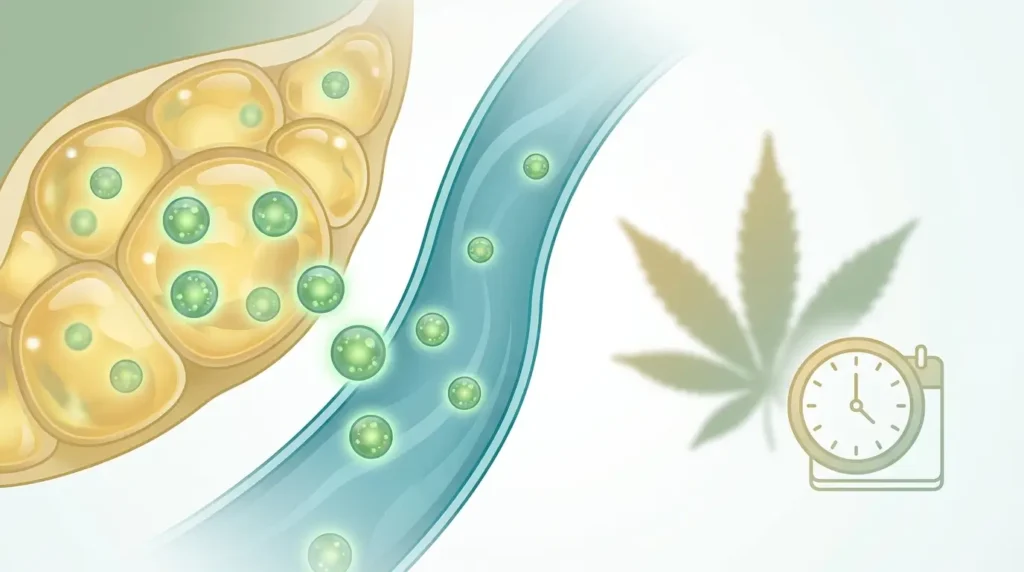
The biological reason comes down to basic organic chemistry: lipophilicity. THC does not dissolve easily in water; it seeks out and embeds itself into neutral lipids, lipid membranes, and fat cells. In this comprehensive clinical guide, we explore the cellular science behind THC stored in fat cells detection, the physiological mechanics of lipolysis, and why standard detox myths can actually cause you to fail.
1. The Science of THC Stored in Fat Cells Detection: How Lipolysis Releases Cannabinoids
To understand why cannabis detection lasts for weeks, we must follow the journey of a $\Delta^9\text{-THC}$ molecule from the lungs or gut to the cellular core of an adipocyte (fat cell):
                   Cannabis Inhalation / Edible Ingestion
                                     │
                                     ▼
                      Arterial Systemic Circulation
                      (Rapid Brain & Organ Uptake)
                                     │
                                     ▼
                High Lipophilicity Partitioning (log P ≈ 5.6)
                                     │
                 ┌───────────────────┴───────────────────┐
                 ▼                                       ▼
        Hepatic Processing                    Adipose Tissue Sequestration
     (CYP2C9 / CYP3A4 Enzymes)                 (Stored in Lipid Droplets
                 │                               within Fat Cells)
                 ▼                                       │
      11-OH-THC ──> THC-COOH                             │
                 │                                       │ Weeks / Months
                 ▼                                       ▼ (Basal Lipolysis)
          Renal / Fecal Excretion           Slow Trickle of Stored THC
                                            Back into Blood Circulation
                                                         │
                                                         ▼
                                            Hepatic Conversion to THC-COOH
                                                         │
                                                         ▼
                                            Prolonged Urinary Detection
The Lipophilic Partition Coefficient ($\log P$)
Chemical substances are classified by how easily they dissolve in fats versus water using the octanol-water partition coefficient ($\log P$).
- Ethanol has a $\log P$ of $-0.31$ (it loves water, dissolves in blood, and does not store in fat).
- Active delta-9-THC has a massive $\log P$ of $+5.6$.
A $\log P$ of 5.6 means THC is roughly 400,000 times more soluble in lipid fats than in water.
When THC circulates through your capillaries, it rapidly slips across the lipid bilayer membranes of your body’s cells. While a portion distributes to the brain (binding to $CB_1$ receptors to create the high), the vast majority of unused THC is sequestered inside adipose lipid droplets throughout your abdominal, subcutaneous, and visceral fat depots.
The Two Phases of Elimination
Pharmacokineticists divide THC clearance into two distinct physiological phases:
- The Distribution Phase (Rapid, $t_{1/2} \approx 1\text{ to }4\text{ hours}$): Active THC rapidly leaves the bloodstream as it gets soaked up by fat tissues and internal organs. This is why the intoxicating effects wear off in 2 to 4 hours, and why active THC drops below blood detection limits within 12 to 24 hours.
- The Terminal Elimination Phase (Prolonged, $t_{1/2} \approx 20\text{ to }57\text{ hours}$): Once your blood levels drop, equilibrium reverses. The fat cells slowly and continuously release their stored THC back into venous circulation through normal cellular maintenance. This slow trickle of stored THC is continuously delivered to the liver, where enzymes convert it into the inactive metabolite 11-nor-9-carboxy-THC (THC-COOH), which is then eliminated in urine.
2. The 30-Day Myth vs. Documented 77-Day Clinical Cases
One of the most persistent cannabis myths is that “weed leaves your system in exactly 30 days.” In reality, 30 days is merely an arbitrary statistical average for moderate-to-heavy users.
In groundbreaking clinical trials led by Johansson et al. (1988) and Dr. Marilyn Huestis at the National Institute on Drug Abuse (NIDA), researchers placed chronic cannabis users under strict 24/7 inpatient confinement to ensure absolute abstinence:
- While occasional users cleared below the standard $50\text{ ng/mL}$ cutoff in 3 to 7 days,
- Moderate daily smokers required 15 to 25 days,
- Heavy, multi-year daily consumers took 30 to 45 days, and
- Several chronic individuals with elevated body fat continued to excrete detectable THC-COOH for 77 days, with single documented outliers stretching past 90 days.
The following matrix illustrates how use frequency and body fat alter the detection window at standard laboratory screening cutoffs:
| Usage Frequency | Typical Baseline | Detection Window (Lean Body: $<15%$ Fat) | Detection Window (Average: $18\text{–}25%$ Fat) | Detection Window (High Fat: $>30%$ Fat) |
|---|---|---|---|---|
| Single Use (One-Off) | 1 session | 1 to 3 Days | 2 to 4 Days | 3 to 6 Days |
| Occasional (1–2x / week) | Low accumulation | 3 to 5 Days | 5 to 7 Days | 7 to 10 Days |
| Moderate (3–4x / week) | Steady accumulation | 7 to 12 Days | 10 to 16 Days | 14 to 21 Days |
| Daily Smoker / Vaper | Fully saturated fat | 14 to 21 Days | 18 to 28 Days | 25 to 40 Days |
| Heavy Chronic / Concentrates | Dense adipose reserves | 25 to 35 Days | 35 to 55 Days | 55 to 77+ Days |
3. The Exercise Paradox: Why Burning Fat Spikes Urine THC
If THC is trapped inside your fat cells, the intuitive response seems obvious: Hit the gym, run miles on the treadmill, sit in the sauna, and burn that fat away before your test!
While regular exercise helps clear cannabinoids over a span of several weeks, exercising right before a drug test is one of the most dangerous mistakes you can make.
                   Strenuous Workout / Caloric Deficit
                                     │
                                     ▼
                Sympathetic Nervous System Activation
                     (Epinephrine / Norepinephrine)
                                     │
                                     ▼
                 Hormone-Sensitive Lipase (HSL) Activated
                                     │
                                     ▼
                       Rapid Adipose Lipolysis
             (Fat Cells Break Down Triglycerides for Fuel)
                                     │
                                     ▼
           Mass Release of Stored THC into Venous Bloodstream
                                     │
                                     ▼
                   Hepatic Oxidation to THC-COOH
                                     │
                                     ▼
            SUDDEN SPIKE IN URINARY METABOLITE CONCENTRATION
               (Borderline Pass Turns into Confirmed Fail)
The Clinical Proof: The University of Sydney Study
In a landmark 2013 trial published in Drug and Alcohol Dependence, researchers Wong et al. examined regular cannabis users who performed 35 minutes of moderate exercise on a stationary bicycle after overnight fasting:
- Blood plasma levels of active THC increased significantly by an average of 25% to 30% immediately post-exercise.
- The spike was directly correlated with circulating free fatty acids (FFAs) and the subjects’ body mass index (BMI).
- In several subjects, urine concentrations of THC-COOH surged above the $50\text{ ng/mL}$ cutoff, turning individuals who would have passed an hour earlier into positive tests.
The Mechanism of Hormone-Sensitive Lipase (HSL)
When you engage in cardio or calorie restriction, your body releases stress catecholamines (epinephrine and norepinephrine). These hormones activate Hormone-Sensitive Lipase (HSL), an intracellular enzyme that hydrolyzes stored triglycerides into glycerol and free fatty acids.
As fat cells shrink and discharge their energy reserves, the THC stored inside those lipids hitchhikes along into the bloodstream.
Crucial Rule: If you are within 48 to 72 hours of a urine drug test, cease all strenuous exercise immediately. Continuing to burn fat will flood your kidneys with fresh THC metabolites at the exact moment you need your urine to be clean.
4. Understanding Screening Cutoffs: 50 ng/mL vs. 15 ng/mL
When evaluating THC stored in fat cells detection, you must understand the two-tiered testing protocol used by certified laboratories (SAMHSA, DOT, Quest, LabCorp):
                        Initial Urine Immunoassay
                          Cutoff: 50 ng/mL
                                 │
             ┌───────────────────┴───────────────────┐
             ▼                                       ▼
       BELOW 50 ng/mL                          ABOVE 50 ng/mL
       (TEST PASSED)                     (Presumptive Positive)
                                                     │
                                                     ▼
                                          Confirmatory GC-MS or LC-MS
                                                Cutoff: 15 ng/mL
                                                     │
                                 ┌───────────────────┴───────────────────┐
                                 ▼                                       ▼
                           BELOW 15 ng/mL                          ABOVE 15 ng/mL
                           (FALSE POSITIVE                         (FINAL CONFIRMED
                             OVERTURNED)                               FAILURE)
- Step 1: The Initial Immunoassay Screen ($50\text{ ng/mL}$): The lab uses antibodies to detect all cannabinoid metabolites combined (including glucuronide conjugates). If your concentration is below $50\text{ ng/mL}$, your test is reported as negative.
- Step 2: The Confirmatory Mass Spectrometry Screen ($15\text{ ng/mL}$): If the initial screen flags positive, the specimen undergoes gas chromatography-mass spectrometry (GC-MS) or LC-MS/MS. This instrument separates and measures only pure 11-nor-9-carboxy-THC. Because it isolates a single target molecule, the cutoff drops to $15\text{ ng/mL}$.
This two-tier structure is why people often fail confirmation tests even when home dip cards (which test at 50 ng/mL) showed faint passing lines.
5. Body Composition: Why BMI and Adiposity Dictate Detection
Two people can smoke the exact same joint of high-potency cannabis, yet clear it on entirely different schedules based on three physiological variables:
1. Total Adipose Volume (Body Fat Percentage)
A 6-foot-tall, 170-pound athlete with 12% body fat has a small storage depot. Their fat cells become saturated quickly, but once consumption stops, their body depletes those stores rapidly. Conversely, an individual with 35% body fat has a massive biological sponge that can store thousands of micrograms of lipophilic cannabinoids, continuously trickling them out for an extra 2 to 3 weeks.
2. Dietary Macronutrient Intake During Detox
- Low-Carb / Ketogenic Diets: Diets that induce ketosis force continuous lipolysis. Burning fat for fuel speeds overall clearance long-term, but elevates urinary THC levels every single day you remain in ketosis.
- High-Carbohydrate Diets: Ingesting carbohydrates triggers insulin release. Insulin is a potent anti-lipolytic hormone that directly inhibits hormone-sensitive lipase (HSL), halting the release of fatty acids and stored THC from adipocytes.
3. Consumption Route (Combustion vs. Edibles vs. Concentrates)
- High-Potency Concentrates (Dabs / Vapes, 70–90% THC): Massive boluses of THC overwhelm immediate hepatic clearance, driving huge percentages directly into adipose tissue storage.
- Oral Edibles: When ingested, THC undergoes extensive first-pass hepatic metabolism via CYP2C9 into 11-hydroxy-THC (11-OH-THC), a potent metabolite that is also lipophilic and extends systemic clearance.
6. The Danger of “Flushing” and Dilution Traps
When faced with an unexpected test, many people panic and try to wash THC out by drinking gallons of water or commercial detox drinks.
As detailed in our clinical guide on Urine Dilution & Creatinine, water does not dissolve or eliminate fat-stored THC. Consuming excess water only temporarily lowers the concentration of metabolites floating in your bladder at that exact second.
Certified laboratories routinely conduct Specimen Validity Testing (SVT):
- Creatinine Cutoff: Normal urine creatinine is $> 20\text{ mg/dL}$. If heavy water intake pushes creatinine below $20\text{ mg/dL}$, your sample is flagged as Negative-Dilute.
- Specific Gravity: Must be $\ge 1.003$. Falling below this marks the sample as dilute.
In employment, safety-sensitive DOT roles, and court probation programs, a negative-dilute result is frequently rejected, requiring an immediate observed retest or counted as a failed drop. Model your hydration limits using our free Urine Dilution & Creatinine Calculator.
7. Strategic 72-Hour Protocol: Managing Lipolysis Before a Test
If you have an upcoming urine drug test and are nearing the end of your detection window, use this scientifically grounded protocol to prevent accidental fat-release spikes:
                            72 Hours Prior to Test
                                      │
        ┌─────────────────────────────┼─────────────────────────────┐
        ▼                             ▼                             ▼
   HALT EXERCISE             CONSUME CARBOHYDRATES             PACED HYDRATION
Stop all cardio, weight-    Eat complex carbs (pasta, rice)   Drink 16-24 oz fluids
lifting, and saunas to      to elevate insulin and block      every 3-4 hours; avoid
suppress HSL lipolysis.     fat-cell THC leakage.             dilution rejections.
Day 1 & 2 (72 to 24 Hours Pre-Test): Inhibit Lipolysis
- Completely Stop Intense Physical Activity: Avoid gym workouts, runs, and heavy physical labor. You want your fat cells in a resting, storage state.
- Shift to a Moderate-to-High Carbohydrate Diet: Eat carbohydrates (oats, rice, pasta, potatoes). Carbohydrates stimulate insulin release, which acts as a molecular “lock” on adipocytes by inhibiting hormone-sensitive lipase. This minimizes the leakage of stored THC into blood.
- Avoid Fasting or Caloric Deficits: Never skip meals in the 48 hours before testing. Caloric deficits trigger immediate fat breakdown for energy.
Day of the Test (The Final 6 Hours):
- Wake Up Early & Discard the First Void: The first urination of the morning contains stagnant metabolites that accumulated during overnight fasting and bladder retention. Never submit this sample.
- Hydrate Moderately (Paced): Drink 16 to 24 ounces of water or an electrolyte beverage 2 to 3 hours before your appointment. Do not overconsume fluid to avoid dilute flags.
- Eat a Balanced Breakfast: Consume a meal with complex carbs and protein 2 to 3 hours before testing to keep insulin elevated and maintain normal metabolic excretion.
- Collect Mid-Stream: Urinate the first 25% of your stream into the toilet, collect the middle $45\text{ to }60\text{ mL}$ in the testing cup, and finish in the toilet. The initial stream contains the highest density of sediment and cellular debris.
Alternative Testing Windows: Saliva, Hair, and Blood
If your test involves matrices other than urine, lipophilic fat storage plays a different diagnostic role:
- Oral Fluid (Saliva Swabs): Saliva tests detect parent active THC from oral cavity coating, clearing in 24 to 72 hours. Model your swab window with our Saliva Drug Test Calculator.
- Hair Follicle Tests: Sebum and capillary diffusion trap THC in the keratin matrix as hair grows, establishing a fixed 90-day forensic window. Calculate hair growth timelines using our Hair Follicle Drug Test Calculator.
- Blood Testing: Primarily detects active THC for DUI impairment; drops below $2\text{–}5\text{ ng/mL}$ within 12 to 24 hours in occasional users, but can linger at low levels for 3 to 7 days in chronic heavy users due to fat recirculation.
Frequently Asked Questions
Why did my home drug test show a faint line?
In standard competitive immunoassay test strips, any visible line next to the ‘Test’ (T) marker is officially interpreted as a negative (pass), regardless of how faint or dark the line appears. A faint line simply indicates that the concentration of THC-COOH in your sample is below the strip’s calibrated cutoff threshold (typically 50 ng/mL). However, if your urine is dilute, that faint line may disappear on a more concentrated second void.
Does sweating in a sauna remove THC from fat cells?
No. Saunas cause you to sweat out water and electrolytes—not stored adipose tissue. Less than 1% of eliminated cannabinoids leave the body through sweat. In fact, sitting in a sauna dehydrates you, which concentrates your urine and can make a borderline THC-COOH concentration read even higher on a test.
Can niacin or detox kits flush THC out of fat?
No reputable clinical study supports the claim that high-dose niacin (Vitamin B3) or over-the-counter herbal detox kits chemically remove THC from adipose cells. High doses of niacin can cause painful cutaneous flushing, liver toxicity, and severe metabolic acidosis without accelerating cannabinoid clearance.
Does activated charcoal help eliminate THC?
Because approximately 65% of THC metabolites are excreted through feces via biliary secretion, an enterohepatic circulation loop exists where some THC-COOH is reabsorbed in the lower intestine. Clinical studies show that oral activated charcoal can bind bile-secreted metabolites in the gut and prevent reabsorption, but it does not pull stored THC directly out of peripheral fat cells.
Scientific Studies & Clinical References
- Wong, A., Montebello, M. E., Norberg, M. M., et al. (2013). Exercise increases plasma THC concentrations in regular cannabis users. Drug and Alcohol Dependence, 133(2), 763–767. PubMed PMID: 24012626.
- Huestis, M. A. (2007). Human cannabinoid pharmacokinetics. Chemistry & Biodiversity, 4(8), 1770–1804. PubMed PMID: 17712819.
- Johansson, E., Halldin, M. M., et al. (1988). Prolonged apparent half-life of delta-9-tetrahydrocannabinol in plasma of chronic marijuana users. Journal of Pharmacy and Pharmacology, 41(8), 572–577. PubMed PMID: 2572714.
- Gunasekaran, N., Long, L. E., Dawson, B. L., et al. (2009). Re-intoxication: food deprivation results in fat mobilization and release of delta-9-tetrahydrocannabinol into the bloodstream. British Journal of Pharmacology, 158(5), 1330–1337. PubMed PMID: 19741031.
- Ellis, G. M. Jr., Mann, M. A., Judson, B. A., et al. (1985). Excretion of cannabinoid metabolites in urine: detection time in chronic marijuana users. Clinical Pharmacology & Therapeutics, 38(5), 572–578. PubMed PMID: 3009762.