
Caffeine Half Life Sleep: How Adenosine & Clearance Kinetics Ruin Deep Rest
Quick Summary: Most people believe the effects of an afternoon coffee wear off the moment the initial energy surge subsides. In reality, caffeine exhibits an average elimination half-life of 5 hours (ranging from 3 to 9+ hours based on liver enzymes). Even if you fall asleep easily, residual caffeine molecules competitively plug your brain’s adenosine receptors, suppressing restorative Stage 3 slow-wave (NREM) deep sleep by up to $30%$. Understanding the relationship between caffeine half life sleep architecture and hepatic CYP1A2 metabolism is the key to waking up genuinely refreshed.
Calculate Your Personal Caffeine Bedtime Cutoff
Avoid sleep-disrupting residual stimulant levels. Select your exact beverages, daily milligrams, liver metabolism speed (CYP1A2), and target bedtime in our interactive clinical tool: Open Caffeine Half-Life & Elimination Calculator →
We have all heard someone boast: “I can drink a double espresso after dinner, go straight to sleep 30 minutes later, and sleep like a baby. Caffeine doesn’t affect me!”
From a neurobiological standpoint, that claim is completely false.
Being able to close your eyes and lose consciousness is not the same as obtaining restorative, biologically reparative sleep. You can fall unconscious while under the influence of heavy alcohol, yet alcohol completely obliterates REM sleep (as detailed in our EtG Pass/Fail Predictor).
Caffeine pulls off a similar biochemical deception. While you may be unconscious, circulating caffeine molecules continue to bind to adenosine receptors in your brainstem and cortex, fracturing your sleep architecture from the inside out.
To fix your energy levels, you do not necessarily need to quit coffee. You simply need to understand the physiological timeline of caffeine half life sleep mechanics.
1. How Caffeine Half Life Sleep Disruption Alters Brain Chemistry
To understand why coffee lingers so stubbornly in your brain, we must explore the daily biological cycle of adenosine:
                       Normal Awake State: Day Progression
                                      │
                         Cellular Energy Expenditure
                            (ATP Breakdown in Brain)
                                      │
                                      ▼
                      Continuous Adenosine Accumulation
                         (Building "Sleep Pressure")
                                      │
           ┌──────────────────────────┴──────────────────────────┐
           ▼                                                     ▼
     NATURAL STATE (NO CAFFEINE)                          WITH CAFFEINE INGESTED
 Adenosine binds to A1 & A2A Receptors              Caffeine Competitively Plugs Receptors
               │                                                 │
 Drowsiness signals trigger sleep cascades          Adenosine signal is completely masked
               │                                                 │
 RESTORATIVE SLOW-WAVE DEEP SLEEP                   FALSE ALERTNESS & FRACTURED SLEEP
The Adenosine Accumulation Engine
From the exact moment you open your eyes in the morning, billions of neurons throughout your central nervous system burn adenosine triphosphate (ATP) for metabolic fuel.
Every time an ATP molecule is cleaved for energy, an adenosine molecule is left behind. Throughout the day, adenosine levels in your basal forebrain and cortex rise steadily like water filling a reservoir. This mounting concentration is known clinically as homeostatic sleep pressure—the physiological force that makes you crave sleep after 14 to 16 hours of wakefulness.
The Competitive Antagonist Trap
Caffeine is a plant alkaloid (1,3,7-trimethylxanthine) with a molecular ring structure that almost perfectly mirrors that of endogenous adenosine.
When you consume a cup of coffee:
- Caffeine crosses the blood-brain barrier within 15 to 30 minutes.
- It docks directly into your brain’s adenosine $A_1$ and $A_{2A}$ receptors.
- It acts as a competitive antagonist: it plugs the receptor site without activating it.
Because caffeine occupies the receptor, the massive pool of accumulating adenosine cannot connect. Your brain is blind to its own physiological exhaustion. You feel energized, alert, and focused—not because caffeine created real biological energy, but because it muted your body’s fatigue alarms.
2. The Exponential Elimination Curve: First-Order Kinetics
A common misconception is that caffeine is eliminated in a linear fashion (e.g., losing 20 mg per hour). Like many xenobiotics, caffeine clears via first-order exponential decay:
$$C(t) = C_0 \times \left(\frac{1}{2}\right)^{\frac{t}{t_{1/2}}}$$
Where $C_0$ is your peak intake, $t$ is hours elapsed, and $t_{1/2}$ is your biological half-life.
In healthy, non-smoking adults, the average elimination half-life is approximately 5.0 hours (with a normal range of 3.0 to 7.0 hours).
The Real-World Bedtime Math (150 mg Afternoon Latte)
Imagine you order a 16-oz latte containing 150 mg of caffeine at 2:00 PM:
2:00 PM (Intake)    ───> 150 mg circulating (Peak absorption)
7:00 PM (+ 5 hours) ───>  75 mg circulating (Half eliminated)
12:00 AM (+10 hours)───>  37.5 mg circulating (AT BEDTIME)
5:00 AM (+15 hours) ───>  18.7 mg circulating (Still active during REM cycles)
10:00 AM (+20 hours)───>   9.3 mg circulating
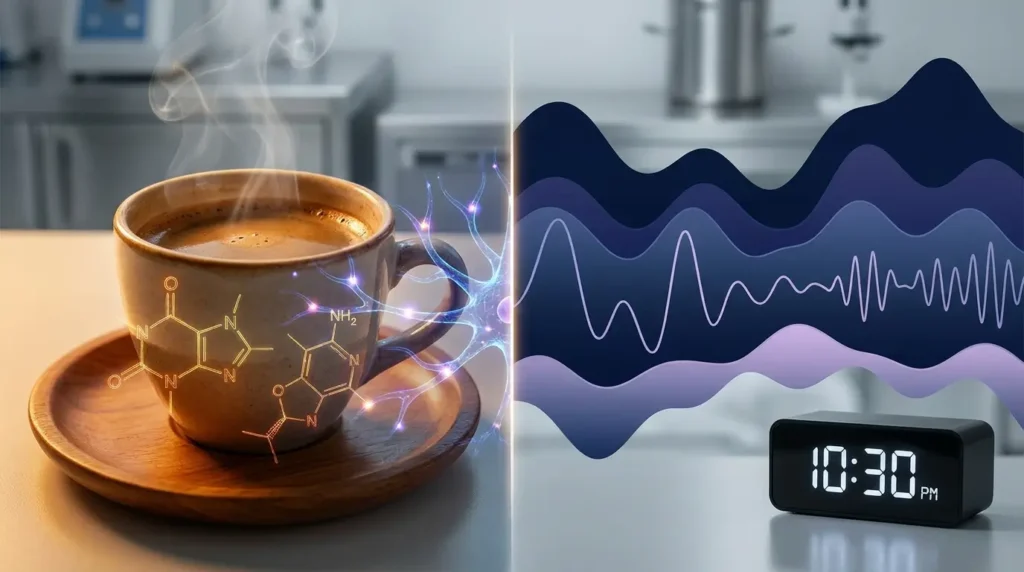
When you crawl into bed at midnight, you still have nearly 40 mg of active caffeine circulating in your brain—the pharmacological equivalent of drinking a full cup of green tea or a half can of Red Bull right before turning off the lights!
3. How Caffeine Destroys Sleep Architecture (Even When You Sleep)
The most insidious aspect of caffeine half life sleep interference is what happens to your sleep stages.
In a landmark study published in the Journal of Clinical Sleep Medicine, sleep researcher Dr. Christopher Drake and colleagues administered 400 mg of caffeine at bedtime, 3 hours before bed, and 6 hours before bed:
- Caffeine taken even 6 full hours prior to bedtime produced objective, polysomnographically measured reductions in total sleep time of more than one full hour.
- It doubled the time it took to fall asleep (sleep latency).
- It caused a severe reduction in Stage 3 Non-REM (NREM) Slow-Wave Sleep.
                           Sleep Architecture Impact
                                       │
         ┌─────────────────────────────┴─────────────────────────────┐
         ▼                                                           ▼
  SLOW-WAVE DEEP SLEEP (NREM 3)                             REM SLEEP & FRAGMENTATION
* Suppressed by 20% to 30%                                 • Micro-arousals throughout night
* Impairs growth hormone release                           • Brain wakes unconsciously 15-25x
* Disables the glymphatic waste system                     • Prevents emotional memory consolidation
Why Slow-Wave Sleep (Deep Sleep) Is Irreplaceable
Stage 3 NREM sleep is the deepest, most rejuvenating phase of human sleep. During this stage:
- Blood pressure drops, breathing slows, and your pituitary gland releases human growth hormone (HGH) to repair muscle, tissue, and cellular damage.
- The brain’s glymphatic system opens up, washing cerebrospinal fluid through neural pathways to flush away metabolic waste, including beta-amyloid proteins.
When residual caffeine sits on adenosine receptors throughout the night, the brain cannot generate the synchronized, high-voltage delta waves required for slow-wave sleep. You spend the night trapped in light, superficial Stage 1 and 2 sleep.
You wake up feeling unrefreshed, reach for a larger cup of coffee to shake off the morning brain fog, and lock yourself into an escalating cycle of chemical exhaustion.
4. The Liver Engine: Why CYP1A2 Dictates Your Clearance Speed
Why can some individuals drink coffee at 6:00 PM without issue, while others get heart palpitations and insomnia from a midday cup of green tea?
Over 95% of caffeine metabolism is handled by a single cytochrome P450 enzyme in your liver: CYP1A2. This enzyme oxidizes caffeine into three secondary dimethylxanthines:
- Paraxanthine (~84%): Lipolytic stimulant that increases free fatty acids in blood.
- Theobromine (~12%): Mild vasodilator found heavily in cacao/chocolate.
- Theophylline (~4%): Bronchodilator that relaxes smooth muscle.
                                  1,3,7-Trimethylxanthine (Caffeine)
                                                  │
                                                  ▼
                                      Hepatic CYP1A2 Enzyme
                                                  │
                   ┌──────────────────────────────┼──────────────────────────────┐
                   ▼                              ▼                              ▼
          Paraxanthine (84%)              Theobromine (12%)              Theophylline (4%)
       Stimulates lipolysis &          Dilates blood vessels &        Relaxes bronchial smooth
       muscle glycogen release          mild cardiac stimulant         muscle (respiratory aid)
The transcription rate of CYP1A2 varies dramatically across the population based on genetics, lifestyle, and medications:
| Physiological Factor | Effect on CYP1A2 Activity | Elimination Half-Life ($t_{1/2}$) | Sleep Impact / Recommendation |
|---|---|---|---|
| Fast Metabolizers ($CYP1A2^*1A$ AA) | High enzyme expression | 3.0 to 4.0 Hours | Clears rapidly; safe cutoff is 7–8 hours before bed. |
| Slow Metabolizers ($CYP1A2^*1F$ C allele) | Low enzyme expression | 6.0 to 9.5 Hours | Severe sleep vulnerability; cutoff should be 12 hours. |
| Cigarette Smoking / Nicotine | Induces CYP1A2 (+100%) | 2.5 to 3.5 Hours | Clears twice as fast; quitting doubles caffeine levels. |
| Oral Contraceptive Pills (Birth Control) | Inhibits CYP1A2 (-50%) | 8.0 to 12.0 Hours | Half-life doubles; caffeine stays active overnight. |
| Pregnancy (3rd Trimester) | Severe enzyme suppression | 11.0 to 15.0+ Hours | Residual caffeine circulates for over 24 hours. |
| Fluvoxamine (Luvox – SSRI) | Massive CYP1A2 inhibitor | Up to 30+ Hours | Even a single morning cup causes severe insomnia. |
The Nicotine & Caffeine Connection
Polycyclic aromatic hydrocarbons in tobacco smoke powerfully induce CYP1A2 synthesis. This is why chronic smokers often drink massive pots of coffee without feeling jittery.
However, when a smoker abruptly quits nicotine (for example, when detoxing to pass an insurance screen as discussed in our Cotinine Urine Detection Guide), their CYP1A2 enzyme activity drops back to normal within days. If they continue drinking their usual amount of coffee, their circulating caffeine levels double or triple, causing panic attacks, tremors, and severe insomnia.
If you are using prescription stimulants alongside caffeine, verify your systemic clearance profiles with our Adderall Clearance Calculator.
5. Caffeine Content in Everyday Drinks: What Are You Actually Ingesting?
Many people fail to realize how much caffeine is hidden in everyday beverages, teas, and fitness supplements:
| Beverage / Item | Standard Serving Size | Average Caffeine Content | Realistic Clearance Time to $<25\text{ mg}$ |
|---|---|---|---|
| Brewed Drip Coffee | 8 oz (240 mL) | 95 mg | 10 Hours |
| Espresso Shot (Single) | 1 oz (30 mL) | 63 mg | 8 Hours |
| Espresso Shot (Double) | 2 oz (60 mL) | 126 mg | 11.5 Hours |
| Starbucks Cold Brew | 16 oz (Grande) | 205 mg | 13.5 Hours |
| Panera Charged Lemonade (discontinued) | 20 oz | 260 mg | 15 Hours |
| Energy Drink (Monster / Rockstar) | 16 oz (473 mL) | 160 mg | 12.5 Hours |
| Energy Drink (Red Bull) | 8.4 oz (250 mL) | 80 mg | 9.5 Hours |
| Pre-Workout Powders (C4, Ghost) | 1 scoop | 200 – 350 mg | 14 to 17 Hours |
| Matcha Green Tea | 8 oz (prepared) | 70 mg | 9 Hours |
| Black Tea (Earl Grey / English Breakfast) | 8 oz (240 mL) | 47 mg | 7.5 Hours |
| Dark Chocolate (70–85% Cacao) | 100 g bar | 80 mg | 9.5 Hours |
The Cold Brew Warning: Traditional iced coffee is brewed hot over minutes. Cold brew is steeped for 16 to 24 hours, extracting significantly higher concentrations of caffeine. Drinking a large cold brew at 1:00 PM is one of the leading causes of modern unexplained insomnia.
6. The 10-Hour Rule vs. Personalized Bedtime Cutoffs
A popular blanket rule advocated by sleep specialists is the “10-Hour Rule” (stop consuming caffeine at least 10 hours before bed).
While the 10-Hour Rule is a good baseline for an average person drinking a standard 95 mg cup of drip coffee, it completely breaks down in two common scenarios:
- High-Dose Intakes: If you drink a 250 mg energy drink or double cold brew, 10 hours leaves 62.5 mg circulating—far above the 25 mg sleep-disruption threshold.
- Slow Metabolizers & Hormones: If you carry the slow CYP1A2 gene or take birth control, a 10-hour window only accounts for a single half-life.
                      Personalized Bedtime Cutoff Schedule
                     (Target: < 25 mg Residual at 11:00 PM)
                                       │
         ┌─────────────────────────────┼─────────────────────────────┐
         ▼                             ▼                             ▼
   STANDARD COFFEE               HIGH COLD BREW               SLOW METABOLIZER
     (95 mg Dose)                 (220 mg Dose)               OR BIRTH CONTROL
   Safe Cutoff: 2:00 PM          Safe Cutoff: 11:30 AM         Safe Cutoff: 9:00 AM
 (9 Hours Before Bed)          (11.5 Hours Before Bed)        (14 Hours Before Bed)
To find your exact, mathematically modeled cutoff based on your specific drinks, weight, and biological modifiers, use our free Caffeine Half-Life Calculator.
7. How to Ethically and Rapidly Clear Caffeine from Your System
If you accidentally drank an energy drink late in the afternoon or find your heart racing at 10:00 PM, what can you actually do to accelerate caffeine clearance?
1. What DOES NOT Work:
- Drinking Gallons of Water: Caffeine is eliminated through hepatic Phase I enzymatic oxidation, not direct renal filtration. While staying hydrated prevents headaches, chugging water will not speed up CYP1A2 enzyme activity. (It will, however, wake you up repeatedly to urinate; see our analysis on Urine Dilution & Creatinine).
- Exercise at Bedtime: Late-night cardio raises core body temperature, spikes cortisol, and prevents the natural circadian temperature drop required for sleep onset.
2. Clinical Strategies to Mitigate the Damage:
- L-Theanine Supplementation (200–400 mg): An amino acid found naturally in green tea, L-Theanine crosses the blood-brain barrier and antagonizes glutamate receptors while boosting GABA. While it does not physically remove caffeine from receptors, it counteracts the autonomic nervous system stimulation, reducing anxiety and heart rate.
- Rutaecarpine (Herbal CYP1A2 Inducer): An alkaloid extracted from the fruit of Evodia rutaecarpa, rutaecarpine has been shown in human pharmacology trials to significantly induce CYP1A2, accelerating caffeine clearance by up to 30% to 50%.
- Cruciferous Vegetables (Broccoli, Brussels Sprouts): Compounds like indole-3-carbinol in brassica vegetables naturally up-regulate CYP1A2 transcription over time.
Frequently Asked Questions
Can you build a tolerance to caffeine’s sleep disruption?
While you can build a behavioral tolerance to the daytime alertness of caffeine (your brain adapts by growing more adenosine receptors), tolerance does not protect your sleep architecture. Studies show that even habitual high-dose coffee drinkers who claim caffeine has “no effect” suffer identical reductions in delta slow-wave sleep and nighttime awakenings when tested in sleep laboratories.
What is the “caffeine crash” and why does it happen?
The crash occurs when the liver finally clears caffeine molecules off your adenosine receptors. While caffeine was blocking those receptors, adenosine continued to accumulate in your brain for hours. The moment the caffeine leaves, that massive, pent-up tidal wave of backed-up adenosine binds to the newly opened receptors all at once, plunging you into overwhelming fatigue.
Does decaf coffee affect sleep?
Standard decaffeinated coffee is not 100% caffeine-free. An 8-oz cup of decaf typically contains 3 to 7 mg of caffeine. While this is negligible for average metabolizers, someone who is an extreme CYP1A2 slow metabolizer and drinks 3 to 4 cups of decaf in the evening can accumulate 15 to 25 mg of caffeine, which is enough to disrupt sleep in hyper-sensitive individuals.
Scientific Studies & Clinical References
- Drake, C., Roehrs, T., Shambroom, J., & Roth, T. (2013). Caffeine effects on sleep taken 0, 3, or 6 hours before going to bed. Journal of Clinical Sleep Medicine, 9(11), 1195–1200. PubMed PMID: 24235903.
- Nehlig, A. (2018). Interindividual differences in caffeine metabolism and factors driving caffeine consumption. Pharmacological Reviews, 70(2), 384–411. PubMed PMID: 29514871.
- Fredholm, B. B., Bättig, K., Holmén, J., et al. (1999). Actions of caffeine in the brain with special reference to factors that contribute to its widespread use. Pharmacological Reviews, 51(1), 83–133. PubMed PMID: 10049999.
- Landolt, H. P. (2008). Sleep homeostasis: a role for adenosine in humans? Biochemical Pharmacology, 75(11), 2070–2079. PubMed PMID: 18395697.
- Clark, I., & Landolt, H. P. (2017). Coffee, caffeine, and sleep: A systematic review of epidemiological studies and randomized controlled trials. Sleep Medicine Reviews, 31, 70–78. PubMed PMID: 26899133.