
How Long Does Cotinine Stay in Urine? The Complete Nicotine Test Guide
Quick Summary: When preparing for a pre-employment health screening, elective surgery, or a life insurance medical exam, testing agencies rarely look for nicotine itself. Because nicotine leaves the bloodstream within a few hours, laboratories test for its primary hepatic metabolite: cotinine. In healthy adults, cotinine exhibits an elimination half-life of 16 to 20 hours, persisting in urine for 2 to 4 days in occasional users and 4 to 10 days in chronic, heavy smokers, vapers, and oral pouch users.
Model Your Personalized Cotinine Clearance Window
Cotinine elimination varies dramatically based on whether you smoke, vape, or use nicotine pouches, your liver metabolism speed (CYP2A6), and body weight. Use our interactive pharmacokinetic calculator to predict your exact clearance timeline: Open Cotinine Clearance Calculator →
If you have an upcoming medical exam for a life insurance policy, an employer health discount, or a surgical pre-clearance evaluation, you have likely asked yourself: How long does nicotine actually stay in your system?
The surprising clinical reality is that nicotine itself is gone almost immediately. If laboratories screened solely for parent nicotine, virtually anyone could pass a drug test simply by skipping tobacco for 12 hours.
To close this loophole, clinical toxicologists test for cotinine—the remarkably persistent biomarker created when your liver breaks down nicotine molecules. Whether you smoke Marlboros, vape high-potency nicotine salts, chew dip, or use modern synthetic nicotine pouches like ZYN, your body transforms that nicotine into cotinine.
Understanding how this metabolite behaves inside your tissues, how different testing cutoffs work, and what factors speed up or slow down clearance can save you thousands of dollars in insurance premiums and ensure clinical compliance.
1. Nicotine vs. Cotinine: The Hepatic Conversion Pathway
To understand detection timelines, you have to follow the journey of a nicotine molecule through your bloodstream and liver:
                  Inhaled / Ingested Nicotine Molecule
                                  │
                                  ▼
                    Systemic Arterial Circulation
                 (Rapid Brain Uptake, t1/2: ~1.5 - 2.0 hrs)
                                  │
                                  ▼
                      Hepatic Cytochrome P450
                          (CYP2A6 Enzyme)
                                  │
               ┌──────────────────┴──────────────────┐
               ▼                                     ▼
        ~ 70% to 80%                              ~ 20%
     Oxidized to Cotinine                   Other Minor Metabolites
   (Elimination t1/2: ~16 - 20 hrs)       (Nicotine-N'-oxide, Nornicotine)
               │
               ▼
     Further Phase I & II Hepatic Conjugation
  (trans-3'-hydroxycotinine & Glucuronides)
               │
               ▼
      Renal Glomerular Filtration & Urine Excretion
Why Testing Labs Ignore Nicotine
Parent nicotine is a volatile tertiary amine. When introduced into the body, it has an elimination half-life ($t_{1/2}$) of only 90 to 120 minutes. Within 6 to 8 hours of your last cigarette or vape puff, arterial blood nicotine drops below analytical limits.
Why Cotinine Is the “Gold Standard” Biomarker
Within the liver, the cytochrome P450 enzyme CYP2A6 oxidizes approximately 70% to 80% of circulating nicotine into cotinine.
Unlike nicotine, cotinine:
- Binds minimally to plasma proteins.
- Has an elimination half-life of 16 to 20 hours—nearly ten times longer than parent nicotine.
- Concentrates in urine at levels 3 to 6 times higher than in circulating blood.
- Is chemically stable in bodily fluids, remaining unaltered at room temperature for days.
In pharmacokinetic terms, it takes approximately 4 to 5 half-lives for any substance to clear the body down to clinically negligible levels ($<3.1%$ of peak). For cotinine:
$$5 \times 16.5\text{ hours} \approx 82.5\text{ hours (3.4 days)}$$
For light users, clearance occurs right around that 3-to-4-day mark. But for heavy, regular users whose tissues have become saturated, clearance can easily stretch to 7 to 10 days.
2. Cotinine Detection Windows by Substance and Frequency
How long cotinine lingers in your urine depends heavily on your daily nicotine consumption, your route of administration, and how deeply saturated your body’s volume of distribution ($V_d \approx 0.66\text{ L/kg}$) has become:
| Nicotine Source / Usage Level | Typical Daily Dose | Peak Urine Cotinine | Clearance Time (Standard 200 ng/mL Cutoff) | Clearance Time (Strict 50 ng/mL Cutoff) |
|---|---|---|---|---|
| Occasional / Social User (1–2 cigarettes, single party vape) | 1 – 3 mg | 100 – 400 ng/mL | 2 to 3 Days | 3 to 4 Days |
| Light Daily Smoker / Vaper (3–5 cigarettes, low-watt vape) | 4 – 8 mg | 500 – 1,500 ng/mL | 3 to 4 Days | 5 to 6 Days |
| Moderate Daily User (1/2 pack/day, 3% vape pod) | 10 – 15 mg | 1,500 – 3,500 ng/mL | 4 to 6 Days | 6 to 8 Days |
| Heavy Daily User (1+ pack/day, 5% disposable vape) | 20 – 40 mg | 4,000 – 8,000+ ng/mL | 5 to 7 Days | 7 to 10 Days |
| Oral Nicotine Pouches (ZYN/On!) (4–8 pouches of 6mg/day) | 20 – 35 mg | 3,000 – 7,000 ng/mL | 4 to 7 Days | 7 to 9 Days |
| Smokeless Tobacco / Dip (1/2 to 1 can/day) | 25 – 50 mg | 5,000 – 10,000+ ng/mL | 6 to 8 Days | 8 to 12 Days |
| Secondhand Exposure (Shared living space, bars) | Trace | 5 – 25 ng/mL | Undetectable | 1 to 2 Days |
3. The 4 Testing Modalities: Urine, Saliva, Blood, and Hair
Different testing agencies utilize different biological matrices depending on cost, convenience, and how deep of a historical record they require:
                            Diagnostic Testing Modalities
                                          │
       ┌──────────────────┬───────────────┴───────────────┬──────────────────┐
       ▼                  ▼                               ▼                  ▼
  URINE SCREEN       SALIVA SWAB                     BLOOD SERUM        HAIR SHAFT
Standard: 200 ng/mL   Standard: 10 - 30 ng/mL         Cutoff: 10 ng/mL   Cutoff: 0.1 ng/mg
Window: 3 - 7 Days   Window: 2 - 4 Days              Window: 2 - 4 Days Window: Up to 90 Days
Used by: Pre-emp,    Used by: Life insurance         Used by: Pre-op,   Used by: High-security,
Corporate Wellness   paramedical home visits         Clinical research  Forensic profiling
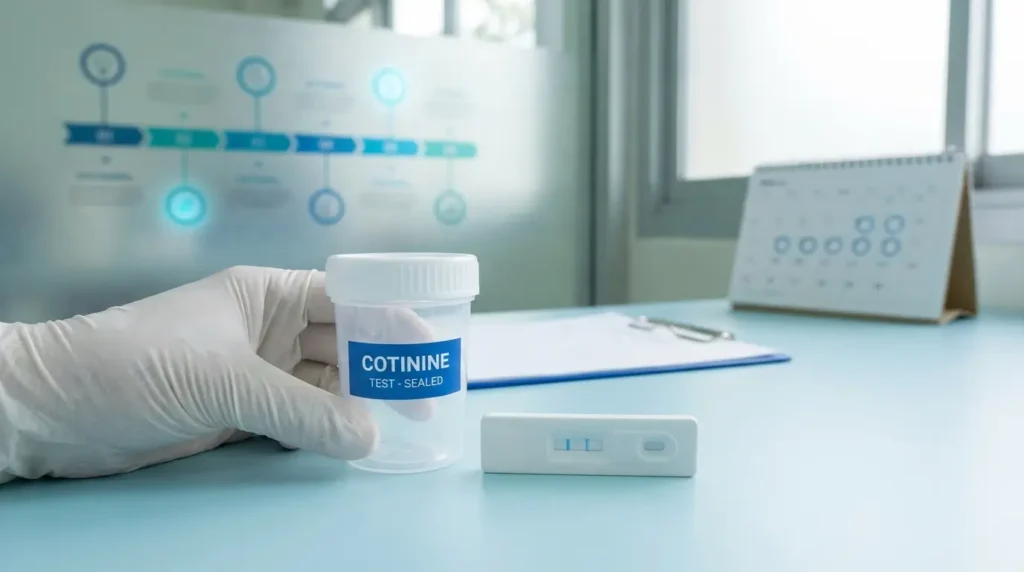
1. Urine Testing (Most Common)
- Primary Cutoff: Standard immunoassay test strips use $200\text{ ng/mL}$. Confirmatory gas chromatography-mass spectrometry (GC-MS) or LC-MS/MS can measure down to $50\text{ ng/mL}$ or $10\text{ ng/mL}$.
- Why It’s Popular: Urine yields the highest concentrations of cotinine, making it easy and affordable to detect exposure up to a full week after cessation.
- The Dilution Vulnerability: Like all urine screens, donors who drink massive volumes of water can trigger a negative-dilute specimen. Read our in-depth analysis on Specimen Validity and Urine Dilution to see why low creatinine ($<20\text{ mg/dL}$) causes lab rejections.
2. Saliva (Oral Fluid) Swab Testing
- Primary Cutoff: $10\text{ to }30\text{ ng/mL}$.
- Detection Window: Typically 48 to 96 hours (2 to 4 days).
- The Life Insurance Favorite: Paramedical examiners representing companies like Prudential, Mutual of Omaha, or Northwestern Mutual love oral swabs because they can be collected right at your kitchen table under direct observation, completely eliminating the possibility of specimen substitution or bathroom tampering.
- To evaluate oral fluid detection kinetics across other substances, check our Saliva Drug Test Calculator.
3. Blood Serum Testing
- Primary Cutoff: $1\text{ to }10\text{ ng/mL}$.
- Detection Window: 48 to 72 hours.
- Clinical Use: Mostly reserved for clinical toxicology trials, pediatric accidental ingestion cases, and specialized pre-operative cardiovascular assessments.
4. Hair Follicle Testing
- Primary Cutoff: $0.1\text{ ng/mg}$ of hair.
- Detection Window: Up to 90 days (standard 1.5-inch cosmetic hair specimen).
- How It Works: As hair grows from the vascularized follicle, cotinine binds into the keratin matrix. While rarely used for standard job interviews due to expense, child custody courts and specialized health programs use hair tests to prove long-term smoking history. Explore how hair matrix binding functions in our Hair Follicle Drug Test Calculator.
4. Biological Variables: Why One Person Clears Cotinine Faster Than Another
Two individuals can share a pack of cigarettes on Friday night, yet one person tests completely clean by Tuesday morning while the other fails on Thursday. What drives this massive physiological divergence?
A. CYP2A6 Hepatic Genetic Polymorphisms
The CYP2A6 gene is among the most genetically variable cytochrome enzymes in the human liver:
- *Normal / Extensive Metabolizers ($CYP2A6^1$): Standard enzyme expression. Cotinine half-life is between 15 and 17 hours.
- **Slow / Poor Metabolizers ($CYP2A6^*2, ^4, ^9$): Enzyme activity is significantly reduced. Cotinine half-life can exceed 24 to 30 hours, meaning it takes them nearly twice as long to clear the metabolite from their bloodstream.
- Racial and Ethnic Disparities: Clinical studies by Dr. Neal Benowitz demonstrate that African American individuals and Asian populations have a higher prevalence of slow-metabolizing CYP2A6 alleles compared to Caucasians, resulting in slower cotinine clearance and higher urinary cotinine concentrations per cigarette smoked.
B. Biological Sex and Estrogen Status
Estrogen induces CYP2A6 gene transcription. As a result:
- Females taking oral contraceptives (birth control) metabolize nicotine and cotinine up to 20% to 30% faster than men.
- Pregnant women exhibit dramatic increases in CYP2A6 clearance, resulting in cotinine half-lives dropping to as short as 9 to 11 hours.
- Post-menopausal women and biological men exhibit slower, steadier baseline clearance.
C. Urinary pH and Renal Tubular Reabsorption
Unlike many metabolites that are entirely filtered without re-entry, cotinine undergoes pH-dependent passive tubular reabsorption:
- Acidic Urine (pH $< 5.5$): Cotinine is ionized (ionized molecules cannot easily cross cell membranes), preventing it from being reabsorbed by the kidney tubules. It is rapidly excreted in urine, accelerating clearance.
- Alkaline Urine (pH $> 7.0$): Cotinine remains un-ionized, allowing up to 40% of filtered cotinine to be passively reabsorbed back into the bloodstream, prolonging the elimination window.
5. The Vaping & Nicotine Pouch (ZYN) Dilemma
A massive misconception among modern tobacco users is that smoke-free nicotine products do not trigger “tobacco” drug tests:
                      The Nicotine Delivery Matrix
   ┌───────────────────────────────────────────────────────────────┐
   │                                                               │
   │  Traditional Cigarettes ────> Tobacco Leaf + Tar + Nicotine   │
   │  Vape / E-Cigarettes    ────> Propylene Glycol + Freebase/Salt│
   │  Oral Pouches (ZYN)     ────> Plant Fiber + Synthetic Nicotine│
   │                                                               │
   └───────────────────────────────┬───────────────────────────────┘
                                   │
                                   ▼
                      Absorbed Nicotine into Liver
                                   │
                                   ▼
                       CYP2A6 Liver Oxidation
                                   │
                                   ▼
                       100% IDENTICAL COTININE
                    (Indistinguishable on All Labs)
Why Vaping Often Takes LONGER to Clear Than Cigarettes
Modern pod-based e-cigarettes (Juul, Elf Bar, Geek Bar) utilize nicotine salts (nicotine combined with benzoic or levulinic acid). Nicotine salts allow vapers to inhale immense concentrations ($50\text{ mg/mL}$ or $5%$) with virtually no harsh throat burn.
Furthermore, unlike a combustible cigarette that burns down and ends in 7 minutes, a pod vape sits on your desk all day. Continuous, micro-puffing throughout the day sustains high plasma nicotine levels for 16 consecutive hours, driving daily cotinine production far beyond that of an average pack-a-day smoker.
Do ZYN and Nicotine Pouches Trigger Tests?
Yes, 100%. Even though nicotine pouches like ZYN contain zero tobacco leaf and no nitrosamines, they deliver pharmaceutical-grade nicotine that is swallowed or absorbed through the buccal mucosa. The liver does not care whether nicotine came from a Cuban cigar or a synthetically synthesized pouch—it converts it into the exact same cotinine molecule.
If your insurance exam checks for cotinine, ZYN will trigger an identical positive result as smoking cigarettes.
6. The Medical Exam Strategy: Passing for Life Insurance
The financial stakes of a cotinine test are staggering. In the life insurance industry, underwriting guidelines are merciless:
- Non-Smoker Rate: A 35-year-old in good health might pay $45 per month for a $1,000,000 20-year term policy.
- Smoker Rate: Testing positive for cotinine categorizes you into the “Tobacco” tier. That exact same policy jumps to $175 to $220 per month. Over the life of a 20-year policy, testing positive for cotinine can cost you over $30,000 in excess premiums.
The Life Insurance Testing Protocol
- The Paramedical Exam: The examiner comes to your home or office. They will record your vitals, draw two vials of blood, and either collect a urine cup or swab your cheek.
- The “Clean Break” Rule: If you are an active vaper, smoker, or pouch user looking to qualify for non-smoker rates, you must completely abstain from all nicotine sources (including NRT gums and patches) for at least 7 to 10 full days before your exam.
- The 12-Month Rule: Note that life insurance applications ask: “In the past 12 months, have you used any substance containing nicotine?” Answering “no” when you used nicotine 2 weeks ago is legally considered material insurance fraud. If you die during the 2-year contestability period, the insurer can examine medical records and deny the death benefit to your beneficiaries.
7. The Nicotine-Caffeine Metabolic Interaction
Here is a clinical curiosity that catches many people by surprise when they quit nicotine to pass a drug test:
The polycyclic aromatic hydrocarbons (PAHs) found in tobacco smoke are powerful inducers of the hepatic enzyme CYP1A2—the exact same liver enzyme responsible for metabolizing caffeine.
- When you are smoking regularly, your liver clears caffeine roughly twice as fast as a non-smoker.
- When you abruptly stop smoking to clear cotinine before an upcoming test, your CYP1A2 activity returns to normal baseline within 3 to 5 days.
- If you continue drinking your usual 4 cups of daily coffee, your circulating caffeine levels will skyrocket by 200% to 300%, triggering intense anxiety, insomnia, palpitations, and tremors—which many people mistake for nicotine withdrawal!
If you are detoxing from nicotine, cut your coffee intake in half to maintain steady adenosine kinetics. You can model your daily caffeine clearance using our Caffeine Half-Life Calculator.
8. Can You “Flush” Cotinine Out Faster?
The internet is flooded with claims that drinking cranberry juice, taking hot saunas, or chugging gallons of green tea will “flush” cotinine out in 24 hours. Let us look at what the clinical data actually supports:
                            Cotinine Clearance Strategies
                                          │
       ┌──────────────────────────────────┴──────────────────────────────────┐
       ▼                                                                     ▼
  WHAT ACTUALLY WORKS                                                   WHAT IS A MYTH
  • 100% Total Nicotine Cessation                                      • "Detox" Teas / Pills
  • Ascorbic Acid (Vitamin C, 1-2g/day)                                • Saunas & Sweating (Cotinine
    lowers urine pH, trapping cotinine                                   is water-soluble, not excreted
    in urine and blocking reabsorption                                   significantly in sweat)
  • Normal Hydration (2 - 3L/day)                                      • Extreme Water Chugging
  • Exercise (burns adipose stores)                                      (Causes failed "Negative-Dilute")
1. Ascorbic Acid (Vitamin C) & Urine Acidification
Because cotinine undergoes pH-dependent passive tubular reabsorption in the kidneys, acidifying your urine prevents reabsorption. Taking 1,000 to 2,000 mg of Vitamin C (Ascorbic Acid) daily lowers urinary pH below 5.5, ionizes urinary cotinine, and forces it out through the bladder faster.
2. Physical Exercise (Early Phase Only)
Unlike THC, which binds tenaciously to lipocytes for 30+ days (see our THC Clearance Calculator), cotinine distributes primarily through total body water ($V_d = 0.66\text{ L/kg}$) with only minor lipid affinity. Moderate cardiovascular exercise boosts blood flow and glomerular filtration rate (GFR), speeding hepatic delivery.
3. Do NOT Cause a Dilute Specimen
Panicking and drinking 2 gallons of water the morning of your test will not erase cotinine from your body—it will simply dilute your urinary creatinine below $20\text{ mg/dL}$. As explored in our Urine Dilution & Creatinine Guide, life insurance underwriters view a dilute specimen as an automatic flag, either canceling your exam or demanding a mandatory re-test.
Cotinine Detection Matrix: Quick Clinical Summary
| Time Post Last Use | Occasional User Status | Daily Smoker / Vaper Status | Heavy User / ZYN User Status |
|---|---|---|---|
| 24 Hours | High Positive ($> 200\text{ ng/mL}$) | Extreme Positive ($> 2,000\text{ ng/mL}$) | Extreme Positive ($> 4,000\text{ ng/mL}$) |
| 48 Hours | Borderline / Clearing | High Positive ($> 1,000\text{ ng/mL}$) | High Positive ($> 2,000\text{ ng/mL}$) |
| 72 Hours (3 Days) | CLEAN (Below 200 ng/mL) | Borderline ($150 – 400\text{ ng/mL}$) | High Positive ($> 800\text{ ng/mL}$) |
| 96 Hours (4 Days) | CLEAN (Below 50 ng/mL) | CLEAN (Below 200 ng/mL) | Borderline ($100 – 300\text{ ng/mL}$) |
| 7 Days | CLEAN (Below 10 ng/mL) | CLEAN (Below 50 ng/mL) | CLEAN (Below 200 ng/mL) |
| 10 Days | Completely Negative | CLEAN (Below 10 ng/mL) | CLEAN (Below 50 ng/mL) |
| 14 Days | Completely Negative | Completely Negative | CLEAN (Below 10 ng/mL) |
Frequently Asked Questions
Can nicotine patches or gum help me pass a cotinine test?
No. Nicotine replacement therapy (NRT) products—including transdermal patches, nicotine polacrilex gum, lozenges, and inhalers—contain pure medicinal nicotine. Your liver oxidizes this nicotine into cotinine in the exact same manner as cigarettes. To test clean for cotinine, all forms of NRT must be discontinued.
Does dental surgery or mouthwash affect a cotinine saliva test?
No. Over-the-counter mouthwashes, toothpastes, and breath mints do not break down cotinine molecules. Cotinine in saliva is secreted continuously through the salivary glands from systemic arterial blood. While vigorous rinsing may dilute oral fluid for 5 to 10 minutes, the paramedical examiner collects saliva via an absorbent swab kept in the mouth for several minutes, capturing fresh glandular secretions.
How long does cotinine stay in breast milk?
Cotinine crosses readily into breast milk, reaching concentrations that are typically 2 to 3 times higher than maternal blood plasma. In nursing mothers, cotinine takes roughly 3 to 5 days after full nicotine cessation to clear breast milk down to undetectable limits.
Scientific Studies & Clinical References
- Benowitz, N. L., Hukkanen, J., & Jacob, P. 3rd. (2009). Nicotine chemistry, metabolism, kinetics and biomarkers. Handbook of Experimental Pharmacology, (192), 29–60. PubMed PMID: 19345122.
- Hukkanen, J., Jacob, P. 3rd, & Benowitz, N. L. (2005). Metabolism and disposition kinetics of nicotine. Pharmacological Reviews, 57(1), 79–115. PubMed PMID: 15734762.
- Perez-Stable, E. J., Herrera, B., Jacob, P. 3rd, & Benowitz, N. L. (1998). Nicotine metabolism and intake in black and white smokers. JAMA, 280(2), 152–156. PubMed PMID: 9669788.
- Jarvis, M. J., Tunstall-Pedoe, H., Feyerabend, C., et al. (1987). Comparison of tests used to distinguish smokers from nonsmokers. American Journal of Public Health, 77(11), 1435–1438. PubMed PMID: 3661797.
- Benowitz, N. L., & Jacob, P. 3rd. (1994). Metabolism of nicotine to cotinine studied by a dual stable isotope method. Clinical Pharmacology & Therapeutics, 56(5), 483–493. PubMed PMID: 8040012.
1 thought on “How Long Does Cotinine Stay in Urine? Detection Time Guide”