
Hair Follicle Drug Test Detection Window: How the 90-Day Window Actually Works
Quick Summary: The hair follicle drug test detection window extends approximately 90 days for scalp hair and up to 12 months for body hair. Unlike urine, saliva, or blood screens that measure active metabolites circulating in bodily fluids, hair testing captures a permanent biochemical record of drug exposure locked inside the keratin protein matrix as each strand grows from the follicle bulb. Understanding how substances enter hair, why melanin concentration creates racial testing disparities, and where the biological blind spots exist is essential for anyone facing workplace, court-ordered, or pre-employment hair screening.
Calculate Your Personalized Hair Test Detection Timeline
Enter your substance, date of last use, scalp vs. body hair, and hair length to see exactly which segment of your hair contains detectable metabolites: Open Hair Follicle Drug Test Calculator →
Every other drug testing method gives you a window measured in hours or days. Urine screens catch metabolites circulating through your kidneys this week. Saliva swabs capture what has been in your mouth for the last 48 hours. Blood draws reflect the drugs flowing through your veins right now.
Hair testing does something fundamentally different. It creates a permanent biological diary—a centimeter-by-centimeter chronological record of every substance your bloodstream carried over the past three months, entombed forever in dead keratin protein.
That is precisely why courts, federal employers, custody judges, and high-security clearance agencies consider hair follicle testing the gold standard of forensic drug detection. You cannot flush it with water, dilute it by drinking fluids, or sweat it out in a sauna. The evidence is physically embedded inside your body.
This guide explains exactly how the hair follicle drug test detection window operates at the cellular and molecular level, which substances are captured, why the test has built-in blind spots, and what the clinical science says about beating it.
1. How Drugs Enter Hair: The Three Biological Pathways
When you consume any substance—whether inhaled, injected, swallowed, or absorbed through the skin—active parent compounds and their hepatic metabolites circulate through your arterial blood. A portion of these molecules enters the hair follicle through three distinct mechanisms:
                        Systemic Blood Circulation
                    (Parent Drug + Hepatic Metabolites)
                                    │
             ┌──────────────────────┼──────────────────────┐
             ▼                      ▼                      ▼
   PATHWAY 1: CAPILLARY       PATHWAY 2: SEBUM        PATHWAY 3: SWEAT
     DIFFUSION INTO            AND APOCRINE              AND ECCRINE
     FOLLICLE BULB             GLAND SECRETION          GLAND SECRETION
             │                      │                      │
    Drug molecules cross       Oil-soluble drugs      Water-soluble drugs
    dermal papilla blood       coat the external      deposit onto the
    vessels → matrix cells     cuticle layer           hair surface
             │                      │                      │
             ▼                      ▼                      ▼
      INTERNAL CORTEX        EXTERNAL CUTICLE         EXTERNAL CUTICLE
   (Permanent Incorporation   (Removable by Lab       (Removable by Lab
    into Keratin Matrix)        Wash Procedure)         Wash Procedure)
Pathway 1: Capillary Diffusion into the Hair Matrix (Primary)
The hair follicle bulb is one of the most vascularized microstructures in human skin. A dense network of capillaries in the dermal papilla supplies blood directly to the rapidly dividing matrix keratinocytes (the cells that build the hair shaft from the inside out).
As blood flows past the matrix cells, drug molecules and metabolites passively diffuse across capillary walls and cell membranes into the growing cells. Once inside, these molecules become trapped in the nascent keratin protein as it polymerizes, cross-links, and hardens into the mature hair cortex.
This is the most forensically significant pathway because it creates an internal, permanent incorporation that cannot be washed away with shampoo, bleach, or detox treatments.
Pathway 2: Sebum and Apocrine Gland Coating (External)
Sebaceous glands attached to each follicle secrete an oily substance called sebum. Lipophilic (fat-soluble) compounds like THC, cocaine, and their metabolites can dissolve into sebum and coat the external surface of the hair shaft as it emerges from the scalp.
Pathway 3: Sweat and Eccrine Gland Deposition (External)
Water-soluble drugs and metabolites are excreted in sweat, which bathes the hair surface and can deposit analytes onto the outer cuticle.
Critical Distinction: Certified forensic laboratories (Psychemedics, Quest Diagnostics Hair, Omega Laboratories) perform rigorous pre-analytical decontamination washes using organic solvents and phosphate buffers to strip away all external surface contamination from Pathways 2 and 3 before testing the internal cortex. This is specifically designed to eliminate false positives from environmental exposure, secondhand smoke, and incidental contact.
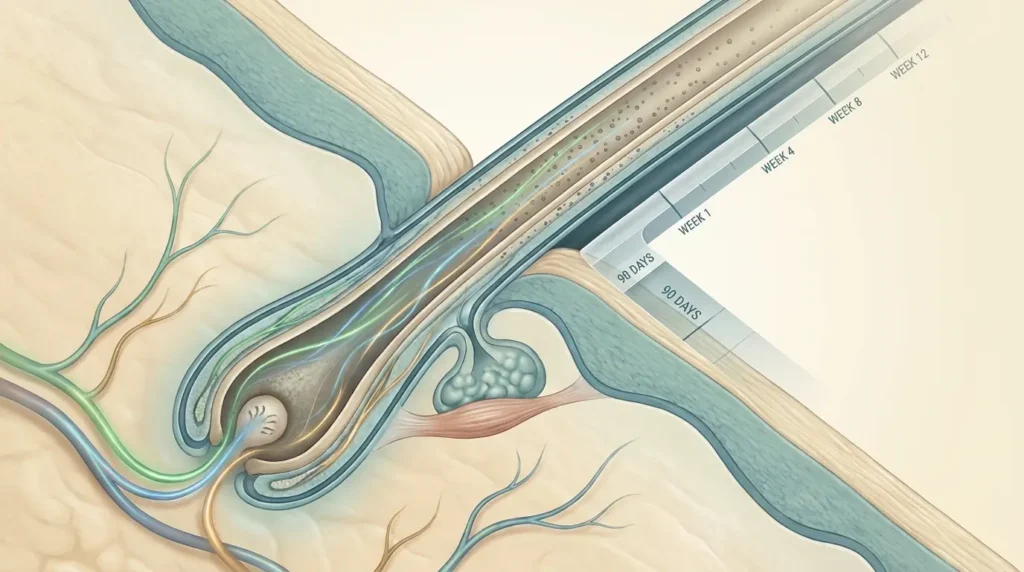
2. The Hair Follicle Drug Test Detection Window: Why Exactly 90 Days?
The standard hair follicle drug test detection window of 90 days is not an arbitrary number chosen by testing companies. It is a direct mathematical product of two biological constants:
$$\text{Detection Window (days)} = \frac{\text{Hair Sample Length (cm)}}{\text{Scalp Hair Growth Rate (cm/day)}}$$
The Growth Rate Foundation
Human scalp hair grows at a remarkably consistent rate across all ethnicities and ages:
- Average Growth Rate: Approximately 1.0 to 1.3 cm per month (roughly $0.35\text{ to }0.44\text{ mm per day}$).
- Standard Collection Length: The Society of Hair Testing (SoHT) and SAMHSA guidelines specify collecting the proximal 1.5 inches (3.8 cm) of hair cut as close to the scalp as possible.
$$\frac{3.8\text{ cm}}{1.0\text{ to }1.3\text{ cm/month}} \approx 2.9\text{ to }3.8\text{ months} \approx \textbf{90 days}$$
The collected 1.5-inch segment therefore represents a biological record of drug exposure during the most recent approximately 90 days.
                    Hair Growth Timeline (Scalp Hair)

     ◄───── 90 Days (3 Months) ──────────────────────────────────►
     ◄── 60 Days ──────────────────────►
     ◄── 30 Days ────────►

     ┌──────┬──────┬──────┐
     │ Most │ Mid  │ Old  │
     │Recent│      │      │ ──► Scalp Surface
     │Month │Month │Month │
     │  1   │  2   │  3   │
     └──────┴──────┴──────┘
     ↑                    ↑
   CUT HERE            END OF
  (At Scalp)          STANDARD
                      1.5-INCH
                       SAMPLE
What About Longer Hair Samples?
Some laboratories (particularly in legal proceedings) collect longer hair samples to extend the detection window:
- A 3-inch sample can theoretically reflect 6 months of drug history.
- A 6-inch sample can theoretically reflect 12 months.
However, there are diminishing returns. As hair ages and is exposed to sun, water, chemical treatments, and mechanical wear, internal analyte concentrations degrade through slow photolytic and oxidative breakdown. Results from older segments are less reliable.
3. The 5-to-7-Day Blind Spot: Hair Testing’s Hidden Weakness
One of the least understood aspects of the hair follicle drug test detection window is that it cannot detect very recent drug use:
                   DRUG USE EVENT
                         │
                         ▼
            Day 0: Substance enters blood
            Day 1: Metabolites deposit into follicle bulb matrix cells
            Day 2: Keratinization begins; analyte is locked in
          Days 3-5: Contaminated hair segment grows inside the skin
          Days 5-7: Contaminated segment EMERGES above the scalp surface
                         │
                         ▼
               NOW COLLECTIBLE AND DETECTABLE

              ◄── "BLIND SPOT" ──►
              (5 to 7 Days Minimum)
Drug metabolites deposited into the matrix cells at the base of the follicle bulb take approximately 5 to 7 days to grow through the subcutaneous tissue and emerge above the scalp as collectible hair fiber. Any substance consumed within the past week exists in hair that is still physically below the skin surface, invisible and inaccessible to the collector’s scissors.
This blind spot is precisely why hair testing is never used as a standalone method for detecting acute impairment or very recent use. For same-day or same-week detection, employers and courts rely on:
- Urine screens (detection window: 1 to 30+ days depending on the substance; model yours with our THC Clearance Calculator or Urine Dilution Calculator).
- Oral fluid swabs (detection window: 24 to 72 hours; model your timeline with our Saliva Drug Test Calculator).
4. Scalp Hair vs. Body Hair Detection Window: The Expanded Timeline
When a donor presents with a shaved scalp or hair too short to collect a valid 1.5-inch scalp sample, collectors are trained to harvest body hair from the chest, arms, legs, underarms, or beard.
Body hair has fundamentally different growth kinetics than scalp hair:
| Hair Location | Growth Rate | Active Growth Phase (Anagen) | Resting Phase (Telogen) | Effective Detection Window |
|---|---|---|---|---|
| Scalp | 1.0 – 1.3 cm/month | 2 – 6 Years | 2 – 3 Months | ~90 Days (Standard) |
| Arm / Leg | 0.2 – 0.5 cm/month | 3 – 6 Months | 3 – 6 Months | 6 to 12 Months |
| Chest / Abdomen | 0.2 – 0.4 cm/month | 3 – 5 Months | 3 – 6 Months | 6 to 12 Months |
| Underarm (Axillary) | 0.3 – 0.5 cm/month | 4 – 6 Months | 3 – 4 Months | 6 to 12 Months |
| Beard / Facial | 0.8 – 1.0 cm/month | 1 – 3 Years | 2 – 4 Months | 4 to 6 Months |
| Pubic | 0.3 – 0.5 cm/month | Variable | Variable | 6 to 12 Months |
Why Body Hair Creates a Longer Detection Window
Unlike scalp hair, which grows continuously in a long anagen phase, body hair cycles through relatively short active growth periods (3 to 6 months) followed by extended resting phases. During the telogen (resting) phase, the hair shaft remains anchored in the follicle but does not grow. Any drug metabolites deposited during the previous active growth phase are frozen in place, potentially representing exposure from many months ago.
Key Implication: If you used a substance 8 months ago and have been completely abstinent since, a scalp hair test would return negative (it only covers 90 days). But a body hair test could still return positive, because that arm or chest hair may have been in its growth phase during your period of use and has been sitting dormant in telogen ever since.
5. Which Substances Can the Hair Follicle Drug Test Detection Window Capture?
Standard hair panel screens (the “5-panel” and expanded “12-panel”) target the following analytes, each with specific laboratory cutoff concentrations established by SAMHSA and the Society of Hair Testing (SoHT):
| Drug Class | Target Analyte in Hair | Screening Cutoff | Confirmation Cutoff | Incorporation Efficiency |
|---|---|---|---|---|
| Cannabis / Marijuana | THC-COOH (carboxy-THC) | 1 pg/mg | 0.05 pg/mg | Low (THC is acidic; poor melanin binding) |
| Cocaine | Cocaine + Benzoylecgonine | 500 pg/mg | 50 pg/mg | Very High (basic compound; strong melanin binding) |
| Opiates (Heroin, Morphine, Codeine) | 6-MAM, Morphine, Codeine | 200 pg/mg | 200 pg/mg | High |
| Amphetamines (Adderall, Meth) | Amphetamine, Methamphetamine | 300 pg/mg | 300 pg/mg | High (basic amine; excellent keratin incorporation) |
| PCP (Phencyclidine) | Phencyclidine | 300 pg/mg | 300 pg/mg | High |
| Benzodiazepines (Xanax, Valium) | Alprazolam, Diazepam, etc. | 200 pg/mg | 50 pg/mg | Moderate |
| MDMA / Ecstasy | MDMA + MDA | 300 pg/mg | 300 pg/mg | High |
| Alcohol (EtG Hair Test) | Ethyl Glucuronide (EtG) | 8 pg/mg (chronic) | 8 pg/mg | Low-Moderate |
| Fentanyl | Fentanyl + Norfentanyl | 200 pg/mg | 50 pg/mg | Moderate-High |
Why Cannabis Has the Worst Incorporation Rate
THC-COOH is an acidic metabolite. Hair keratin and melanin granules preferentially bind basic (alkaline) drug molecules through electrostatic ionic interactions. This means cocaine and amphetamines incorporate into hair far more efficiently than cannabis metabolites.
As a result, single-use or infrequent cannabis exposure is significantly less likely to produce a hair test positive than equivalent exposure to cocaine or methamphetamine. Chronic, heavy cannabis use is required to generate the sustained blood concentration necessary to push internal hair THC-COOH above the strict $0.05\text{ pg/mg}$ confirmation cutoff.
6. The Melanin Controversy: Does Hair Color Create Testing Bias?
One of the most scientifically contentious aspects of the hair follicle drug test detection window is the role of melanin pigment in drug binding:
                    Eumelanin (Dark Pigment) vs. Pheomelanin (Light Pigment)
                                            │
                   ┌────────────────────────┴────────────────────────┐
                   ▼                                                 ▼
          BLACK / DARK BROWN HAIR                           BLONDE / RED / GRAY HAIR
     High Eumelanin Concentration                      Low Eumelanin Concentration
                   │                                                 │
   Strong Electrostatic Binding                          Weak Drug-Melanin Binding
   of Basic Drug Cations                                 Lower Analyte Retention
                   │                                                 │
         HIGHER DRUG CONCENTRATIONS                    LOWER DRUG CONCENTRATIONS
          Per Milligram of Hair                         Per Milligram of Hair
       (3x to 10x More Than Blonde)                  (Even at Identical Dose Exposure)
The Research Evidence
In a landmark study by Kidwell et al. (2004) and systematic reviews by Pragst & Balikova (2006), controlled dose-administration experiments revealed:
- Subjects with black hair retained 3 to 10 times higher concentrations of cocaine, codeine, and methamphetamine per milligram of hair compared to subjects with blonde or light brown hair, even when given identical doses.
- The mechanism is ionic binding: eumelanin carries a net negative charge, attracting the positively charged cations of basic drug molecules.
- Cosmetically bleached or dyed hair showed reduced drug concentrations due to melanin destruction and cuticle damage.
Legal and Ethical Implications
Several federal court cases in the United States have challenged the admissibility of hair testing on grounds of racial discrimination, arguing that individuals of African, Asian, and Mediterranean descent with naturally high eumelanin concentrations face a disproportionate risk of false positives or inflated readings compared to fair-haired individuals at the same dose exposure.
While testing companies counter that confirmation cutoffs and decontamination procedures control for this bias, it remains an active area of litigation in civil rights law.
7. Can You Beat a Hair Follicle Drug Test? Myth vs. Clinical Reality
The internet is saturated with products and methods claiming to “cleanse” or “detox” hair to pass a follicle test. Here is what the forensic toxicology literature actually says:
Myth 1: Detox Shampoos (Aloe Rid, Zydot, Macujo Method)
- The Claim: Specialized shampoos penetrate the hair cuticle and extract internal drug metabolites.
- The Reality: Forensic studies by Jurado et al. (1997) demonstrated that aggressive cosmetic treatments (including commercial detox products, propylene glycol washes, and repeated bleaching) can reduce analyte concentrations by 30% to 60%. However, laboratories account for this degradation by using extremely low confirmation cutoffs. In most clinical trials, heavy users still failed even after extensive detox treatment. Moreover, laboratories document abnormal cuticle damage under microscopy, which raises immediate suspicion.
Myth 2: Shaving Your Entire Body
- The Claim: If the collector cannot harvest any hair, the test cannot proceed.
- The Reality: Arriving with a completely shaved head, face, arms, chest, and legs is treated as a refusal to test by virtually all testing authorities—legally equivalent to a positive result. Most programs require an alternative specimen (urine or oral fluid) and document the evasion attempt on your permanent record.
Myth 3: Bleaching and Dyeing Hair
- The Claim: Chemical treatments destroy embedded metabolites.
- The Reality: Hydrogen peroxide bleaching oxidizes and degrades some analytes (particularly cocaine and amphetamine metabolites) trapped in the cortex. However:
- It does not fully eliminate metabolites from the medulla (the deepest core of thick hair).
- Laboratories can detect bleach-damaged hair through cuticle integrity analysis.
- THC-COOH, being already an oxidized carboxylic acid metabolite, is more resistant to bleaching than basic compounds.
8. Hair EtG Testing: The Alcohol History Panel
Beyond illicit drugs, hair follicle testing can also detect chronic alcohol use through Ethyl Glucuronide (EtG) embedded in the hair shaft:
- Cutoff for Chronic Excessive Drinking: $\ge 30\text{ pg/mg}$ of hair.
- Cutoff for Repeated Drinking (Social / Regular): $8\text{ to }30\text{ pg/mg}$.
- Below 8 pg/mg: Consistent with abstinence or very rare incidental consumption.
Hair EtG is increasingly used in custody disputes, liver transplant candidacy assessments, and professional licensing reinstatement applications.
If you are facing an EtG alcohol monitoring program that uses urine screens rather than hair, model your real-time clearance timeline with our EtG Pass/Fail Predictor or learn about the risks of specimen dilution in our Urine Dilution & Creatinine Guide.
Hair Follicle Drug Test Detection Window: Quick Reference Matrix
Use this summary table to estimate the detection status for each substance class across different timeframes:
| Time Since Last Use | Cannabis (Heavy) | Cocaine | Opiates | Amphetamines | Alcohol (EtG) |
|---|---|---|---|---|---|
| 1 to 7 Days | Blind Spot (Too Recent) | Blind Spot | Blind Spot | Blind Spot | Blind Spot |
| 7 to 14 Days | Emerging Positive | Emerging Positive | Emerging Positive | Emerging Positive | Emerging Positive |
| 14 to 30 Days | Detectable | Strongly Detectable | Detectable | Strongly Detectable | Detectable |
| 30 to 60 Days | Detectable | Strongly Detectable | Detectable | Strongly Detectable | Detectable |
| 60 to 90 Days | Fading (if light use) | Still Detectable | Fading | Still Detectable | Detectable |
| 90 to 120 Days | Cleared (Scalp) | Cleared (Scalp) | Cleared (Scalp) | Cleared (Scalp) | Cleared (Scalp) |
| 6 to 12 Months | Body Hair Possible | Body Hair Possible | Body Hair Possible | Body Hair Possible | Body Hair Possible |
Frequently Asked Questions
Can a single one-time use show up on a hair follicle drug test?
It depends heavily on the substance. A single heavy cocaine session produces detectable benzoylecgonine in hair in the majority of cases due to cocaine’s excellent melanin-binding properties. However, a single marijuana session rarely produces enough THC-COOH to exceed the $0.05\text{ pg/mg}$ confirmation cutoff. Single-use amphetamine or MDMA detection is variable and depends on dose, hair color, and individual metabolism.
Does washing or styling my hair daily reduce drug concentrations?
Daily shampooing, conditioning, and heat styling cause gradual cuticle erosion and minor surface analyte loss over time. However, the primary forensic evidence sits in the interior cortex and medulla, which are protected beneath the cuticle scales. Standard hygiene practices do not significantly alter internal concentrations enough to turn a positive test into a negative one.
How does a hair follicle drug test compare to a urine test for THC?
The two methods answer entirely different clinical questions. A urine test for THC (at the $50\text{ ng/mL}$ cutoff) detects recent cannabis metabolite excretion from the past 3 to 30+ days, depending on body fat and usage frequency (calculate yours with our THC Clearance Calculator). A hair test creates a 90-day historical record but cannot detect use in the past 5 to 7 days. Many testing programs combine both methods for comprehensive coverage.
Can prescription medications cause a false positive on a hair follicle test?
Yes. Codeine-containing cough syrups can trigger opiate panels. Prescription amphetamines like Adderall or Vyvanse (calculate clearance windows with our Adderall Clearance Calculator or Vyvanse Clearance Calculator) will be detected on amphetamine panels. The Medical Review Officer (MRO) should request valid prescription documentation before finalizing a positive result.
Scientific Studies & Clinical References
- Pragst, F., & Balikova, M. A. (2006). State of the art in hair analysis for detection of drug and alcohol abuse. Clinica Chimica Acta, 370(1–2), 17–49. PubMed PMID: 16595284.
- Cone, E. J. (1996). Mechanisms of drug incorporation into hair. Therapeutic Drug Monitoring, 18(4), 438–443. PubMed PMID: 8857564.
- Kidwell, D. A., Lee, E. H., & DeLauder, S. F. (2000). Evidence for bias in hair testing and procedures to correct bias. Forensic Science International, 107(1–3), 63–86. PubMed PMID: 10689563.
- Society of Hair Testing (SoHT). (2021). Revised consensus on hair testing for chronic excessive alcohol consumption. Drug Testing and Analysis, 13(10), 1600–1607. PubMed PMID: 22036890.
- Cooper, G. A. A., Kronstrand, R., & Kintz, P. (2012). Society of Hair Testing guidelines for drug testing in hair. Forensic Science International, 218(1–3), 20–24. PubMed PMID: 22088946.