
How Long Does Adderall Stay in Urine? pH, Vitamin C & Amphetamine Clearance Science
Quick Summary: For a standard urine drug screen at the SAMHSA $500\text{ ng/mL}$ immunoassay cutoff, Adderall (mixed amphetamine salts) is typically detectable for 48 to 72 hours after a single therapeutic dose. However, this window is not fixed. The single most powerful variable controlling how long Adderall stays in urine is your urinary pH. Acidic urine (pH $< 6.0$) can halve the amphetamine half-life to ~7 hours, clearing the drug in under 2 days. Alkaline urine (pH $> 7.5$) can double or triple the half-life to 18–34 hours, trapping the drug for 5 to 6 days.
Model Your Exact Adderall Detection Window
Plug in your dose, formulation (IR vs. XR), urinary pH estimate, and body weight into our pharmacokinetic calculator for a personalized clearance timeline: Open Adderall Clearance Calculator →
If you take Adderall—whether it is prescribed for ADHD or you are studying for finals—and a drug test is on the horizon, the first thing you probably Googled was: “How long does Adderall stay in urine?”
You likely found a dozen websites that gave you a lazy answer like “2 to 4 days.” That answer is not wrong, but it is dangerously incomplete. Amphetamine elimination is one of the most physiologically variable clearance processes in all of clinical pharmacology. Two people can swallow the exact same 20 mg tablet at the same time, and one can test completely clean in 36 hours while the other fails on Day 5.
The variable that drives this radical divergence is not body weight, not liver enzymes, and not how much water you drink. It is the pH of your urine—and it can swing your detection window by a factor of three.
1. How Long Does Adderall Stay in Urine: The pH-Dependent Elimination Pathway
To understand why amphetamine clearance is so wildly variable, you need to follow the drug from your stomach to your kidneys:
              Oral Adderall Tablet Ingested
                         │
                         ▼
            GI Absorption (>75% Bioavailability)
                         │
                         ▼
               Systemic Blood Circulation
         (d-Amphetamine 75% / l-Amphetamine 25%)
                         │
           ┌─────────────┴─────────────────┐
           ▼                               ▼
   HEPATIC METABOLISM                RENAL EXCRETION
    (~30% to 50%)                    (~30% to 70%)
   CYP2D6 Enzyme ──>             UNCHANGED AMPHETAMINE
  4-OH-Amphetamine              Filtered into Urine
  + Norephedrine                         │
   (Inactive)                            ▼
                            pH-DEPENDENT ION TRAPPING
                                         │
                   ┌─────────────────────┴─────────────────────┐
                   ▼                                           ▼
            ACIDIC URINE                              ALKALINE URINE
           (pH < 6.0)                                 (pH > 7.5)
                   │                                           │
       Amphetamine IONIZED                      Amphetamine UN-IONIZED
   (Cannot cross tubular membrane)          (Easily crosses back into blood)
                   │                                           │
       RAPID EXCRETION                          MASSIVE REABSORPTION
     Half-life: 7 - 8 hours                   Half-life: 18 - 34 hours
     Clearance: ~36 to 48 hrs                 Clearance: ~96 to 144 hrs
The Henderson-Hasselbalch Principle Applied to Amphetamine
Amphetamine is a weak base with an acid dissociation constant (pKa) of approximately 9.9. In basic chemistry, weak bases exist in equilibrium between their ionized (protonated, water-soluble) form and their un-ionized (neutral, lipid-soluble) form.
The ratio of ionized to un-ionized molecules is governed by the Henderson-Hasselbalch equation:
$$\text{pH} = \text{pKa} + \log\left(\frac{[\text{un-ionized base}]}{[\text{ionized base}]}\right)$$
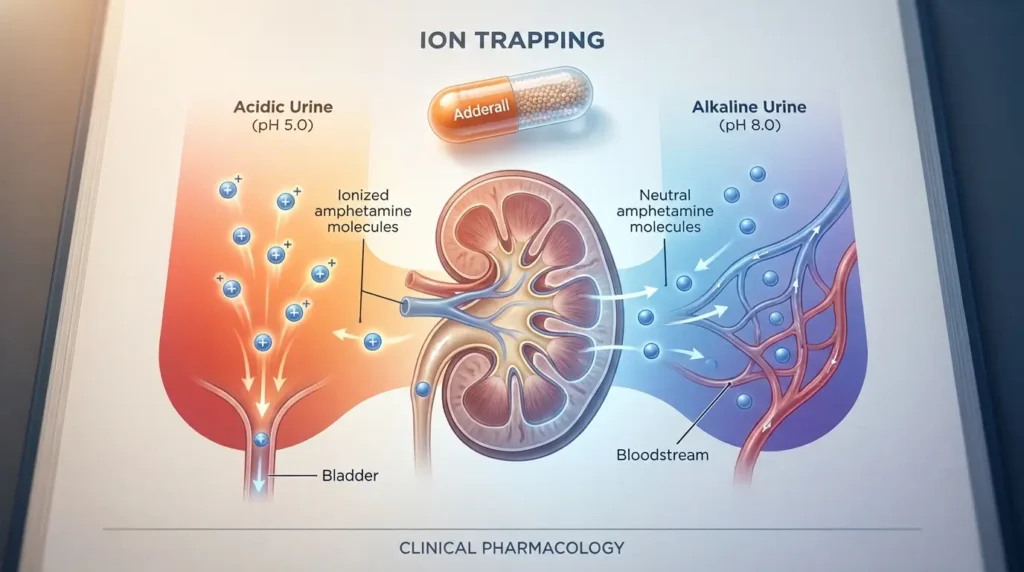
At a urinary pH of 5.0 (acidic), virtually 99.99% of amphetamine molecules in the renal tubular fluid are positively charged (ionized). Charged molecules cannot passively diffuse back through the lipid bilayer membranes of the tubular epithelial cells. They are effectively trapped in the urine and flushed out with each void.
At a urinary pH of 8.0 (alkaline), a dramatically higher proportion of amphetamine remains un-ionized and lipophilic. These neutral molecules freely cross the tubular membrane back into the peritubular capillaries, returning to systemic circulation. As much as 50% to 70% of filtered amphetamine is reabsorbed in alkaline urine.
The Clinical Impact: Half-Life Swings from 7 to 34 Hours
In landmark renal pharmacology research by Beckett & Rowland (1965) and confirmed by Davis et al. (1971), controlled human studies demonstrated:
| Urinary pH Range | Measured Amphetamine Half-Life | Approximate Urine Detection Window (500 ng/mL) |
|---|---|---|
| pH 5.0 – 5.5 (Highly Acidic) | 7 to 8 Hours | 24 to 36 Hours |
| pH 6.0 – 6.5 (Mildly Acidic) | 9 to 11 Hours | 48 to 60 Hours |
| pH 6.5 – 7.0 (Neutral) | 11 to 14 Hours | 60 to 72 Hours |
| pH 7.0 – 7.5 (Mildly Alkaline) | 14 to 20 Hours | 72 to 96 Hours |
| pH 7.5 – 8.0 (Highly Alkaline) | 20 to 34 Hours | 96 to 144+ Hours |
This is a five-fold variation in elimination half-life driven solely by the acidity of your urine—a factor that most generic drug testing guides completely ignore.
2. How Long Does Adderall Stay in Urine: Vitamin C and the Acidification Strategy
The relationship between urinary pH and amphetamine clearance has a direct practical implication: deliberately acidifying your urine with Vitamin C (ascorbic acid) accelerates Adderall elimination.
              Ascorbic Acid (Vitamin C) Supplementation
                             │
                             ▼
                  Absorbed → Blood → Kidneys
                             │
                             ▼
               Urinary pH Drops to 5.0 – 5.5
                             │
                             ▼
             Amphetamine Molecules Ionized
            (Protonated → Water-Soluble → Trapped)
                             │
                             ▼
          Tubular Reabsorption BLOCKED
                             │
                             ▼
       Accelerated Urinary Excretion (~40-50% Faster)
             Half-Life Reduced to ~7 Hours
How Vitamin C Works Pharmacologically
Ascorbic acid is metabolized into dehydroascorbic acid and oxalic acid, both of which are excreted renally. This process introduces hydrogen ions into the renal tubular fluid, directly lowering urinary pH.
Taking 1,000 to 2,000 mg of Vitamin C (ascorbic acid) daily:
- Drops urinary pH below $6.0$ within 2 to 4 hours of ingestion.
- Ionizes amphetamine molecules in the proximal and distal tubules.
- Prevents passive tubular reabsorption.
- Shortens the d-amphetamine half-life from ~12 hours to ~7 hours.
Foods and Substances That Acidify Urine
Beyond Vitamin C supplements, these dietary choices naturally lower urinary pH:
- Cranberry juice (hippuric acid and quinic acid excretion)
- High-protein diets (meat, eggs, fish — generate sulfuric and phosphoric acid from sulfur-containing amino acid catabolism)
- Grains and cereals (generate phosphoric acid)
- Carbonated cola beverages (phosphoric acid content)
Foods and Substances That ALKALINIZE Urine (Slow Clearance)
Conversely, the following raise urinary pH and extend how long Adderall stays in urine:
- Sodium bicarbonate (baking soda) — Direct alkalinizing agent
- Antacids (Tums, calcium carbonate)
- Strict vegetarian/vegan diets — Fruit and vegetable metabolism generates bicarbonate
- Citrus fruits (paradoxically — while citric acid is acidic before ingestion, it is metabolized into alkaline bicarbonate)
- Proton pump inhibitors (Omeprazole / Nexium)
Clinical Warning: If your physician prescribed Adderall for therapeutic ADHD management, deliberately acidifying your urine with high-dose Vitamin C will reduce the drug’s clinical efficacy. The same ion-trapping mechanism that accelerates excretion also prevents amphetamine from reaching therapeutic blood concentrations. This is why Adderall prescribing information warns patients to avoid Vitamin C and acidic fruit juices within 1 hour of dosing.
3. Adderall IR vs. Adderall XR: How Formulation Alters Detection
Adderall comes in two pharmaceutical formulations with dramatically different pharmacokinetic profiles:
                      ADDERALL IR (Immediate Release)
                      ┌────────────────────────────────┐
                      │  Entire dose released instantly │
                      │  in the stomach upon ingestion  │
                      │  Tmax (Peak): ~3 Hours          │
                      │  Duration: 4 - 6 Hours          │
                      └────────────────────────────────┘

                      ADDERALL XR (Extended Release)
                      ┌────────────────────────────────┐
                      │  50% Immediate-Release Beads    │
                      │  + 50% Enteric-Coated Beads     │
                      │  (Delayed release at ~4 hours)  │
                      │  Tmax (Peak): ~7 Hours           │
                      │  Duration: 10 - 12 Hours        │
                      └────────────────────────────────┘
| Pharmacokinetic Parameter | Adderall IR | Adderall XR |
|---|---|---|
| Release Mechanism | Full immediate dissolution | Dual-bead biphasic release |
| Time to Peak Blood Level ($T_{max}$) | ~3 Hours | ~7 Hours |
| Clinical Duration | 4 to 6 Hours | 10 to 12 Hours |
| Elimination Onset | Begins declining at ~3 hours | Begins declining at ~7 hours |
| Urine Detection (Neutral pH) | 48 to 72 Hours | 60 to 96 Hours |
Because Adderall XR delays peak blood concentration by approximately 4 hours through its enteric-coated delayed-release bead system, the elimination clock does not start until much later in the day. If you take an XR capsule at 8:00 AM, the second bead pulse does not even reach full plasma levels until approximately 3:00 PM. The result: XR is typically detectable in urine for 12 to 18 additional hours compared to an equivalent IR dose taken at the same time.
4. Drug Testing Cutoffs: The Two-Tier SAMHSA Amphetamine Protocol
When your employer, probation officer, or military command orders a standard 5-panel, 10-panel, or DOT drug screen, amphetamines are included as one of the core analyte classes. Understanding the two-step testing protocol reveals exactly how close you are to passing or failing:
                   Step 1: Initial Immunoassay (EMIT/ELISA)
                         Cutoff: 500 ng/mL
                                  │
                ┌─────────────────┴─────────────────┐
                ▼                                   ▼
         BELOW 500 ng/mL                     ABOVE 500 ng/mL
          (NEGATIVE RESULT)              (Presumptive Positive)
                                                    │
                                                    ▼
                               Step 2: Confirmatory GC-MS / LC-MS/MS
                                       Cutoff: 250 ng/mL
                                                    │
                                ┌───────────────────┴───────────────────┐
                                ▼                                       ▼
                          BELOW 250 ng/mL                         ABOVE 250 ng/mL
                         (FALSE POSITIVE                         (CONFIRMED POSITIVE)
                           OVERTURNED)                                  │
                                                                        ▼
                                                              MRO Reviews Prescription
                                                          (Valid Rx = Negative Report)
Why the Confirmatory Cutoff Matters
The initial immunoassay is a broad antibody-based screen that cross-reacts with multiple amphetamine-class compounds. If you score between $250\text{ and }500\text{ ng/mL}$, you pass the initial screen but would fail if the lab chose to run a confirmatory test at the lower threshold.
The confirmation test using gas chromatography-mass spectrometry (GC-MS) or liquid chromatography-tandem mass spectrometry (LC-MS/MS) specifically identifies the exact molecular structure of d-amphetamine and l-amphetamine. It distinguishes:
- Prescription Adderall from illicit methamphetamine
- Amphetamine from structurally similar OTC decongestants (pseudoephedrine, phenylephrine)
- d-Amphetamine (Adderall, Dexedrine) from l-methamphetamine (Vicks VapoInhaler)
5. How Long Does Adderall Stay in Urine: Detection Matrix Across All Test Types
Different biological matrices capture amphetamine over vastly different timeframes:
| Testing Matrix | Standard Cutoff | Typical Detection Window (Single Dose) | Extended Window (Chronic / High Dose) |
|---|---|---|---|
| Urine (Immunoassay) | 500 ng/mL | 48 to 72 Hours | 4 to 6 Days |
| Urine (GC-MS Confirmation) | 250 ng/mL | 60 to 84 Hours | 5 to 7 Days |
| Oral Fluid / Saliva | 50 ng/mL | 24 to 48 Hours | 48 to 72 Hours |
| Blood / Plasma | 20 ng/mL | 24 to 36 Hours | 36 to 48 Hours |
| Hair Follicle | 300 pg/mg | Up to 90 Days | Up to 90 Days |
For hair testing mechanics—including the 5-to-7-day blind spot, scalp vs. body hair growth rates, and melanin-binding bias—read our complete guide: Hair Follicle Drug Test Detection Window: How the 90-Day Window Actually Works.
For oral fluid swab detection windows across multiple substance classes, model your timeline with our Saliva Drug Test Calculator.
6. Biological Variables Beyond pH That Alter Detection
While urinary pH is the dominant factor, several secondary biological variables also influence how long Adderall stays in urine:
A. CYP2D6 Hepatic Polymorphisms
The liver enzyme CYP2D6 handles 30% to 50% of amphetamine metabolism. Individuals with CYP2D6 poor metabolizer genotypes (approximately 5–10% of Caucasians) process amphetamine through the liver more slowly, shifting a greater proportion to renal excretion and extending systemic exposure.
B. Body Mass and Adiposity
While amphetamine is not as intensely lipophilic as THC (which sequesters in fat cells for weeks—see our THC Clearance Calculator), higher body mass does increase the volume of distribution ($V_d$), slightly extending the terminal elimination phase.
C. Kidney Function (eGFR / Creatinine Clearance)
Because 30% to 70% of amphetamine is excreted unchanged through the kidneys, any impairment in glomerular filtration rate (GFR) directly slows renal clearance. Individuals with mild-to-moderate kidney disease, elderly patients with age-related GFR decline, and those taking nephrotoxic medications will retain amphetamine longer.
D. Urine Flow Rate and Hydration Status
Higher fluid intake increases urine volume and flow rate, diluting the concentration of amphetamine per milliliter. However, excessive water consumption triggers a negative-dilute specimen rejection (creatinine $< 20\text{ mg/dL}$, specific gravity $< 1.003$).
In probation, military, and DOT testing, a dilute specimen is frequently treated as a presumptive positive or a mandatory observed retest. Model your hydration safety margins with our Urine Dilution Calculator, and read the full clinical breakdown in our Urine Dilution & Creatinine Guide.
7. The Cross-Reactivity Problem: What Else Triggers the Amphetamine Panel?
One of the most stressful aspects of amphetamine drug testing is that the initial immunoassay screen is not perfectly specific. Several legal, over-the-counter substances can generate a false positive on the amphetamine panel:
| Substance | Mechanism of Cross-Reactivity | Confirmed by GC-MS? |
|---|---|---|
| Pseudoephedrine (Sudafed) | Structural similarity to amphetamine ring | No — GC-MS distinguishes the molecular structure. |
| Phenylephrine (Neo-Synephrine) | Weak antibody cross-reactivity | No — Overturned on confirmation. |
| Ranitidine (Zantac – discontinued) | Historical false positives documented | No — Overturned on confirmation. |
| Bupropion (Wellbutrin) | Aminoketone structure mimics amphetamine | No — GC-MS identifies bupropion metabolites. |
| Selegiline (Eldepryl / Emsam) | Metabolized into l-amphetamine and l-methamphetamine in vivo | YES — True positive for amphetamine metabolites. |
| Vyvanse (Lisdexamfetamine) | Prodrug — enzymatically cleaved into d-amphetamine in blood | YES — Produces identical d-amphetamine. |
The Vyvanse Connection
Lisdexamfetamine (Vyvanse) is a prodrug that is pharmacologically inert until red blood cell enzymes cleave the lysine amino acid, liberating pure d-amphetamine into the bloodstream. A urine drug test cannot distinguish between Adderall-derived and Vyvanse-derived d-amphetamine. If you are prescribed Vyvanse, model your specific clearance kinetics with our Vyvanse Clearance Calculator.
The Ritalin Distinction
A common misconception is that Ritalin (methylphenidate) triggers the same amphetamine drug test panel. It does not. Methylphenidate is a completely different molecular class (a piperidine derivative) that does not cross-react with amphetamine immunoassays. Ritalin requires its own specialized panel for detection. Explore the pharmacological distinction in our Ritalin Clearance Calculator.
8. The Practical Clearance Protocol: Maximizing Elimination Before a Test
If you have a legitimate prescription and simply want to ensure your dose has cleared before a scheduled test (or if your prescription has lapsed and you want to minimize your detection window), this evidence-based protocol leverages the renal pH pathway:
72+ Hours Before Test: Begin Urinary Acidification
- Supplement with 1,000 mg Vitamin C (Ascorbic Acid) three times daily (breakfast, lunch, dinner). This maintains urinary pH below $6.0$ throughout the day and night.
- Increase dietary protein (chicken, beef, fish, eggs). Protein catabolism generates sulfuric and phosphoric acid, lowering systemic pH.
- Avoid all alkalinizing agents: No antacids (Tums, Rolaids), no sodium bicarbonate, no proton pump inhibitors if medically safe to skip.
48 Hours Before Test: Hydration Pacing
- Drink 2.0 to 2.5 liters of water daily — enough to maintain healthy renal flow without over-diluting creatinine below $20\text{ mg/dL}$.
- Continue acidification protocol.
- Stop taking Adderall (if your physician has not instructed otherwise).
Test Day Morning:
- Discard the first morning void — overnight urine contains concentrated metabolites from reduced nighttime renal flow.
- Urinate a second time 1 to 2 hours after waking.
- Provide the third or fourth void of the day as your official specimen — this captures the optimal dilution-to-creatinine ratio.
- Collect midstream — let the first 2 seconds flow into the toilet, collect $45\text{ to }60\text{ mL}$ in the cup, finish in the toilet.
Adderall Urine Detection Quick-Reference Timeline
| Hours Since Last Dose | Single 20mg IR (Acidic pH 5.5) | Single 20mg IR (Neutral pH 6.5) | Single 30mg XR (Neutral pH 6.5) | Chronic Daily 60mg XR (Alkaline pH 7.5) |
|---|---|---|---|---|
| 12 Hours | High Positive | High Positive | High Positive | Extreme Positive |
| 24 Hours | Moderate Positive | High Positive | High Positive | Extreme Positive |
| 36 Hours | Borderline / Clearing | Moderate Positive | High Positive | High Positive |
| 48 Hours | CLEAN ($< 500$ ng/mL) | Borderline | Moderate Positive | High Positive |
| 72 Hours | CLEAN ($< 250$ ng/mL) | CLEAN ($< 500$ ng/mL) | Borderline | Moderate Positive |
| 96 Hours | Completely Negative | CLEAN ($< 250$ ng/mL) | CLEAN ($< 500$ ng/mL) | Borderline |
| 120 Hours (5 Days) | Completely Negative | Completely Negative | CLEAN ($< 250$ ng/mL) | CLEAN ($< 500$ ng/mL) |
| 144 Hours (6 Days) | Completely Negative | Completely Negative | Completely Negative | CLEAN ($< 250$ ng/mL) |
Frequently Asked Questions
Will my prescribed Adderall cause me to fail a pre-employment drug test?
Prescribed Adderall will produce a positive initial amphetamine screen. However, the testing process includes a Medical Review Officer (MRO) who will contact you to verify your prescription before reporting results to your employer. If you hold a valid, current prescription from a licensed prescriber, the MRO reports the test as negative. Always carry your prescription documentation or pharmacy records to the testing appointment.
Can energy drinks or pre-workout supplements trigger the amphetamine panel?
Standard caffeine-based energy drinks (Red Bull, Monster, Bang) do not cross-react with amphetamine immunoassays. However, some herbal pre-workout supplements contain 1,3-dimethylamylamine (DMAA) or beta-methylphenylethylamine (BMPEA), which are structurally similar to amphetamine and have been documented to cause false positives. Always check ingredient labels. To understand caffeine’s separate metabolic clearance, see our Caffeine Half-Life Calculator.
How does Adderall compare to methamphetamine on a drug test?
The initial immunoassay screen cannot distinguish between d-amphetamine (Adderall) and methamphetamine. Both trigger the same “AMP” panel. The confirmatory GC-MS or LC-MS/MS test separates them: it measures the specific ratio of amphetamine to methamphetamine. Adderall produces pure amphetamine. Methamphetamine produces both methamphetamine AND its metabolite amphetamine in a characteristic ratio, which forensic toxicologists can identify.
Scientific Studies & Clinical References
- Beckett, A. H., & Rowland, M. (1965). Urinary excretion kinetics of amphetamine in man. Journal of Pharmacy and Pharmacology, 17(10), 628–639. PubMed PMID: 4379809.
- Davis, J. M., Kopin, I. J., Lemberger, L., & Axelrod, J. (1971). Effects of urinary pH on amphetamine metabolism. Annals of the New York Academy of Sciences, 179(1), 493–501. PubMed PMID: 5285929.
- Baselt, R. C. (2020). Disposition of Toxic Drugs and Chemicals in Man. 12th Edition. Biomedical Publications, Seal Beach, CA.
- Poklis, A., & Moore, K. A. (1995). Stereoselectivity of the TDxADx/FLx Amphetamine/Methamphetamine II immunoassay. Journal of Toxicology: Clinical Toxicology, 33(4), 353–358. PubMed PMID: 7650770.
- Substance Abuse and Mental Health Services Administration (SAMHSA). (2017). Clinical Drug Testing in Primary Care. Technical Assistance Publication (TAP) 32. HHS Publication No. (SMA) 12-4668.
3 thoughts on “How Long Does Adderall Stay in Urine? pH & Clearance Guide”