
How Long Does Xanax Stay in Urine? Alprazolam Half-Life by Dose & Age
Quick Summary: In healthy young adults taking an isolated therapeutic dose ($0.25\text{ to }0.5\text{ mg}$), Xanax is typically detectable in urine for 2 to 4 days. However, when answering how long does Xanax stay in urine, individual biology causes massive variations. Because alprazolam is oxidized by hepatic CYP3A4 enzymes, its elimination half-life expands from 11.2 hours in young adults to 16.3 hours in elderly individuals, 19.7 hours in liver disease, and 21.8 hours in obesity. In chronic, daily high-dose users, urinary detection can readily extend to 6 to 8+ days.
Model Your Personalized Xanax Clearance Window
Alprazolam clearance varies dramatically based on dose strength, immediate vs. extended release, age, and liver health. Enter your specific details into our interactive clinical calculator: Open Xanax Clearance Calculator →
If you take Xanax (alprazolam) for generalized anxiety, acute panic disorder, or insomnia, facing an upcoming drug screening can trigger intense stress.
Perhaps you took a single pill during a severe panic attack three days ago. Or perhaps you have been prescribed a daily regimen and need to know how long it takes to clear prior to a pre-employment medical exam.
When searching online, you will frequently see a generic, one-size-fits-all answer: “Xanax stays in urine for 3 days.”
In clinical pharmacology, that blanket statement is dangerously inaccurate. Alprazolam is a specialized triazolobenzodiazepine. Its clearance is heavily governed by the hepatic cytochrome P450 enzyme system, your age, body composition, and dosing formulation.
This comprehensive guide details the cellular and enzymatic mechanisms determining how long does Xanax stay in urine, how laboratory cutoff thresholds operate, and how age and dosage alter your detection timeline.
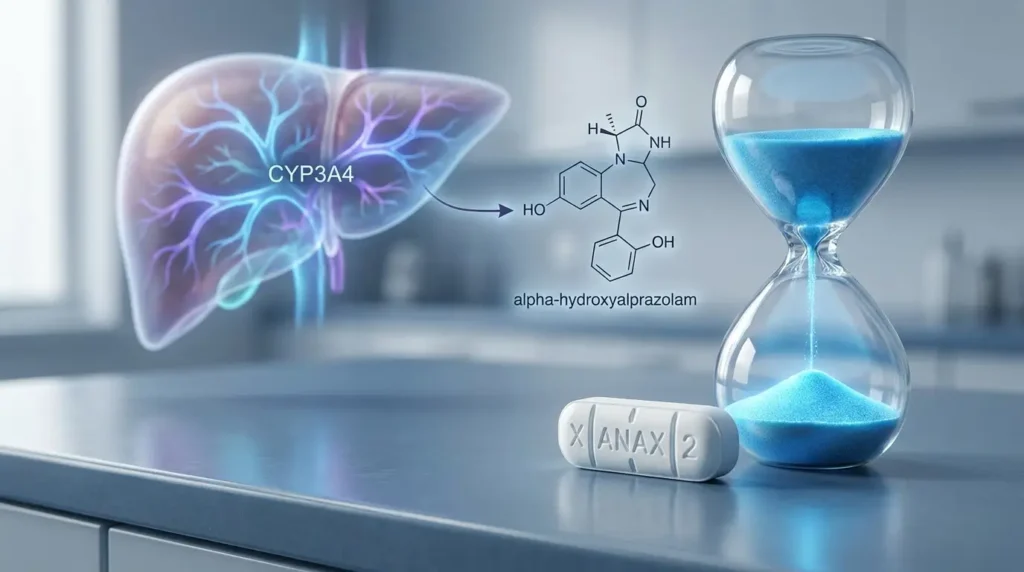
1. How Long Does Xanax Stay in Urine: Hepatic Metabolism & Clearance Kinetics
To understand why Xanax detection ranges anywhere from 48 hours to more than a week, we must follow an alprazolam molecule through absorption, liver transformation, and renal excretion:
                     Oral Alprazolam Ingestion
                                │
                                ▼
            Rapid Gastrointestinal Absorption (>88% Bioavailability)
                                │
                                ▼
                   Systemic Arterial Circulation
                 (Peak Tmax: 1.0 - 2.0 Hours post-dose)
                                │
                                ▼
               Hepatic Cytochrome P450 System (CYP3A4)
                                │
            ┌───────────────────┴───────────────────┐
            ▼                                       ▼
   Alpha-Hydroxyalprazolam                  4-Hydroxyalprazolam
   (Active primary metabolite;              (Minor secondary metabolite;
    retains ~66% potency)                    retains <20% potency)
            │                                       │
            └───────────────────┬───────────────────┘
                                │
                                ▼
               Phase II Hepatic Glucuronidation
             (Conjugated into water-soluble glucuronides)
                                │
                                ▼
                 Renal Glomerular Filtration
            (~80% excreted in urine; ~20% in feces)
The CYP3A4 Enzyme Engine
Following ingestion, alprazolam enters the liver, where it relies almost exclusively on the CYP3A4 enzyme for clearance.
CYP3A4 oxidizes parent alprazolam into two primary metabolites:
- $\alpha$-Hydroxyalprazolam ($\alpha\text{-OH}$): The major active intermediate, possessing approximately $66%$ of the biological activity of parent alprazolam. This metabolite serves as the primary diagnostic biomarker targeted by laboratory confirmatory assays.
- 4-Hydroxyalprazolam: A minor metabolite with low clinical potency.
After Phase I oxidation, both metabolites undergo Phase II hepatic glucuronidation—attaching a glucuronic acid molecule to become polar and water-soluble. The kidneys then filter these glucuronides into urine. Approximately $80%$ of an administered dose is eliminated renally, with less than $20%$ excreted as unchanged parent alprazolam.
2. The Alprazolam Half-Life: How Fast Does the Body Clear It?
In pharmacokinetics, the elimination half-life ($t_{1/2}$) is the time required for the body to metabolize and clear $50%$ of circulating drug concentration.
In healthy, non-smoking young adults, clinical pharmacology trials (Greenblatt et al., 1993; FDA Prescribing Guidelines) establish the mean elimination half-life of alprazolam at 11.2 hours (typical range: 6.3 to 16.0 hours).
The 5.5 Half-Life Clearance Rule
A drug is considered functionally eliminated from systemic blood circulation after 5 to 6 half-lives (clearing $>98%$ of the original molecules):
$$\text{Blood Clearance Time} = 5.5 \times 11.2\text{ hours} \approx 61.6\text{ hours} \approx \mathbf{2.5\text{ Days}}$$
Why Urine Detection Lasts Longer Than Blood
While active alprazolam drops below therapeutic levels in blood within 2.5 to 3 days, urinary detection extends significantly longer.
Your kidneys continuously filter, concentrate, and store glucuronide metabolites in the bladder. Even when plasma concentrations are minimal, urinary concentrations of conjugated $\alpha$-hydroxyalprazolam can remain well above laboratory immunoassay cutoff thresholds for days.
3. How Age, Weight, and Liver Health Drastically Alter Half-Life
The single most common reason people fail a drug test unexpectedly is that their personal elimination half-life is far longer than the “textbook” 11.2 hours.
Human clinical studies demonstrate that age, biological sex, weight, and liver function dramatically alter the clearance rate:
                   Alprazolam Elimination Half-Life by Population
   ┌───────────────────────────────────────────────────────────────┐
   │                                                               │
   │  Healthy Young Adults (Ages 18-40)   ───> 11.2 Hours          │
   │  Healthy Elderly Men (Ages 65+)      ───> 16.3 Hours (+45%)   │
   │  Alcoholic Liver Cirrhosis Patients ───> 19.7 Hours (+75%)   │
   │  Obese Individuals (BMI > 30)        ───> 21.8 Hours (+95%)   │
   │                                                               │
   └───────────────────────────────────────────────────────────────┘
| Demographic / Clinical Group | Mean Half-Life ($t_{1/2}$) | Full Elimination Window | Typical Urine Detection Window |
|---|---|---|---|
| Healthy Young Adults (18–40) | 11.2 Hours | 2.5 Days | 2 to 4 Days |
| Healthy Elderly Adults (65+) | 16.3 Hours (up to 26h) | 3.7 to 5.5 Days | 4 to 7 Days |
| Obese Individuals (BMI $> 30$) | 21.8 Hours (up to 40h) | 5.0 to 7.5 Days | 5 to 8 Days |
| Hepatic Cirrhosis / Liver Impairment | 19.7 Hours | 4.5 to 6.5 Days | 5 to 8+ Days |
| Asian Ethnicity | ~13.0 Hours (+15%) | 3.0 Days | 3 to 5 Days |
1. Age-Related Metabolic Decline (Elderly Populations)
In adults over age 65, hepatic blood flow decreases by up to $30%\text{–}40%$, and cellular synthesis of CYP3A4 enzymes declines. As a result, alprazolam clearance is delayed by nearly $50%$, causing the drug to accumulate and prolonging urinary detection by several days.
2. Adipose Tissue Sequestration (Obesity)
Alprazolam is a lipophilic (fat-soluble) compound with an average volume of distribution ($V_d$) of $0.8\text{ to }1.2\text{ L/kg}$. In individuals with elevated body fat, the drug distributes into peripheral adipose reserves, expanding the volume of distribution and nearly doubling the elimination half-life to 21.8 hours. (Compare this with cannabinoid fat storage in our THC Clearance Calculator).
3. Hepatic Impairment and Alcohol Synergy
Because the liver is the sole site of alprazolam oxidation, cirrhosis, chronic hepatitis, or alcoholic liver damage slows clearance to a crawl (half-life: 19.7 hours). Furthermore, co-ingesting alcohol competitively inhibits CYP enzymes while causing dangerous, life-threatening CNS depression. Model alcohol metabolism timelines with our EtG Pass/Fail Predictor.
4. How Long Does Xanax Stay in Urine: Dosage & Formulation Differences
How much you take—and which pharmaceutical formulation you ingest—fundamentally dictates your detection window:
                      XANAX IR (Immediate Release)
                      ┌────────────────────────────────┐
                      │  Rapid dissolution in stomach  │
                      │  Peak Concentration: 1-2 Hours │
                      │  Duration: 4 to 6 Hours        │
                      └────────────────────────────────┘

                      XANAX XR (Extended Release)
                      ┌────────────────────────────────┐
                      │  Hydrophilic matrix polymer    │
                      │  Peak Concentration: 9-11 Hours│
                      │  Duration: 12 to 24 Hours      │
                      └────────────────────────────────┘
Xanax IR vs. Xanax XR
- Immediate-Release (IR): The standard tablet dissolves instantly. Blood levels spike quickly and begin their exponential downward descent within 2 hours.
- Extended-Release (XR): Formulated with a hydrophilic polymer matrix that slowly releases alprazolam over 12 hours. Peak plasma concentration ($T_{\text{max}}$) is delayed to 9 to 11 hours post-dose. Because the elimination countdown starts 8 hours later in the day, Xanax XR extends urine detection by an additional 24 to 36 hours.
Detection Matrix by Dosing Pattern
| Usage Category | Typical Dosage | Estimated Urine Detection Window (200 ng/mL Cutoff) |
|---|---|---|
| Single Low Dose (One-Off) | 0.25 mg – 0.5 mg | 2 to 3 Days (36 to 72 Hours) |
| Single Moderate Dose | 1.0 mg – 2.0 mg | 3 to 4 Days (72 to 96 Hours) |
| Therapeutic Daily Regimen | 0.5 mg – 1.0 mg TID (1–3 mg/day) | 4 to 6 Days |
| Chronic High-Dose / Long-Term | 4.0 mg – 8.0+ mg daily | 6 to 8+ Days (Outliers: 10 Days) |
5. Drug Testing Cutoffs: 200 vs. 300 ng/mL & Confirmatory Testing
When an employer, medical facility, or court orders a standard 10-panel or 12-panel drug test, benzodiazepines are designated as BZO.
Testing facilities deploy a standard two-step screening protocol:
                    Step 1: Rapid Immunoassay Urine Screen
                           Cutoff: 200 or 300 ng/mL
                                      │
                 ┌────────────────────┴────────────────────┐
                 ▼                                         ▼
          BELOW 200 ng/mL                           ABOVE 200 ng/mL
          (NEGATIVE PASS)                       (Presumptive Positive)
                                                           │
                                                           ▼
                                         Step 2: Confirmatory GC-MS / LC-MS/MS
                                                    Cutoff: 100 ng/mL
                                                           │
                                      ┌────────────────────┴────────────────────┐
                                      ▼                                         ▼
                               BELOW 100 ng/mL                           ABOVE 100 ng/mL
                              (FALSE POSITIVE                           (CONFIRMED POSITIVE)
                                OVERTURNED)                                     │
                                                                                ▼
                                                                      MRO Verifies Prescription
The Immunoassay Cross-Reactivity Issue
Most standard rapid immunoassay test cups are calibrated against oxazepam or nordiazepam (the metabolites of traditional benzodiazepines like Valium).
Because alprazolam is a triazolobenzodiazepine (possessing an attached triazole ring), its cross-reactivity with older immunoassay antibodies is relatively low ($40%\text{–}70%$).
Consequently:
- An individual taking a small therapeutic dose ($0.25\text{ mg}$) may test negative on a standard $300\text{ ng/mL}$ rapid cup within 24 to 48 hours.
- However, if the sample is sent to a laboratory using modern multi-analyte LC-MS/MS confirmation, the cutoff drops to $100\text{ ng/mL}$ (or as low as $20\text{ ng/mL}$ in specialized pain clinics), easily identifying active $\alpha$-hydroxyalprazolam for 4 to 7 days.
Compare this clearance with another popular benzodiazepine in our Clonazepam (Klonopin) Clearance Calculator.
6. Multi-Matrix Detection Windows (Urine, Saliva, Blood, Hair)
Different biological testing media detect alprazolam across completely distinct analytical windows:
| Testing Modality | Standard Cutoff Level | Detection Window (Single Dose) | Detection Window (Chronic Daily) |
|---|---|---|---|
| Urine (Standard Screen) | $300\text{ ng/mL}$ | 2 to 3 Days | 4 to 6 Days |
| Urine (Sensitive Screen) | $200\text{ ng/mL}$ | 2 to 4 Days | 5 to 7 Days |
| Urine (LC-MS Confirmation) | $100\text{ ng/mL}$ | 3 to 5 Days | 6 to 8 Days (up to 10 days) |
| Oral Fluid / Saliva Swab | $5\text{ ng/mL}$ | 24 to 36 Hours | 48 to 60 Hours |
| Blood Plasma Screen | $10\text{ ng/mL}$ | 24 to 36 Hours | 48 to 72 Hours |
| Hair Follicle Drug Test | $100\text{ pg/mg}$ | Undetectable (Isolated use) | Up to 90 Days |
- Oral Fluid (Saliva): Captures recent parent alprazolam diffusing from blood into salivary glands. Model your oral swab timeline with our Saliva Drug Test Calculator.
- Hair Follicles: Alprazolam embeds permanently into growing keratin. While an isolated pill rarely incorporates above cutoffs, chronic use creates a verifiable historical record. Read our comprehensive guide: Hair Follicle Drug Test Detection Window: How the 90-Day Science Works.
7. Drug Interactions: What Traps Xanax in Your System?
Because alprazolam relies almost exclusively on the CYP3A4 hepatic pathway, co-administered medications and dietary compounds can either accelerate or drastically retard its elimination:
                            CYP3A4 Enzyme Modulators
                                       │
        ┌──────────────────────────────┴──────────────────────────────┐
        ▼                                                             ▼
  CYP3A4 INHIBITORS (EXTEND DETECTION)              CYP3A4 INDUCERS (SHORTEN DETECTION)
* Grapefruit & Grapefruit Juice (furanocoumarins)  • St. John's Wort
* Ketoconazole & Itraconazole (antifungals)        • Carbamazepine (Tegretol)
* Clarithromycin & Erythromycin (antibiotics)      • Rifampin (potent inducer)
* Cimetidine (Tagamet) & Fluvoxamine (Luvox)       • Phenytoin (Dilantin)
  Effect: Doubles half-life; traps drug in body     Effect: Accelerates clearance by 40-50%
The Grapefruit Warning: Grapefruit contains furanocoumarins, which irreversibly inhibit intestinal and hepatic CYP3A4 enzymes. Drinking a glass of grapefruit juice while taking Xanax can spike circulating alprazolam levels by $100%\text{–}150%$ and extend clearance by an extra 2 to 3 days.
8. Can You Flush Xanax Out Faster? What Works and What Fails
If you have a drug test approaching, you might be tempted to try internet “detox” hacks. Here is the forensic pharmacology truth:
What DOES NOT Work:
- Drinking Gallons of Water: Xanax is eliminated through hepatic enzymatic oxidation, not direct renal washing. Chugging excessive water will not make liver enzymes work faster. However, it will dilute your urinary creatinine below $20\text{ mg/dL}$, triggering a Negative-Dilute specimen rejection. In probation, parole, and DOT testing, dilute urine is treated as a failed drop or requires an immediate observed retest. Read our clinical guide on Urine Dilution & Creatinine and model your fluid limits with our Urine Dilution Calculator.
- Urinary Acidification (Vitamin C): While acidifying urine accelerates the excretion of weak bases like Adderall (as explained in our Adderall Urine Clearance Guide), alprazolam metabolites are neutral glucuronides that do not undergo pH-dependent ion trapping.
Evidence-Based Steps to Ensure Clean Testing:
- Discontinue Use Immediately: Elimination cannot outpace continuous intake.
- Avoid All CYP3A4 Inhibitors: Eliminate grapefruit, cimetidine, and interacting medications.
- Maintain Healthy, Paced Hydration: Drink 2 liters of water daily to maintain steady glomerular filtration.
- Discard the First Morning Void: Overnight urine contains concentrated cellular debris and accumulated metabolites. Provide your third or fourth urination of the day, using the midstream collection technique.
- Have Your Prescription Ready: If you have a valid, unexpired prescription for alprazolam from a licensed physician, you have complete legal protection. The Medical Review Officer (MRO) will contact you, verify the pharmacy records, and report your test result to your employer as a negative pass.
Frequently Asked Questions
Does Xanax show up on a standard 5-panel drug test?
No. Standard federal 5-panel drug tests (SAMHSA) only screen for THC, Cocaine, Opiates, Amphetamines, and PCP. Benzodiazepines like Xanax are only included on expanded 10-panel, 12-panel, or custom workplace screens under the “BZO” label.
How long does a single 0.5 mg Xanax tablet stay in urine?
In a healthy adult with normal liver and kidney function, a single $0.5\text{ mg}$ dose of Xanax drops below standard $300\text{ ng/mL}$ immunoassay cutoffs within 24 to 48 hours, and clears below sensitive $100\text{ ng/mL}$ confirmation thresholds within 2 to 3 days (48 to 72 hours).
Can Xanax be detected after 7 days?
Yes, but primarily in specific high-risk scenarios: chronic daily users taking high doses ($3\text{–}6+\text{ mg/day}$), elderly individuals with reduced CYP3A4 metabolism, patients with liver cirrhosis, or tests using ultra-sensitive laboratory confirmation thresholds ($20\text{–}50\text{ ng/mL}$). In healthy occasional users, detection beyond 5 days is rare.
Does drinking coffee or caffeine speed up Xanax elimination?
No. Caffeine is an adenosine antagonist and central nervous system stimulant that temporarily counteracts the sedative drowsiness of Xanax, but it does not speed up the hepatic breakdown or renal clearance of alprazolam molecules.
Scientific Studies & Clinical References
- Greenblatt, D. J., von Moltke, L. L., Harmatz, J. S., et al. (1993). Alprazolam pharmacokinetics in the elderly: relation to sex and body weight. Archives of General Psychiatry, 50(9), 715–722. PubMed PMID: 8348795.
- Fraser, A. D. (1998). Urinary screening for alprazolam and its major metabolites by immunoassay and GC-MS. Journal of Analytical Toxicology, 22(6), 481–485. PubMed PMID: 9855598.
- U.S. Food and Drug Administration (FDA). (2021). Xanax (Alprazolam Tablets) Prescribing Information and Clinical Pharmacology. FDA Reference Label.
- Schmith, V. D., Piraino, A. J., et al. (1991). Alprazolam metabolism in young and elderly men and women. Clinical Pharmacology & Therapeutics, 49(2), 173–180.
- Baselt, R. C. (2020). Disposition of Toxic Drugs and Chemicals in Man. 12th Edition. Biomedical Publications, Seal Beach, CA.
1 thought on “How Long Does Xanax Stay in Urine? Half-Life & Dose Guide”