
Does Kratom Show Up on a Drug Test? Mitragynine & 10-Panel Immunity
Quick Summary: If you are taking a standard pre-employment or workplace urine drug screen, the short answer is no: kratom does not show up on a standard 5-panel, 10-panel, or 12-panel drug test. Although kratom binds to opioid receptors to produce pain-relieving and calming effects, its primary alkaloids—mitragynine and 7-hydroxymitragynine—are structurally distinct indole alkaloids that do not cross-react with conventional opiate antibody strips. However, specialized 10-panel + Kratom panels and laboratory LC-MS/MS confirmation tests can detect it, with detection windows ranging from 2 to 4 days for single doses up to 6 to 9+ days in daily users.
Model Your Personalized Kratom Clearance Window
Kratom elimination is governed by a long terminal half-life (~29 hours) and high lipid solubility. Enter your dose, preparation form (raw powder vs. liquid extract), and frequency into our clinical pharmacokinetic calculator: Open Kratom Clearance Calculator →
If you use kratom (Mitragyna speciosa) for energy, mood enhancement, or chronic pain management, facing an unexpected drug test can cause intense panic.
You know kratom produces sensations similar to mild prescription opioids. You know standard drug tests check for opioids. And you probably wonder: Am I about to test positive and lose my job?
The internet is full of conflicting claims. Some forums insist kratom is completely invisible to all modern science, while others claim a single cup of kratom tea will trigger a multi-substance failure for morphine, methadone, and fentanyl.
The reality lies in basic molecular pharmacology. In this clinical guide, we explain how and when does kratom show up on a drug test, why it escapes standard 10-panel screens, when specialized testing is ordered, and how long its alkaloids take to leave your body.
1. Does Kratom Show Up on a Drug Test? The 5-Panel and 10-Panel Immunity
To understand why kratom does not trigger standard drug tests, you must understand how immunoassay screening cups function:
                      Standard 5-Panel / 10-Panel Urine Cup
                                       │
         ┌─────────────────────────────┼─────────────────────────────┐
         ▼                             ▼                             ▼
   OPIATE STRIP (OPI)         AMPHETAMINES / THC / COC         BENZOS / BARBS
 Targeted Antibodies:          Targeted Antibodies:          Targeted Antibodies:
 Morphine, Codeine, Heroin     Specific to each drug class    Specific to each drug class
         │                             │                             │
   Does NOT recognize            Does NOT recognize            Does NOT recognize
  Mitragynine Molecules         Mitragynine Molecules         Mitragynine Molecules
         │                             │                             │
         └─────────────────────────────┼─────────────────────────────┘
                                       │
                                       ▼
                         RESULT: 100% NEGATIVE PASS
                  (Kratom molecules slip by undetected)
Why Kratom Misses the “Opiate” Panel
Standard federal (SAMHSA) and commercial workplace drug tests screen for specific classes of compounds using antibody-antigen binding reactions:
- The standard “OPI” (Opiates) test strip is engineered with antibodies specifically calibrated to bind to the morphinan chemical skeleton—namely morphine, codeine, and 6-acetylmorphine (the primary heroin metabolite).
- Expanded panels add synthetic and semi-synthetic opioids like oxycodone (OXY), hydrocodone, buprenorphine (BUP), and methadone (MTD). Compare these panels in our Opioid Clearance Calculator.
Kratom is not an opiate. It is a botanical leaf belonging to the Rubiaceae (coffee) family. Its primary active alkaloid, mitragynine, is an indole alkaloid related structurally to yohimbine and ajmalicine.
Even though mitragynine acts as a partial agonist at the $\mu$-opioid receptor, its 3D molecular shape is totally foreign to the antibodies in an opiate test strip. The test strip antibodies simply do not bind to it.
Unless a test specifically incorporates a dedicated mitragynine test strip, kratom will not trigger a positive result on standard 5-panel, 10-panel, or 12-panel drug tests.
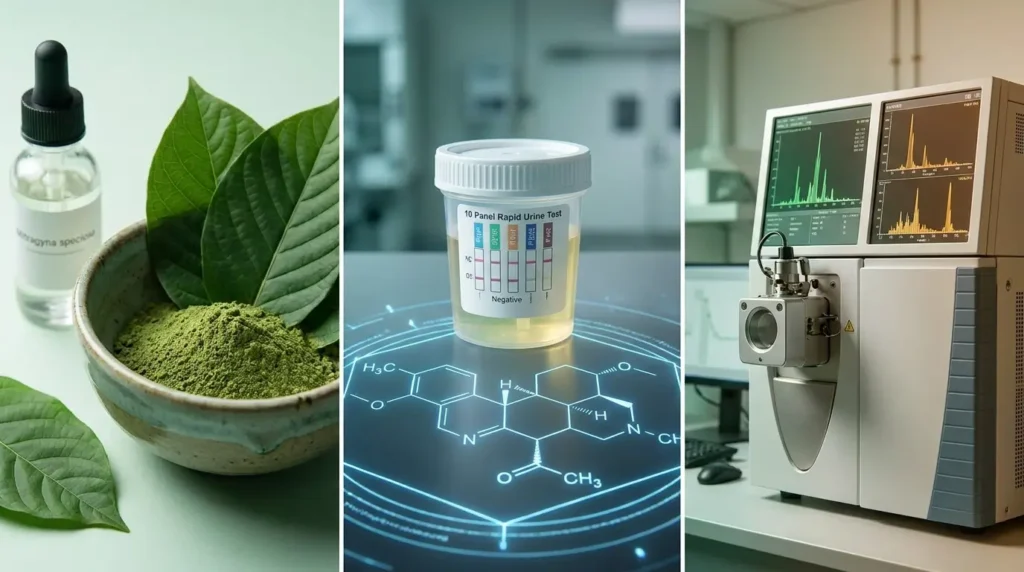
2. When DOES Kratom Show Up on a Drug Test?
While standard employers (retail, corporate office, manufacturing) almost never test for kratom, it is a dangerous mistake to assume you are always in the clear.
Kratom testing has expanded substantially across several specific industries and legal environments:
                             Kratom Testing Landscapes
                                         │
        ┌────────────────────────────────┴────────────────────────────────┐
        ▼                                                                 ▼
  STANDARD TESTING (SAFE)                                      SPECIALIZED TESTING (RISK)
* Pre-employment corporate jobs                               • Pain Management Clinics
* Department of Transportation (DOT)                          • Addiction Treatment & Rehab Centers
* Standard hospital employment                                • Zero-Tolerance Probation & Drug Court
* Sports athletic organizations (NCAA)                        • Military & Special Defense Roles
  Result: NO KRATOM TESTING                                     Result: DEDICATED MITRAGYNINE PANEL
1. Pain Management Clinics
Physicians prescribing Schedule II opioids (such as oxycodone or fentanyl) maintain strict compliance contracts. Many pain clinics now run comprehensive Liquid Chromatography-Tandem Mass Spectrometry (LC-MS/MS) panels that test for over 50 non-prescribed substances—including mitragynine. Testing positive for kratom can lead to immediate dismissal from the practice and revocation of opioid prescriptions.
2. Substance Abuse Treatment & Sober Living Facilities
Because individuals recovering from opioid use disorder frequently turn to kratom as a legal substitute, rehabilitation programs and halfway houses routinely use specialized 14-panel drug screens with Kratom (KRA) dip cards or lab-verified LC-MS/MS testing.
3. Probation, Parole, and Drug Court
In states or municipalities where kratom has been classified as a controlled substance (such as Alabama, Arkansas, Indiana, Rhode Island, Vermont, and Wisconsin) or in counties with strict “zero-tolerance for mind-altering substances” rules, probation officers order specialized kratom urine cups.
4. The United States Military
The Department of Defense (DoD) officially bans active-duty service members from consuming kratom under DoD Instruction 1010.04. While not part of the standard initial random urinalysis, specialized forensic testing is ordered if leadership suspects kratom use or finds botanical powders during barracks inspections.
3. The False-Positive Trap: Methadone and Fentanyl Cross-Reactivity
One of the most clinically documented phenomena in forensic toxicology is the kratom false positive.
Even though mitragynine is structurally distinct from classical opioids, several peer-reviewed clinical studies have reported that heavy kratom consumption can cause false-positive results for methadone on cheap, point-of-care immunoassay dip cards:
                  High-Dose Kratom Consumption
                               │
                               ▼
               Massive Urinary Metabolite Load
                 (Mitragynine-O-glucuronides)
                               │
                               ▼
             Point-of-Care Immunoassay Dip Card
                               │
                               ▼
            Weak Cross-Reactivity with MTD Antibodies
                               │
                               ▼
           PRESUMPTIVE FALSE-POSITIVE FOR METHADONE
                               │
             ┌─────────────────┴─────────────────┐
             ▼                                   ▼
      DONOR PANICS                      LAB RUNS CONFIRMATION
  (Falsely accused of                  (GC-MS or LC-MS/MS)
   illicit methadone use)                        │
                                                 ▼
                                        0.0 ng/mL Methadone
                                      (FALSE POSITIVE CLEARED)
The Mechanism of Immunoassay Interference
In a notable study published in the Journal of Analytical Toxicology by Smith et al., patients consuming high doses of kratom repeatedly triggered presumptive positives on rapid methadone (MTD) screening strips.
Cheap rapid cups use polyclonal antibodies that can occasionally bind to secondary kratom metabolites (such as 9-O-demethylmitragynine glucuronide) due to partial steric structural overlap. To learn more about how methadone and its primary metabolite EDDP clear, explore our Methadone & EDDP Clearance Calculator.
What to Do If You Trigger a False Positive
If you take a rapid drug screen and the cup flags positive for methadone, fentanyl, or general opioids:
- Remain calm and do not admit to taking opioids.
- Demand immediate laboratory confirmation: Insist that the split specimen be sent to a certified reference laboratory (Quest, LabCorp) for GC-MS or LC-MS/MS confirmatory analysis.
- The laboratory confirmation will vindicate you: Confirmatory mass spectrometers do not use antibodies. They separate molecules by molecular weight and mass-to-charge ratio. The lab will confirm zero methadone or synthetic opioids, overturning the false positive completely.
4. Mitragynine Pharmacokinetics: Why Detection Lasts Longer Than Expected
When a specialized kratom test is ordered, how long does the alkaloid actually linger?
Many users mistakenly assume that because kratom is an herbal tea or powder, it leaves the body within 24 to 48 hours. Human clinical pharmacokinetic trials reveal that mitragynine has an unexpectedly long clearance timeline.
                   Oral Ingestion of Kratom Powder
                                  │
                                  ▼
                     Rapid Gastrointestinal Uptake
                     (Peak Plasma Tmax: ~1.5 hours)
                                  │
                                  ▼
                Extremely High Volume of Distribution
                     (Vd ≈ 38 Liters per Kilogram)
                                  │
               ┌──────────────────┴──────────────────┐
               ▼                                     ▼
     Initial Alpha Phase                   Terminal Beta Phase
     (Rapid tissue distribution)           (Slow release from adipose & organs)
     t1/2: ~3.0 - 5.0 hours               t1/2: ~24.0 - 38.3 HOURS (Mean: ~29h)
The Landmark Trakulsrichai Clinical Study
In a rigorous pharmacokinetic trial published by Trakulsrichai et al. (2015), researchers administered controlled doses of kratom tea to chronic, daily human consumers and mapped their blood and urine excretion:
- Biphasic Elimination: Mitragynine clears through a two-phase elimination curve. While blood concentrations drop quickly during the first few hours as the drug leaves circulation (alpha distribution phase), the terminal elimination half-life ($\beta$-phase) averaged 23.8 to 38.3 hours (mean: ~29 hours).
- Enormous Volume of Distribution ($V_d$): Mitragynine exhibits a massive volume of distribution of approximately $38\text{ L/kg}$. This means the molecule is highly lipophilic (fat-soluble). It penetrates deeply into bodily tissues, organs, and fat cells, much like THC (see our THC Clearance Calculator).
- Slow Tissue Trickle: Once inside fat and organ reserves, mitragynine slowly leaches back into the bloodstream over days, providing a continuous supply of parent drug and metabolites to the kidneys.
The 5.5 Half-Life Clearance Rule
Because it takes roughly 5.5 half-lives to eliminate $98%$ of any substance from the human body:
$$\text{Total Clearance Time} = 5.5 \times 29\text{ hours} \approx 160\text{ hours} \approx \mathbf{6.6\text{ Days}}$$
This explains why chronic, daily kratom consumers can continue to test positive on specialized tests for up to a week or more after their last dose.
5. Detection Windows by Testing Modality & Frequency
When a specialized assay is deployed, detection times depend heavily on whether you are a first-time consumer or a daily user:
| Testing Modality | Standard Laboratory Cutoff | Detection Window (Single Dose: 2–4g) | Detection Window (Daily User: 10–20g/day) |
|---|---|---|---|
| Specialized Urine LC-MS/MS | $1.0\text{ ng/mL}$ | 3 to 5 Days | 6 to 9 Days (up to 12 days) |
| Point-of-Care Kratom Dip Cup | $100\text{ to }200\text{ ng/mL}$ | 1 to 2 Days | 4 to 6 Days |
| Blood Plasma Screen | $2.0\text{ ng/mL}$ | 24 to 48 Hours | 3 to 5 Days |
| Oral Fluid / Saliva Swab | $1.0\text{ ng/mL}$ | 24 to 36 Hours | 48 to 72 Hours |
| Hair Follicle Drug Test | $50\text{ pg/mg}$ | Undetectable (Rare) | Up to 90 Days |
| Standard 5/10-Panel Workplace | N/A | UNDETECTED (0 Days) | UNDETECTED (0 Days) |
For hair follicle testing mechanics—including why single or occasional use rarely incorporates into keratin while chronic use creates a permanent 90-day record—read our comprehensive guide: Hair Follicle Drug Test Detection Window: How the 90-Day Science Works.
6. How the Liver Processes Kratom: CYP Enzymes & Metabolites
Mitragynine undergoes extensive Phase I and Phase II hepatic biotransformation before excretion:
                                  Mitragynine
                                       │
                      Hepatic Cytochrome P450 Enzymes
                         (CYP3A4, CYP2D6, CYP2C9)
                                       │
         ┌─────────────────────────────┼─────────────────────────────┐
         ▼                             ▼                             ▼
  7-OH-Mitragynine             9-O-Demethylmitragynine        16-Carboxymitragynine
(Active minor alkaloid;        (Primary inactive             (Major polar metabolite
 potent mu-opioid agonist)       urinary metabolite)           excreted in urine)
         │                             │                             │
         └─────────────────────────────┼─────────────────────────────┘
                                       │
                                       ▼
                       Phase II Hepatic Glucuronidation
                                       │
                                       ▼
                      Renal Filtration & Urine Excretion
The Role of CYP3A4 and 7-Hydroxymitragynine
Research by Kamble et al. (2019) demonstrated that CYP3A4 is the primary enzyme responsible for converting mitragynine into 7-hydroxymitragynine (7-OH).
While 7-OH is roughly 5 to 10 times more potent than mitragynine at the $\mu$-opioid receptor, it is present in raw leaf at negligible concentrations ($<0.05%$). The vast majority of 7-OH in your body is generated in vivo by your liver.
Metabolic Auto-Inhibition in Heavy Users
Clinical studies demonstrate that mitragynine is not just a substrate for liver enzymes—it is also a potent inhibitor of CYP2D6 and CYP3A4.
When taken chronically in high doses, kratom partially suppresses its own metabolic breakdown pathway. This metabolic “traffic jam” further slows liver clearance, extending the elimination half-life and keeping metabolites detectable in urine for several additional days.
7. How to Clear Kratom Faster: What Works and What Fails
If you know you have an upcoming specialized test for kratom, here is the scientific reality of speeding up clearance:
What DOES NOT Work:
- Flushing with Gallons of Water: Drinking massive amounts of water the morning of your test does not remove mitragynine from your fat tissue or liver. It merely thins your urine, creating a high risk of a negative-dilute specimen. As explained in our Urine Dilution & Creatinine Guide, dilute urine is treated with high suspicion or counted as a failed drop in probation and rehab programs. Calculate your hydration limits with our Urine Dilution Calculator.
- Vinegar or Cranberry “Detoxes”: While altering urine pH affects weak base excretion like Adderall (as shown in our Adderall Urine Clearance Guide), mitragynine undergoes complex hepatic glucuronidation, making urinary acidification far less effective.
Evidence-Based Protocol to Accelerate Elimination:
- Absolute Cessation: Glucuronidation and lipid clearing cannot begin until the daily influx of alkaloids ceases completely.
- Moderate Cardiovascular Exercise (Early Phase Only): Because mitragynine is lipophilic ($V_d \approx 38\text{ L/kg}$), burning fat through light cardio 4 to 6 days before testing accelerates the mobilization of stored alkaloids. Stop all workouts 48 hours before testing to prevent a last-minute spike in urinary metabolites.
- Paced Hydration: Drink 2 to 2.5 liters of water daily to maintain an optimal glomerular filtration rate without dropping creatinine below $20\text{ mg/dL}$.
- Discard Early Morning Voids: Never submit your first morning urination. Always submit the third or fourth void of the day, using the midstream collection technique.
Frequently Asked Questions
Can kratom show up on a 5-panel drug test?
No. Standard 5-panel tests only screen for THC, Cocaine, Opiates, Amphetamines, and PCP. Kratom does not cross-react with any of these panels and will not show up.
Does kratom show up as an opiate?
No. Classical opiate panels detect morphinan alkaloids derived from the opium poppy (morphine, codeine, heroin). Mitragynine is an indole alkaloid with an entirely different chemical structure, so it does not trigger a true positive on opiate test strips.
How long does a single dose of kratom stay in your system?
For a first-time or occasional user taking a moderate dose (2 to 4 grams of dried leaf powder), mitragynine levels in blood drop below therapeutic limits within 24 hours, and urinary concentrations clear below specialized laboratory cutoffs within 2 to 4 days.
Can kratom be detected in saliva tests?
Yes, but only if a specialized oral fluid test calibrated for mitragynine is used. Saliva tests capture recent parent drug exposure, with a detection window of approximately 24 to 36 hours for single use and up to 72 hours for chronic daily consumers.
Scientific Studies & Clinical References
- Trakulsrichai, S., Sathirakul, K., Auparakkitanon, S., et al. (2015). Pharmacokinetics of mitragynine in man. Drug Design, Development and Therapy, 9, 2421–2429. PubMed PMID: 25931440.
- Kamble, S. H., Sharma, A., King, T. I., et al. (2019). Metabolite profiling and identification of enzymes responsible for the metabolism of mitragynine, the major alkaloid of Mitragyna speciosa (kratom). Xenobiotica, 49(11), 1279–1288. PubMed PMID: 30528439.
- Smith, K. E., Rogers, J. M., et al. (2020). Assessing cross-reactivity of kratom alkaloids with commercial immunoassay screening tests. Journal of Analytical Toxicology, 44(8), 812–818. PubMed PMID: 32410888.
- Veltri, C., & Grundmann, O. (2019). Current perspectives on the pharmacology and toxicology of kratom (Mitragyna speciosa). Psychopharmacology, 236(2), 853–867. PubMed PMID: 30030588.
- Kruegel, A. C., & Grundmann, O. (2018). The medicinal chemistry and neuropharmacology of kratom: A focus on mitragynine and 7-hydroxymitragynine. Neuropharmacology, 134(Pt A), 108–120. PubMed PMID: 28830758.