
Steroid Detection Times Urine: Long Ester Clearance, WADA & Testing Science
Quick Summary: Unlike recreational substances that clear your body in days, anabolic-androgenic steroids (AAS) possess some of the most prolonged detection windows in forensic toxicology. When analyzing steroid detection times urine profiles, clearance depends almost entirely on esterification chemistry and metabolite longevity. While oral steroids like Anavar clear within 3 to 4 weeks, medium injectables like Testosterone Enanthate linger for 3 months, and long-chain decanoate esters like Nandrolone (Deca-Durabolin) produce detectable urinary metabolites for 12 to 18 months.
Model Your Exact Anabolic Steroid Clearance Timeline
Clearance times vary dramatically based on ester chain length, oral vs. injectable administration, single vs. cycle dosing, and WADA IRMS carbon isotope testing. Enter your specific compounds into our clinical pharmacokinetic calculator: Open Steroid Detection Time Calculator →
If you are an athlete subject to competitive anti-doping testing, a tactical professional undergoing law enforcement pre-employment screening, or a patient navigating hormone replacement therapy (TRT), understanding steroid detection times urine testing protocols is critical.
The gym rumor mill is filled with dangerous myths: “Testosterone clears in 2 weeks,” “Oral steroids are out of your urine in 48 hours,” or “Drinking cranberry juice cleanses steroid metabolites.”
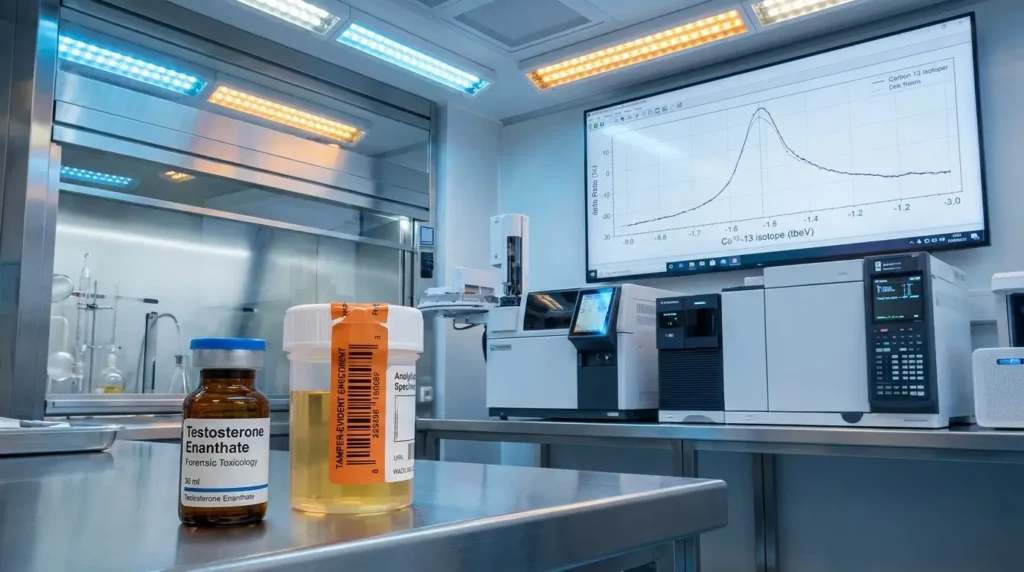
In modern anti-doping science, these myths lead directly to career-ending multi-year suspensions. Over the past decade, anti-doping laboratories accredited by the World Anti-Doping Agency (WADA) have revolutionized forensic detection. Utilizing high-resolution liquid chromatography-tandem mass spectrometry (LC-MS/MS) and Carbon Isotope Ratio (CIR) analysis, labs can now detect long-term steroid metabolites at sub-nanogram (picogram) concentrations months after your last dose.
This comprehensive guide breaks down the organic chemistry behind ester kinetics, why oral steroids leave chemical fingerprints for weeks, how WADA separates synthetic testosterone from natural hormones, and what the real-world urinary detection windows look like across all major performance-enhancing compounds.
1. Steroid Detection Times Urine: The Chemistry of Esters & Depot Release
To understand why some steroids clear in days while others linger for over a year, you must understand esterification:
                  Deep Intramuscular Steroid Injection
                                    │
                                    ▼
                Intramuscular Oil Depot Formation (Glute / Quad)
               (Hydrophobic Steroid-Ester Dissolved in Carrier Oil)
                                    │
                 ┌──────────────────┴──────────────────┐
                 ▼                                     ▼
        SHORT-CHAIN ESTER                     LONG-CHAIN ESTER
     (Propionate / Acetate)                (Decanoate / Undecanoate)
     Small carbon chain (C2 - C3)          Long carbon chain (C10 - C11)
     Less lipophilic                       Extremely lipophilic
                 │                                     │
                 ▼                                     ▼
     Rapid Partition into Blood            Extremely Slow Diffusion from Oil
     Enzymatic Cleavage: ~1 - 2 Days       Enzymatic Cleavage: Weeks / Months
                 │                                     │
                 ▼                                     ▼
     RAPID URINE CLEARANCE                 PROLONGED URINE CLEARANCE
     Detection: 2 to 3 Weeks               Detection: 12 to 18 Months
The Biology of the Intramuscular Depot
Pure, unesterified testosterone (base) is rapidly metabolized and excreted by the liver within hours. To make testosterone therapeutically viable, pharmaceutical chemists attach a carboxylic acid ester chain to the 17-beta hydroxyl position of the steroid molecule.
When an oil-based steroid is injected deep into skeletal muscle tissue (gluteus, vastus lateralis, or deltoid):
- The oil forms a hydrophobic repository depot inside the muscle fibers.
- The steroid molecules are chemically partitioned between the carrier oil (such as cottonseed, grapeseed, or sesame oil) and interstitial extracellular fluid.
- The longer the ester’s carbon chain, the more lipophilic (fat-soluble) the molecule is, and the more stubbornly it stays dissolved inside the oil droplet.
- As individual molecules slowly diffuse out of the oil into surrounding capillaries, circulating blood enzymes called esterases cleave the ester bond, liberating the free, active parent hormone into systemic circulation.
Carbon Chain Length vs. Clearance Timeline
The length of the ester chain directly determines the drug’s biological half-life and urinary detection footprint:
| Ester Type | Chemical Formula | Carbon Chain Length | Effective Half-Life ($t_{1/2}$) | Approximate Urine Detection Window |
|---|---|---|---|---|
| Acetate | $-\text{O-CO-CH}_3$ | 2 Carbons | 1 to 2 Days | 4 to 5 Months (Trenbolone) |
| Propionate | $-\text{O-CO-CH}_2\text{-CH}_3$ | 3 Carbons | 2 to 3 Days | 2 to 3 Weeks |
| Phenylpropionate | $-\text{O-CO-(CH}_2)_2\text{-C}_6\text{H}_5$ | 9 Carbons (aromatic) | 4 to 5 Days | 4 to 5 Months |
| Enanthate | $-\text{O-CO-(CH}_2)_5\text{-CH}_3$ | 7 Carbons | 4.5 to 5 Days | 3 Months |
| Cypionate | $-\text{O-CO-(CH}_2)_2\text{-C}_5\text{H}_9$ | 8 Carbons (cyclopentyl) | 8 Days | 3 to 4 Months |
| Decanoate | $-\text{O-CO-(CH}_2)_8\text{-CH}_3$ | 10 Carbons | 15 Days | 12 to 18 Months (Nandrolone) |
| Undecanoate | $-\text{O-CO-(CH}_2)_9\text{-CH}_3$ | 11 Carbons | 21 to 34 Days | 6 to 8+ Months |
2. The Nandrolone (Deca-Durabolin) Anomaly: Why It Lingers for 18 Months
Among all performance-enhancing drugs, Nandrolone Decanoate (Deca-Durabolin) holds the undisputed crown for the longest urinary detection window in sports anti-doping history.
Athletes who administered a standard Deca cycle have tested positive up to 18 months (1.5 years) after their final injection:
                  Nandrolone Decanoate Administration
                                   │
                                   ▼
             Slow Dissolution from Deep Muscle Depot (15-Day t1/2)
                                   │
                                   ▼
                   Systemic Hepatic Biotransformation
            (5alpha-Reductase & 3alpha-Hydroxysteroid Dehydrogenase)
                                   │
                                   ▼
            19-Norandrosterone (19-NA) Glucuronide Formation
                                   │
                                   ▼
             Massive Lipid Storage & Enterohepatic Recirculation
                                   │
                                   ▼
           Sustained Urinary Excretion Above WADA 2.0 ng/mL Cutoff
                     (Persists for 12 to 18 Months)
The Mechanism of 19-Norandrosterone (19-NA) Persistence
Nandrolone’s extreme persistence stems from a combination of three physiological factors:
- The 10-Carbon Decanoate Carrier: The long aliphatic carbon chain creates an extraordinarily sticky, hydrophobic oil reservoir that leaks micro-doses into systemic blood for months.
- Lipophilic Adipose Storage: Nandrolone and its metabolites distribute heavily into peripheral body fat reserves, slowly trickling back into venous circulation during natural daily lipolysis. (Compare this with cannabis lipid storage in our THC Clearance Calculator).
- The WADA 2.0 ng/mL Threshold: WADA establishes a strict $2.0\text{ ng/mL}$ Decision Limit for the urinary metabolite 19-norandrosterone (19-NA). Because modern mass spectrometers can detect 19-NA at fractions of a picogram, trace urinary shedding remains above the $2.0\text{ ng/mL}$ cutoff for up to 500+ days in heavy or chronic consumers.
3. Oral Steroids: 17-Alpha-Alkylated Clearance & Long-Term Metabolites
Oral anabolic steroids—such as Dianabol (methandrostenolone), Winstrol (stanozolol), and Anavar (oxandrolone)—undergo completely different clearance kinetics than injectables.
                   Oral Steroid Ingestion (e.g., Winstrol)
                                     │
                                     ▼
             17-Alpha-Alkylation (C-17aa) Protects Molecule
                  (Survives Hepatic First-Pass Clearance)
                                     │
                                     ▼
                Short Biological Half-Life (~9 to 10 Hours)
                                     │
                 ┌───────────────────┴───────────────────┐
                 ▼                                       ▼
        PARENT DRUG CLEARED                     LONG-TERM METABOLITES
     (Gone from blood in 2-3 days)           (3'-Hydroxystanozolol Glucuronides)
                                                         │
                                                         ▼
                                            High-Resolution LC-MS/MS
                                            Targets Stable Glucuronides
                                                         │
                                                         ▼
                                            DETECTABLE FOR 2 TO 3 MONTHS
The C-17aa Modification
Naturally occurring steroid hormones cannot be swallowed because the liver’s Phase I enzymes rapidly degrade them before reaching systemic circulation (first-pass hepatic clearance).
To make oral steroids bioavailable, chemists add a methyl or ethyl group at the 17-alpha carbon position (C-17aa). This chemical shield prevents the liver from breaking down the hormone, allowing it to enter the bloodstream intact—though it imposes substantial metabolic strain and hepatotoxicity.
The Modern Long-Term Metabolite Revolution
In the 1990s and early 2000s, oral steroids were considered “short-window” compounds that cleared urine within 1 to 2 weeks because laboratories only tested for the parent compound.
That dynamic was shattered by forensic anti-doping researchers:
- Oral Turinabol (Dehydrochloromethyltestosterone): In 2012, anti-doping scientist Dr. Grigory Rodchenkov and colleagues discovered long-term metabolites (designated M3 and M4) with a modified 17-hydroxymethyl structure that persist in urine for over 6 months—leading to dozens of retroactive Olympic medal revocations.
- Winstrol (Stanozolol): Modern high-resolution mass spectrometers target 3′-hydroxystanozolol glucuronide, extending stanozolol detection from 10 days to 2 to 3 months.
- Anavar (Oxandrolone): Excreted largely unchanged in urine, with detection windows extending to 3 to 4 weeks.
4. How WADA Tests for Steroids: The Science of IRMS & The Biological Passport
Standard workplace drug tests cannot detect synthetic testosterone because testosterone is an endogenous hormone that your body produces naturally.
To overcome this, the World Anti-Doping Agency (WADA) employs two revolutionary analytical testing frameworks:
                            WADA Anti-Doping Framework
                                         │
        ┌────────────────────────────────┴────────────────────────────────┐
        ▼                                                                 ▼
  ATHLETE BIOLOGICAL PASSPORT (ABP)                         CARBON ISOTOPE RATIO (GC-C-IRMS)
  Longitudinal Steroidal Module                             Carbon-13 / Carbon-12 Ratio Analysis
  Monitors: T/E Ratio (Cutoff: 4:1)                         Differentiates Soy/Yam Sterols from
  Androsterone, Etiocholanolone, Diols                      Endogenous Human Steroidogenesis
1. The Testosterone/Epitestosterone (T/E) Ratio
Naturally, human beings produce testosterone and its inactive epimer, epitestosterone, in roughly a 1:1 ratio.
When an athlete injects exogenous testosterone:
- Circulating testosterone levels skyrocket.
- Epitestosterone production remains unchanged or drops due to negative pituitary feedback.
- The T/E ratio surges.
WADA sets a strict 4:1 T/E ratio threshold (formerly 6:1). If an athlete’s urine sample exceeds 4:1, the sample is automatically flagged for confirmatory isotopic analysis.
2. Gas Chromatography-Combustion-Isotope Ratio Mass Spectrometry (GC-C-IRMS)
What if an athlete micro-doses testosterone or co-administers epitestosterone to keep their T/E ratio under 4:1?
WADA deploys GC-C-IRMS—the ultimate forensic lie detector:
- Carbon in nature exists as two stable isotopes: Carbon-12 ($^{12}\text{C}$) and Carbon-13 ($^{13}\text{C}$).
- Pharmaceutical testosterone is synthetically derived from plant sterols (specifically stigmasterol and sitosterol from soy and Mexican yams). These plants utilize a specific photosynthetic pathway ($C_3$ photosynthetic cycle) that results in a measurably lower percentage of Carbon-13.
- Endogenous human testosterone synthesized from dietary cholesterol exhibits a distinct, naturally richer $\delta^{13}\text{C}$ isotopic signature.
- An IRMS instrument burns steroid metabolites into carbon dioxide gas ($CO_2$) and measures the exact $^{13}\text{C}/^{12}\text{C}$ ratio down to sub-parts-per-thousand ($\text{per mil, } \permil$).
If the isotopic ratio of urinary testosterone deviates from internal reference steroid standards (such as pregnanediol), an anti-doping rule violation is confirmed regardless of how normal the athlete’s T/E ratio appears.
5. Master Detection Matrix: Clearance Windows Across All PED Classes
The following matrix compiles published detection timelines based on WADA Technical Documents, clinical pharmacokinetic literature, and specialized high-resolution LC-MS/MS testing:
| Compound | Common Brand / Name | Administration Route | Effective Half-Life | Urine Detection Window | Hair Test Window |
|---|---|---|---|---|---|
| Testosterone Suspension | Base (No ester) | Aqueous Injection | ~2 to 4 Hours | 24 to 48 Hours (IRMS: 1-2 wks) | Up to 90 Days |
| Testosterone Propionate | Test Prop | Short Injectable | 2 to 3 Days | 2 to 3 Weeks (IRMS: 4-6 wks) | Up to 90 Days |
| Testosterone Enanthate | Test E | Medium Injectable | 4.5 to 5 Days | 3 Months (IRMS: 3+ Months) | Up to 90 Days |
| Testosterone Cypionate | Test Cyp | Medium Injectable | 8 Days | 3 to 4 Months (IRMS: 4+ Mos) | Up to 90 Days |
| Nandrolone Decanoate | Deca-Durabolin | Long Injectable | 15 Days | 12 to 18 Months | Up to 90 Days |
| Nandrolone Phenylpropionate | NPP | Fast Injectable | 4.5 Days | 4 to 5 Months | Up to 90 Days |
| Trenbolone Acetate | Tren Ace | Short Injectable | 1 to 2 Days | 4 to 5 Months | Up to 90 Days |
| Trenbolone Enanthate | Tren E | Medium Injectable | 7 to 8 Days | 5 to 6 Months | Up to 90 Days |
| Boldenone Undecylenate | Equipoise (EQ) | Long Injectable | 14 Days | 4 to 6 Months | Up to 90 Days |
| Stanozolol (Winstrol) | Winny | Oral (C-17aa) | 9 Hours | 2 to 3 Months (Glucuronides) | Up to 90 Days |
| Oxandrolone (Anavar) | Var | Oral (C-17aa) | 9 to 10 Hours | 3 to 4 Weeks | Up to 90 Days |
| Methandrostenolone | Dianabol (Dbol) | Oral (C-17aa) | 4 to 6 Hours | 5 to 6 Weeks | Up to 90 Days |
| Oral Turinabol | T-bol | Oral (C-17aa) | 16 Hours | 6 to 8 Months (M4 Metabolite) | Up to 90 Days |
| Ostarine (MK-2866) | SARM | Oral Liquid/Capsule | 24 Hours | 2 to 3 Weeks | Up to 90 Days |
| RAD-140 (Testolone) | SARM | Oral Liquid/Capsule | 60 Hours | 3 to 4 Weeks | Up to 90 Days |
| LGD-4033 (Ligandrol) | SARM | Oral Liquid/Capsule | 30 Hours | 3 to 4 Weeks | Up to 90 Days |
| Human Growth Hormone (HGH) | Somatropin | SubQ Injection | ~20 to 30 Min | NOT DETECTABLE IN URINE | N/A (Blood: 24h) |
For hair testing timelines across all substance classes, explore our comprehensive forensic analysis: Hair Follicle Drug Test Detection Window: How the 90-Day Science Works.
6. Do Anabolic Steroids Show on Standard Workplace Drug Tests?
The single most common anxiety among fitness enthusiasts and workers prescribed TRT is: “Will my gear show up on my new job’s drug test?”
The unequivocal answer is NO.
Standard pre-employment, corporate, and Department of Transportation (DOT) drug screenings use SAMHSA-5 or expanded 10-panel / 12-panel immunoassay cups. These panels exclusively test for recreational substances of abuse:
- Marijuana (THC-COOH)
- Cocaine (Benzoylecgonine)
- Amphetamines / Methamphetamine (see our Adderall Urine Clearance Guide)
- Opiates (Morphine, Codeine, Heroin)
- Phencyclidine (PCP)
- Benzodiazepines (see our Xanax Urine Clearance Guide)
- Barbiturates, Methadone, and Oxycodone
Why Employers Skip Steroid Testing
- Immense Cost: A standard 5-panel immunoassay cup costs an employer $15 to $30. An accredited anabolic steroid GC-MS/LC-MS/MS panel costs $150 to $350 per specimen.
- Technical Complexity: Steroid panels require multi-step solid-phase extraction, enzymatic hydrolysis of glucuronide conjugates, chemical derivatization, and high-resolution mass spectrometry.
- Legal Scope: Corporate drug-free workplace policies are designed to detect acute workplace impairment and safety risks, not athletic performance enhancement.
Unless you are competing in a sanctioned athletic federation (NCAA, USAPL, IFBB, Olympics), joining a tactical law enforcement / swat unit, or assigned to specialized military operations, standard workplace urine tests do not screen for anabolic steroids.
7. Can You “Flush” Steroids Out of Urine? Myth vs. Clinical Reality
Because steroid metabolites are excreted through renal filtration, many individuals attempt extreme water loading or commercial detoxes to pass tests.
                              Steroid Detox Tactics
                                        │
        ┌───────────────────────────────┴───────────────────────────────┐
        ▼                                                               ▼
  DILUTION & WATER CHUGGING                                    HIGH-DOSE DIURETICS
* Thins urine momentarily                                      • Banned by WADA as S5 Masking Agents
* Drops Creatinine below 20 mg/dL                              • Automatically flagged on screens
* Triggers "Negative-Dilute" Rejection                         • Causes severe hypokalemia & cardiac risks
1. Water Loading & Negative-Dilute Rejections
Guzzling gallons of water does not liberate hydrophobic steroid molecules from oil depots or fat tissue. While it may temporarily reduce the metabolite concentration per milliliter, it triggers a catastrophic laboratory red flag: specimen dilution.
Testing facilities routinely check urinary creatinine (must be $\ge 20\text{ mg/dL}$) and specific gravity (must be $\ge 1.003$). If your sample is dilute, it is officially classified as a Negative-Dilute—which sports federations and law enforcement agencies treat as a presumptive positive or an intentional test evasion attempt. Read our full clinical analysis in the Urine Dilution & Creatinine Guide and model your hydration safety margins with our Urine Dilution Calculator.
2. The Diuretic Trap (WADA Prohibited Class S5)
Athletes historically used pharmaceutical loop diuretics (furosemide, hydrochlorothiazide) to flood the bladder with water and mask steroid concentrations. Today, anti-doping laboratories screen for all known diuretics with extreme analytical sensitivity. Testing positive for a diuretic constitutes an automatic anti-doping violation (masking agent charge), carrying the exact same 2-to-4-year suspension as testing positive for an anabolic steroid itself.
Frequently Asked Questions
What happens if an athlete is prescribed Testosterone Replacement Therapy (TRT)?
In competitive sports governed by WADA or USADA, athletes cannot simply present a physician’s prescription for testosterone. To compete while on TRT, the athlete must apply for and receive a Therapeutic Use Exemption (TUE). TUE guidelines for testosterone are exceptionally stringent and are virtually never granted to male athletes with secondary or age-related hypogonadism; they are reserved almost exclusively for verified organic endocrine pathologies (such as testicular cancer or pituitary failure).
Can SARMs (like Ostarine or RAD-140) be detected on standard drug tests?
SARMs do not appear on standard 5-panel or 10-panel workplace drug tests. However, in sports anti-doping, SARMs are classified as non-threshold substances under WADA Prohibited List Category S1.2. WADA-accredited laboratories utilize targeted LC-MS/MS assays capable of identifying SARMs and their secondary glucuronide metabolites at picogram levels for 2 to 4 weeks post-ingestion.
Does Human Growth Hormone (HGH) show up on a urine steroid test?
No. Human Growth Hormone (somatropin) is a large 191-amino-acid peptide hormone that is rapidly metabolized by the kidneys and is not detectable in urine. WADA detects exogenous HGH exclusively through blood plasma testing, utilizing two distinct methods: the HGH Isoform Differential Immunoassay (detecting the abnormal ratio of 22-kDa synthetic somatropin to natural pituitary isoforms within 24 to 36 hours of use) and the Biomarkers Test (measuring secondary surges in IGF-1 and P-III-NP for up to 5 to 7 days).
Scientific Studies & Clinical References
- Thevis, M., & Schänzer, W. (2010). Mass spectrometric identification and characterization of designer steroids in doping control analysis. Journal of Mass Spectrometry, 45(8), 899–908. PubMed PMID: 20824664.
- Ayotte, C. (2006). Significance of 19-norandrosterone in athletes’ urine samples. British Journal of Sports Medicine, 40(Suppl 1), i25–i29. PubMed PMID: 16799100.
- Sobolevsky, T., & Rodchenkov, G. (2012). Detection and mass spectrometric characterization of novel long-term dehydrochloromethyltestosterone metabolites in human urine. The Journal of Steroid Biochemistry and Molecular Biology, 128(3–5), 121–127. PubMed PMID: 22142756.
- World Anti-Doping Agency (WADA). (2024). Technical Document TD2024DL: Decision Limits for the Confirmatory Identification of Contaminants and Prohibited Substances. WADA-AMA.org.
- Cawley, A. T., & Flenker, U. (2008). The application of carbon isotope ratio mass spectrometry to doping control. Journal of Mass Spectrometry, 43(7), 854–864. PubMed PMID: 18563820.